
By Elizabeth Hand / The Washington Post
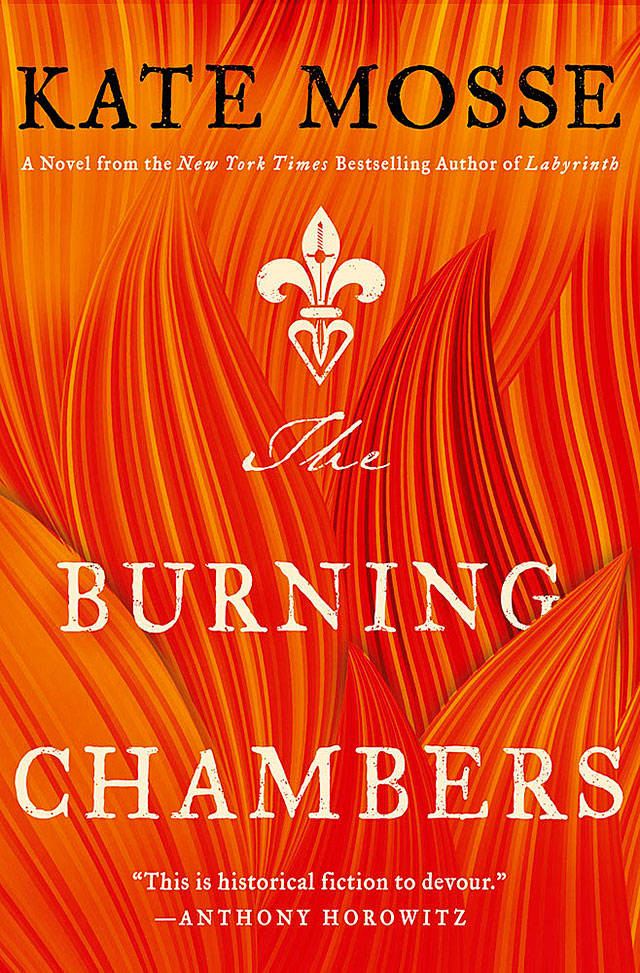
Readers dispirited by our country’s current turmoil — clashing religious and political factions, gender inequality, predatory priests and domestic terrorists — might gain solace from the long view on a similar situation, that of 16th century France as depicted in Kate Mosse’s stirring new historical novel, “The Burning Chambers.” The first volume in a quartet, the novel is set in the same Languedoc region beloved of fans of Mosse’s best-selling Labyrinth trilogy, and takes place in 1562, when after years of skirmishes and resentment between Catholics and Protestant Huguenots, France’s civil Wars of Religion erupted.
After a brief prologue set in 1862 on the Cape of Good Hope, Mosse’s epic opens in a stinking prison cell in Toulouse. Two men are being tortured, their inquisitor intent upon learning the fate of the Shroud of Antioch, a religious relic stolen from a church in Toulouse five years earlier. As one prisoner drifts into unconsciousness, the scene shifts to dawn a few weeks later in the ancient city of Carcassonne, where Mosse introduces the close-knit, Catholic Joubert family: father Bernard, a widowed bookseller whose religious tolerance and erudition led to his torture and imprisonment in that Toulouse jail; his 19-year-old daughter, Minou; 13-year-old son, Aimeric; and young daughter, Alis.
As Minou awakes and begins her day’s errands along the crowded cobblestone streets, she thinks that “the scene could have been one from a hundred years before … two hundred, all the way back to the time of the troubadours. In La Cité, life went on the same, day after day.” Her thoughts do not linger on what she and many readers will already know, from history books or Mosse’s previous novels: that in the time of those troubadours, untold numbers of Languedoc Cathars were slain as heretics in a bloody inquisition.
And even as Minou goes about procuring fennel pie and rose-water biscuits at a busy market stall, the region’s violent history seeks to reassert itself. In Carcassonne’s cathedral, a young Huguenot named Piet Reydon enters a confessional. Piet hopes to reconcile with the man behind the confessional screen — his old college friend Vidal, scion of a disgraced aristocratic Catholic family, now known as Monsignor Valentin. But Vidal is the scheming, spectacularly amoral spider at the center of the novel’s densely woven web of intrigue, obsessed with recovering the Shroud of Antioch not for religious reasons but to serve his own political and religious ambitions.
Vidal rightly suspects that Piet knows of the Shroud’s whereabouts. He responds to his old friend’s overtures, then betrays him, an event that inadvertently brings together Piet and the Joubert family, first young Aimeric and then Minou. The dashing Huguenot man and spirited young Catholic woman fall in love. But as the warring religious factions begin to lay waste to the Languedoc countryside, will they, and their love, survive?
Mosse’s female characters more than hold their own against the men who dominated the political and domestic landscapes of the time, often despite — or because of — enduring decades of abuse from husbands, lovers, strangers. Minou’s late mother had taken the leading role in choosing stock for the Jouberts’ bookshop. Since her father’s imprisonment, Minou handles the business, and she is in the shop when a mysterious envelope appears, addressed to her and bearing a terse, minatory message: “She knows that you live.”
Minou has no idea who She might be, though readers may suspect the increasingly unhinged, unnamed person whose diary excerpts appear throughout the text.
There’s a pleasingly old-fashioned feel to Mosse’s storytelling, with its chaste lovers, purloined letters, breathless escapes, plotting aristos, plucky youngsters and gruff but lovable soldiers. In addition to the evil Monsignor, there’s also his half-mad — make that totally bonkers — lover. And the Shroud of Antioch isn’t the only precious item that’s gone astray: There’s also a missing will, the contents of which could change the lives of … well, you’ll just have to read and find out.
If Mosse’s prose can be workmanlike, her plotting and pacing are impeccable. So is her ability to bring to life an extraordinarily complex conflict and era, as well as a vast cast of both fictional and historical figures. (The author’s note on the Wars of Religion and a list of principal characters come in very handy.) As tensions between Catholic and Huguenots flare into a siege that explodes into open battle, Mosse captures the horror of bloodshed between men who only days earlier had been neighbors and friends, as well as the exhaustion and terror that overwhelm the women who tend to the dying and wounded while the city burns around them.
Mosse doesn’t overstate the parallels between the 16th century’s Wars of Religion and our own. She doesn’t need to. As Minou muses in the novel’s final pages, “Faith and the consequences of faith have bankrupted both the country and men’s souls.” But years after the conflicts began, “It is women who have brokered this latest peace, bringing the third period of war to an end.” Readers of Mosse’s deeply satisfying, richly imagined novel can take heart from those words.
“The Burning Chambers”
By Kate Mosse
Minotaur. 578 pages. $17.99.
Talk to us
> Give us your news tips.
> Send us a letter to the editor.
> More Herald contact information.
























