
By Celeste Gracey / Special to The Herald
Vicki was drenched in sweat and her heart beat rapidly as she stood in line for her next meal at a homeless shelter. But she didn’t think much was wrong.
After all, people with addiction never feel quite right, said Vicki, 29, whose real name has been withheld to protect her privacy.
But the shelter staff was concerned. They encouraged her to get checked out at a free clinic that had been set up at the site.
Dr. Tim McNamara, a retired nephrologist who volunteers with MercyWatch, told Vicki she had a fever, which was a sign of an infection, and a worrisome heart murmur.
“Little did I know, I was days away from dying,” she said.
Each time a person uses a needle, they expose their body to everyday bacteria that our skin usually keeps out. Abscesses often form at these injection sites, but sometimes the infections enter veins and spread rapidly.
In Vicki’s case, the bacteria went straight to her heart. The staph infection ate away at a heart valve, causing the murmur. She was septic. Blood clots then formed pulmonary embolism, which blocked the flow of blood in the lungs.
Her fever was so bad, the Everett hospital staff had to ice her. She spent two months on IV antibiotics. She will need a valve replacement, which requires a major open-heart surgery, but she’s decided to first get treatment for her addiction.
For those struggling with homelessness, the extraordinary barriers to medical care are compounded by the risks of being unsheltered. One way that Washington has addressed this issue is by making it easier for practitioners to volunteer. But most involved agree that it’s not enough.
On a weekday afternoon in Everett’s one-for-one needle exchange, McNamara sets up a free clinic with his wife, nurse Judy McNamara, through the organization MercyWatch. Judy McNamara preps supplies and administers vaccinations from a folding table in a tiny shared office. In addition to about 3,500 patient interactions, the organization administered 220 vaccinations for hepatitis A, shingles and influenza last year.
Tim McNamara’s collared shirt, baseball cap and gray hiking pants are as tidy as a uniform. When he sees Vicki, his gentle and reserved demeanor breaks out into excitement. It’s only been a week since she was discharged from the hospital, but it’s been months since the doctor sent her there.
A downside for physicians practicing on the streets is that they rarely get to hear how their patients fared.
This time, McNamara knows his intervention saved Vicki’s life.
Tim McNamara, alongside a team of doctors and nurses, has been saving lives on the street since 2017, a year after he helped launch MercyWatch in Everett. While the team can be found passing out blankets and sandwiches in downtown Everett twice a week, medicine is the core of their mission. In addition to their five mobile clinics, they are the first in the Everett area to bring doctors to the streets.
It’s all thanks in part to Volunteer and Retired Providers, a state program that offers free liability insurance to medical practitioners who volunteer. Statewide, 2,500 practitioners volunteer through the program. In 2018, these volunteer clinics reported about 98,000 patient visits.
If that patient care was done in emergency rooms, it would cost about $70 million, according to a report by the Washington Healthcare Access Alliance.
One issue with this model of providing care to the homeless through volunteers is that free clinics often are set up near where volunteer physicians live and work, not where they’re needed most, said Christine Lindquist, Washington Healthcare Access Alliance executive director.
Yet, if these pop-up clinics didn’t exist, people would die, she said.
“This underscores how broken the health care system is,” Lindquist said.
The cost of running street medicine and pop-up clinics is more than just the insurance, and it’s up to the nonprofit clinics to raise it. MercyWatch’s annual expenses total about $25,000. It sets up clinics where homeless outreach programs are already established. It even once used a women’s restroom at the Everett Gospel Mission.
“The MercyWatch story is very similar to most of the programs in the state. You have a scrappy organization that wants to do something good,” Lindquist said. “They make this essential magic happen with very little cost.”
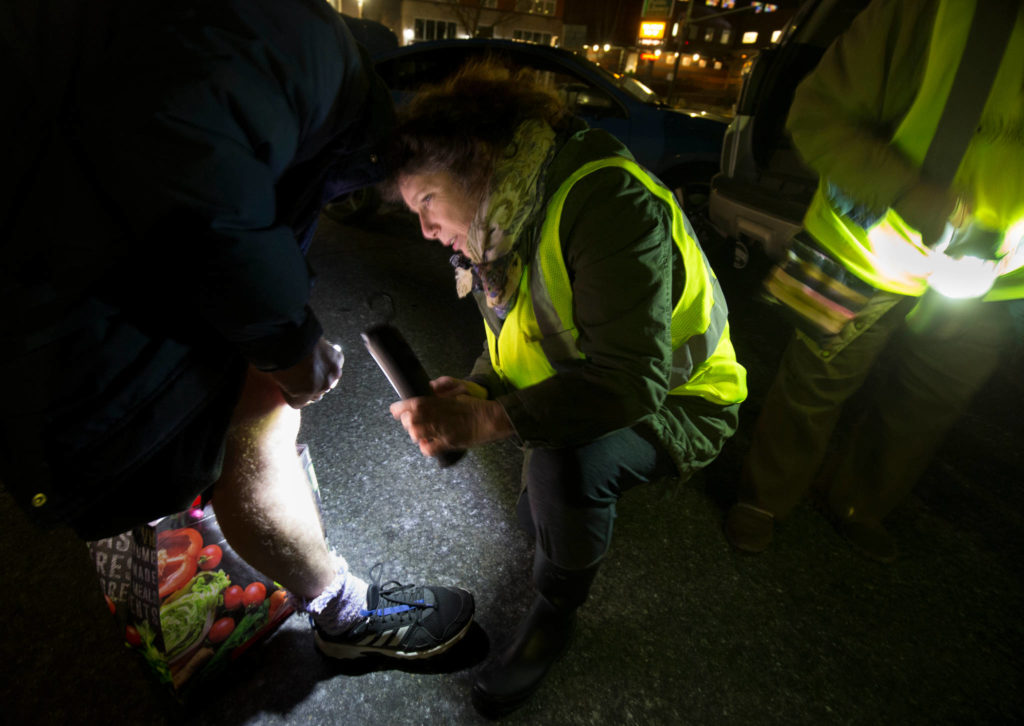
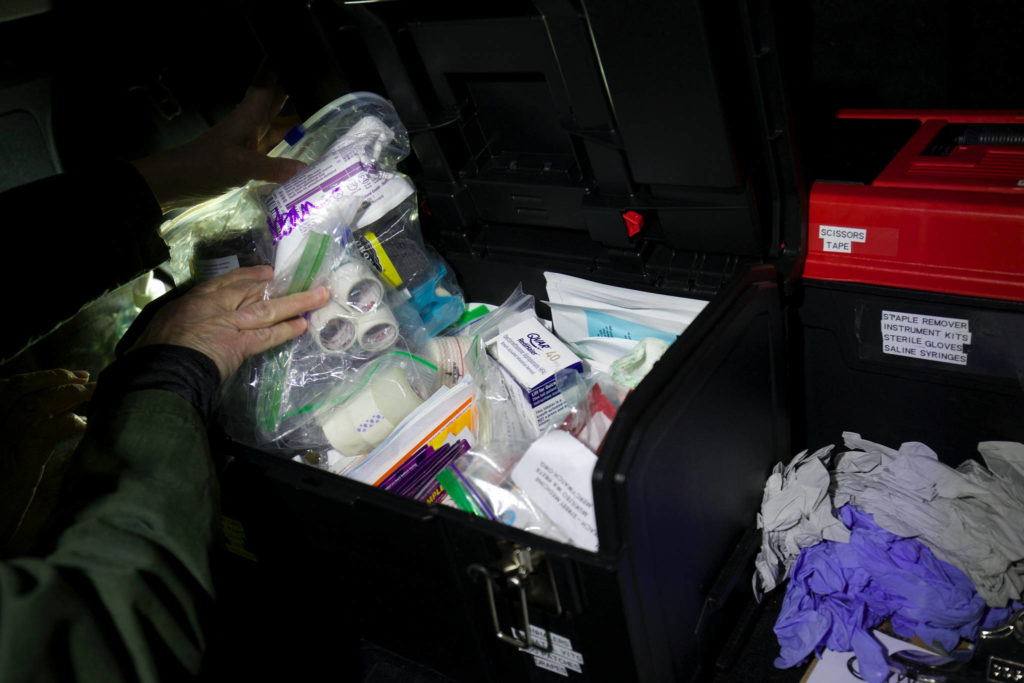
In a parking lot near the Everett Public Library, Sheila Murphy, a nurse anesthetist, digs around for antibiotics in large black toolboxes holding medical supplies. The only useful light come from several LEDs attached to the hatch of an SUV. On this cold, clear winter night, a patient waits with his pant leg pulled above his swollen knee.
Murphy had met him a week earlier, as a winter storm blew through the city. He needed care for an abscess on his backside, but it was so frigid, he rushed off to get in line at the shelter.
After years of injecting drugs, users’ veins often dry up, so they inject directly into muscle. It’s common for those sites to develop abscesses, which are pockets of infection that need to be lanced and drained. If they don’t heal, there’s a risk that the infection will spread. Murphy said the man’s knee infection began with the abscess on his backside. She is now concerned that without antibiotics, the infection might move to vital organs.
She said she understands his decision to seek shelter over medical care during the storm. But she’s glad he returned for the antibiotics. Without MercyWatch’s reputation for being a safe place for the homeless to seek help, she wonders if he would have received any care at all.
Most of the homeless population qualifies for state health insurance, but accessing clinics and hospitals requires time and resources needed to find food and shelter. Theft is common among the homeless population, so they often lose their IDs and medical insurance cards, which require some work to replace. Even with all the documentation, some would rather suffer than endure the shame that sometimes comes with going to the emergency room.
When Vicki was admitted into an Everett emergency room with endocarditis, a nurse struggled to place an IV and prodded around mercilessly in her arm. When she yelped, they responded, “It’s just a needle. Isn’t that what you’re into?”
MercyWatch works hard to build trust with the homeless, Murphy said.
Vicki agrees.
“They treat you like you’re a person and not like you’re a dirty junky doing this to yourself,” she said.
If practitioners can build relationships with people on the streets, perhaps they’ll persuade them to seek help at a free clinic, or get established with a primary care provider. And after that, they might just find the strength to get off the streets, Murphy said.
“Every human being is worthy of dignity and caring,” she said. “We’re all creatures worthy of God’s love.”
Talk to us
> Give us your news tips.
> Send us a letter to the editor.
> More Herald contact information.
Gallery