
By John McCormick and Mark Niquette / Bloomberg News
As the most expensive midterm election campaign in U.S. history raced to a finish Monday, both sides braced for a possible split decision that would hand the House to Democrats and leave Republicans holding onto or expanding their Senate majority.
Partisans were preparing for the unexpected, though, two years after Donald Trump stunned the nation with his surprise win. As candidates, surrogates, outside groups and the two parties frantically worked to turn out their voters on Tuesday, strategists for each party agreed the outcome will be determined by the composition of an electorate that’s showing signs of being larger than normal for a midterm year.
The verdict could dramatically alter the second half of Trump’s first term. If they win at least one chamber, Democrats have pledged to stifle the president’s agenda and start investigations into his finances and administration, and Russia’s meddling in the 2016 election.

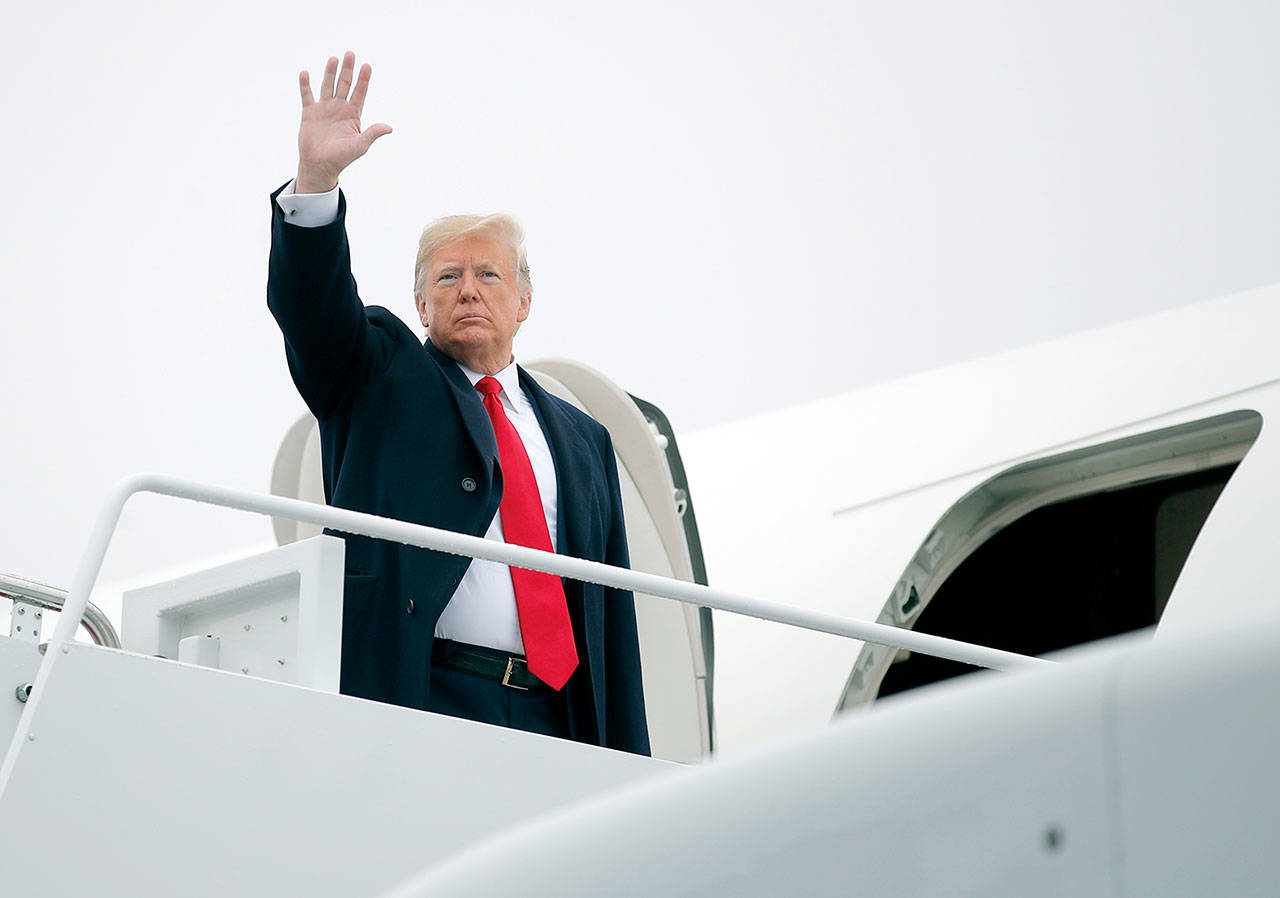
Trump spent Monday trying to protect the GOP’s Senate majority and boosting candidates for governor, with stops in Ohio, Indiana and Missouri. It was the end of a sprint to 11 rallies in eight states over six days.
The president’s strategy, which included heavy emphasis on divisive issues like immigration, risked backfiring on Republican candidates in suburban swing districts that likely will determine control of the House, yet it may be effective in largely rural states where he remains popular and where many of the closest Senate races are playing out.
Trump has been pushing an unsubstantiated narrative that a dangerous caravan of migrants is about to storm the southern border. It’s part of his bet that immigration, the issue that ignited his presidential campaign, will again mobilize his core supporters.
“There’s no games. Because you look at what’s marching up, that’s an invasion,” Trump said Sunday afternoon in Macon, Georgia. “We’re not letting these people invade our country.”
For their part, Democrats entered the final full day of campaigning expressing confidence that they’ll score the net gain of 23 seats needed to take control of the House for the first time since 2010. While Republicans confront serious headwinds in holding the House, the uniqueness of the contest in each of 435 House districts makes for a wide range in the potential number of seats Democrats may gain.
A CBS poll released on Sunday projected that Democrats may win 225 seats, more than enough for a majority, but the margin of error of plus or minus 13 seats showed the outcome is far from set.
Both sides agree, at least privately, that Republicans are strongly favored to keep control of the Senate, where the electoral map is highly favorable to them. In both Senate and House races, Democrats have focused heavily on health care and protecting people with pre-existing conditions.
A Washington Post-ABC News poll released Sunday showed likely voters prefer Democratic candidates over Republicans ones for the House, 51 percent to 44 percent. Among registered voters, 44 percent approved of the job Trump is doing as president, while 52 percent disapproved, his best margin in this poll among this group during his presidency.
An NBC News/Wall Street Journal poll, also made public Sunday, showed Democrats leading among women, 55 percent to 37 percent, in a year when a record number of women are running for Congress.
John Lapp, a strategist who served as executive director of the Democratic Congressional Campaign Committee when his party won the House in 2006, said strong candidate recruitment and record fundraising are paying dividends.
“The resources have allowed them to tell their story, separate and apart from the national attacks,” he said. “We’re still seeing a map that is much broader than it was in 2006, and so that’s a lot of places for Republicans to defend.”
In the fight for the Senate, Republicans enjoy the advantage of having to defend only nine seats, compared with 26 for the Democrats, to maintain or expand their 51-49 majority.
Polls showed Senate races in Arizona, Nevada, Missouri, Indiana and Florida all within the margin of error, with those in Montana and Texas also tight. The Democratic incumbent most at risk is Sen. Heidi Heitkamp, who’s consistently trailed Republican Rep. Kevin Cramer in North Dakota, a state Trump won by almost 36 percentage points.
Regardless of the outcome, there’s no doubt that this year’s election has generated an unusually high level of interest among voters. Typically, only about four in 10 eligible voters cast ballots in midterm elections, compared to six in 10 for presidential years.
Buoyed by strong feelings about Trump, pro and con, turnout could hit levels not seen in a half century, said Michael McDonald, a University of Florida professor who runs the United States Elections Project.
McDonald estimates that 46 percent of Americans eligible to vote will cast ballots, with a wide range possible. Turnout had been declining in midterms from a of 48.7 percent in 1966.
“The only explanation has to be Donald Trump,” McDonald said. “He’s inflamed passions both for and against him.”
David Winston, a Republican strategist who worked for former House Speaker Newt Gingrich and advises Republican leadership in Congress, said he sees a volatile electorate and estimates about a quarter of independents — a majority of whom have a negative view of both political parties — are still undecided.
Much of the national focus has been on the fight for Congress, but 36 states will also elect governors on Tuesday, including high-profile contests in Florida and Georgia. Democrats have decent prospects to capture governorships in Rust Belt and Midwest states like Michigan, Wisconsin and Iowa that were key to Trump’s 2016 victory.
Talk to us
> Give us your news tips.
> Send us a letter to the editor.
> More Herald contact information.























