Charge: Suspect had chemicals used in 1993 Bothell killing
Published 1:30 am Tuesday, August 18, 2020

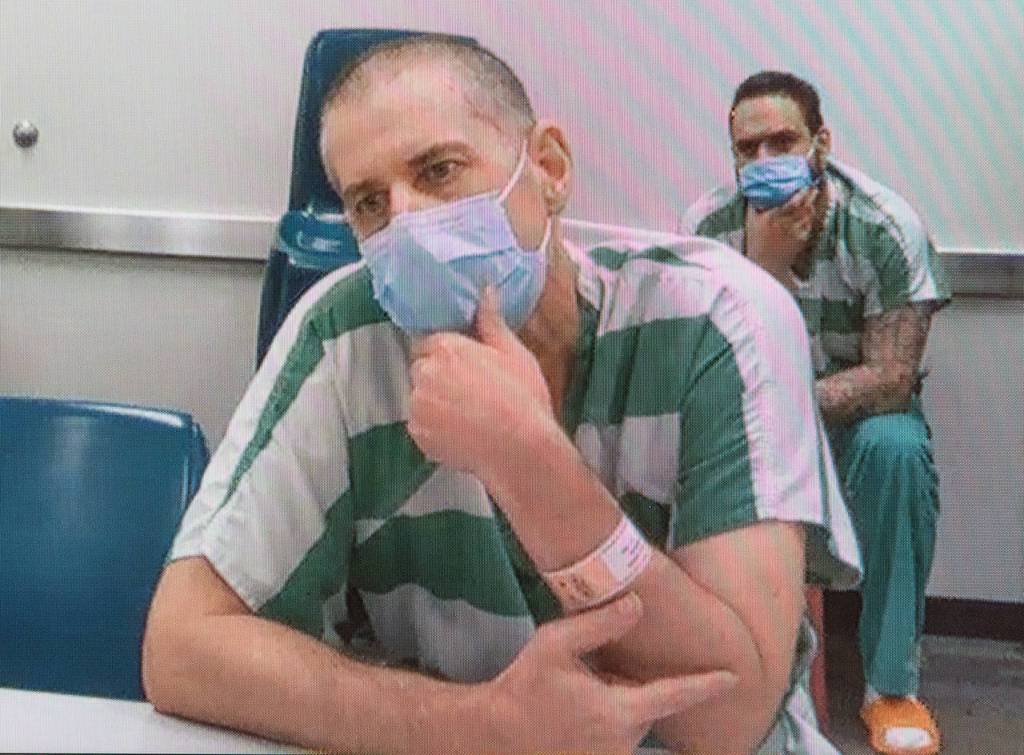








EVERETT — At the time of his arrest in a long-unsolved murder, Alan Edward Dean lived at a Bothell home on Sixth Avenue SE.
It was less than 3½ miles north of the house where Melissa Lee, 15, was incapacitated and abducted in April 1993.
At Dean’s home in late July, police carried out a search warrant that revealed a can of starter fluid in the garage — containing the same substances, ethyl ether and heptane, detected in Lee’s bloodstream after she was killed, according to new charges filed in Snohomish County Superior Court.
Dean was charged Friday with first-degree murder for a killing 27 years ago.
Lee’s mother came home from a night of karaoke on April 14, 1993, to find the house a mess and a strange chemical smell lingering in the living room. Milk, cigarette ashes and peanuts were spilled on the floor. There was no sign of Lee.
Hours later in the afternoon, two passersby spotted a young person’s body about 50 feet below the north end of the Edgewater Creek Bridge, on the western outskirts of Everett.
Lee had been strangled. A bloodstain on her shorts suggested she “put up a struggle prior to her death,” the charges say. Lee was shoeless with socks on, in a hockey sweatshirt she only ever wore at home. Her underwear was on backwards.
Toxicology tests showed no common drugs in her system. However, a lab discovered in her blood she had ether, a chemical compound used in the 1800s as an anesthetic or recreational drug that was known to cause unconsciousness.
Dean worked at a Boeing factory about 3½ miles from the bridge. He then lived on Madison Street, near his workplace.
Police found his phone number in Lee’s planner. She wrote that she had gotten together with “Alan” and another friend on March 15, 1993.
At the time, Dean was 35. Charging papers say Lee dated older men and sometimes told them she was older than her true age. She would use a talk line, also known as a date line or party line, an artifact of the 1990s, when people could dial a number to meet strangers for fun.
As detectives made their way through phone numbers in Lee’s address book, they contacted Dean in May 1993. He acknowledged he met Lee through the phone line, where he used the fake name Michael. He told police he’d gone on a couple of dates with her but denied any sexual contact.
Dean remained a possible suspect for years. The Snohomish County Sheriff’s Office case went cold, however, without conclusive evidence to link him to the crime.
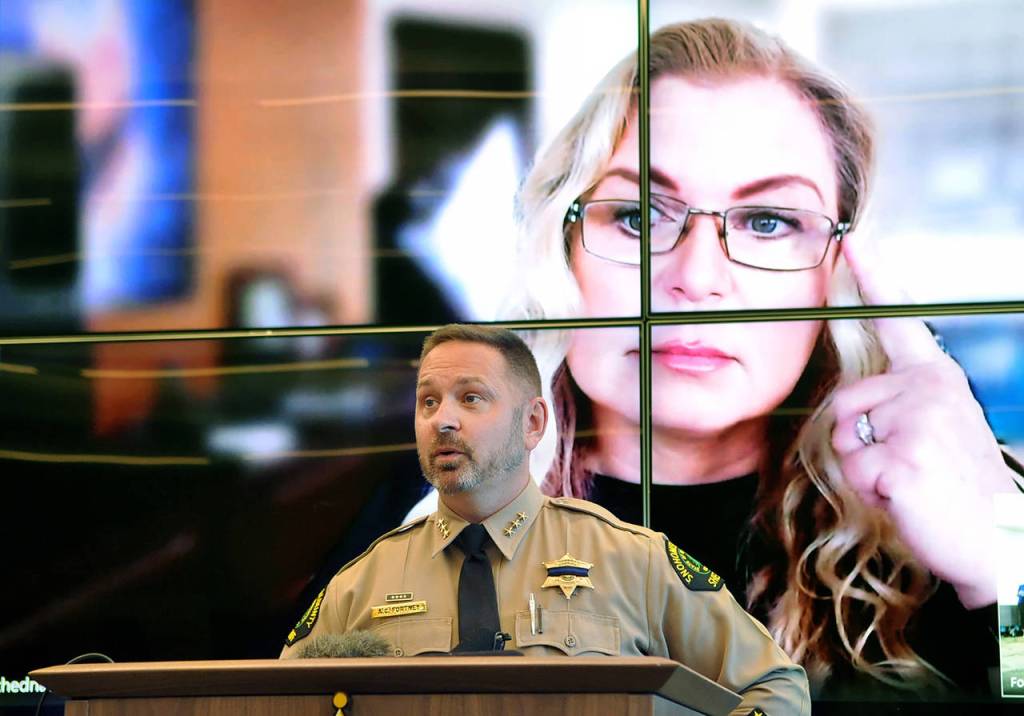
Ultimately, genetic family tree research led to a breakthrough in the case in the past year. A private lab, Parabon, extracted DNA from crime scene evidence and sent the profile to CeCe Moore, a nationally known genealogist. She was able to build a family tree for the unknown suspect through public genetic databases and other research.
Dean was identified as a likely suspect in early 2019. He had no recent felony record, meaning his genetic profile was never entered into a federal database. Detectives put him under surveillance and tried to obtain his DNA through a ruse in which three undercover detectives showed up at his door, asking if he would try some new flavors of gum.
But when they told him to put the chewed gum in a Dixie cup, he grew suspicious. According to the charges, Dean asked, “You’re not here to collect my DNA, right?”
He finally discarded a cigarette outside his home on April 21, 2020, and an undercover officer picked it up from the street to have it tested at a state crime lab. The DNA profile came back as an apparent match to semen on Lee’s underwear, according to the charges.
Prosecutors wrote that Dean fled Arizona in the 1980s, soon after two girls reported he picked them up, gave them beer and marijuana, and sexually touched one of them.
At the time, Dean was 28. The girl was 13.
Formal charges were never filed.
Another woman reported Dean fed her alcohol on a first or second date, until she was “highly intoxicated.” At his apartment, she passed out. Dean allegedly raped her and then would not let her leave the apartment for days, according to the woman’s account.
The incident was not reported until well after the fact. Dean would have been in his early 30s at the time. The woman was about 10 years younger than him.
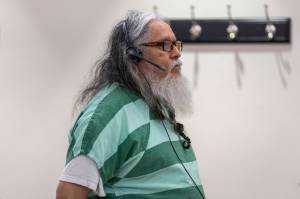
Dean was expected to make an initial plea at an arraignment hearing Monday afternoon. Instead, he objected to any court proceedings and asked to be released from jail. He would not cooperate.
Another hearing was scheduled for 10 a.m. Tuesday.
“This is under duress,” he said when he first appeared in front of Judge Paul Thompson on a television screen. Dean was in a different room because of the coronavirus pandemic.
Thompson asked Dean to confirm his name. He was silent. Thompson asked if Dean could hear him through the speaker they used to talk.
“Yes, I can hear you,” he replied flatly.
Thompson asked his name again.
“I can’t make any determinations on any of the questions you’re asking me,” Dean replied.
He rejected that his attorney, public defender Jon Scott, was representing him.
“Mr. Scott does not represent me, he’s an intervener, he has no representation at all. I’ve told him to leave me alone, and that’s harassment and stalking and enticement to slavery,” Dean said. “He should be arrested for the felonies he’s committed against me.”
“He has advised me of those things, your honor,” Scott told Thompson.
Dean continued to speak while Thompson and the attorneys made new plans to meet the next morning.
“I’m not in agreement with any proceeding that would be adverse to my best interest,” he said.
His arms were crossed on top of the table where he was sitting. He asked to be “made whole again,” for “complete restitution” and to be set free.
“Understood, sir,” Thompson said. “At this point I am respectfully declining, I guess, your request.”
Dean was in front of the judge for about seven minutes.
His bail has been set at $2 million.
In the past weeks, Dean has sent three handwritten letters to judges, each saying almost exactly the same thing about how “i alan edward cannot make any legal determiniations on any of the claims that you are making.”
“for and on The Record,” the first letter reads, “i am not a US citizen nor am i a resident of any Federal Judicial District or any Central District of The United States or The State of Washington. i Decline any and all offers to contract and do not concede to any presumption; i am not in agreement with any procedings That would be adverse to my best interest.”
In another letter, he wrote, “i am not accountable For the errors or ommissions of the offeror of the offeror’s partners known or unknown.”
The letters recite terms used by self-proclaimed sovereign citizens, a fringe movement of anti-government protestors who assert state and federal law does not apply to them. Many refer to themselves as “living, breathing, flesh-and-blood, sentient, natural” men or mortals, or variations on that phrase.
In a higher-profile example of a sovereign citizen challenging the legal system as a whole, an Arkansas man petitioned the U.S. Supreme Court in 2018 while serving a 540-year prison sentence for possession of child pornography. His 44-page petition cited verses from the Old Testament, the U.S. Constitution and the Declaration of Independence as legal authority in an opaque legalistic dialect similar to the language found in Dean’s letters — in some cases, identical to the word.
“I am not a person regulated by the ‘state’, I do not hold any position or office where I am subject to the constitutions or legislators,” the Arkansas man wrote. “The World – of – Man constitutions and legislators do not dictate what I do or do not do, nor am I currently under oath of office, and rescind any and all prior endorsements, of such, I further decline any and all offers to contract and reserve the right to reject any and all, I do not concede to any presumptions to the contrary, whether known or unknown to me, with or without my consent.”
Last month, at his first appearance in court, Dean said he did not wish to have anybody act as his attorney. He said he was present in court under duress. He was assigned a public defender anyway.
Herald writer Stephanie Davey contributed to this report.
Caleb Hutton: 425-339-3454; chutton@heraldnet.com. Twitter: @snocaleb.