
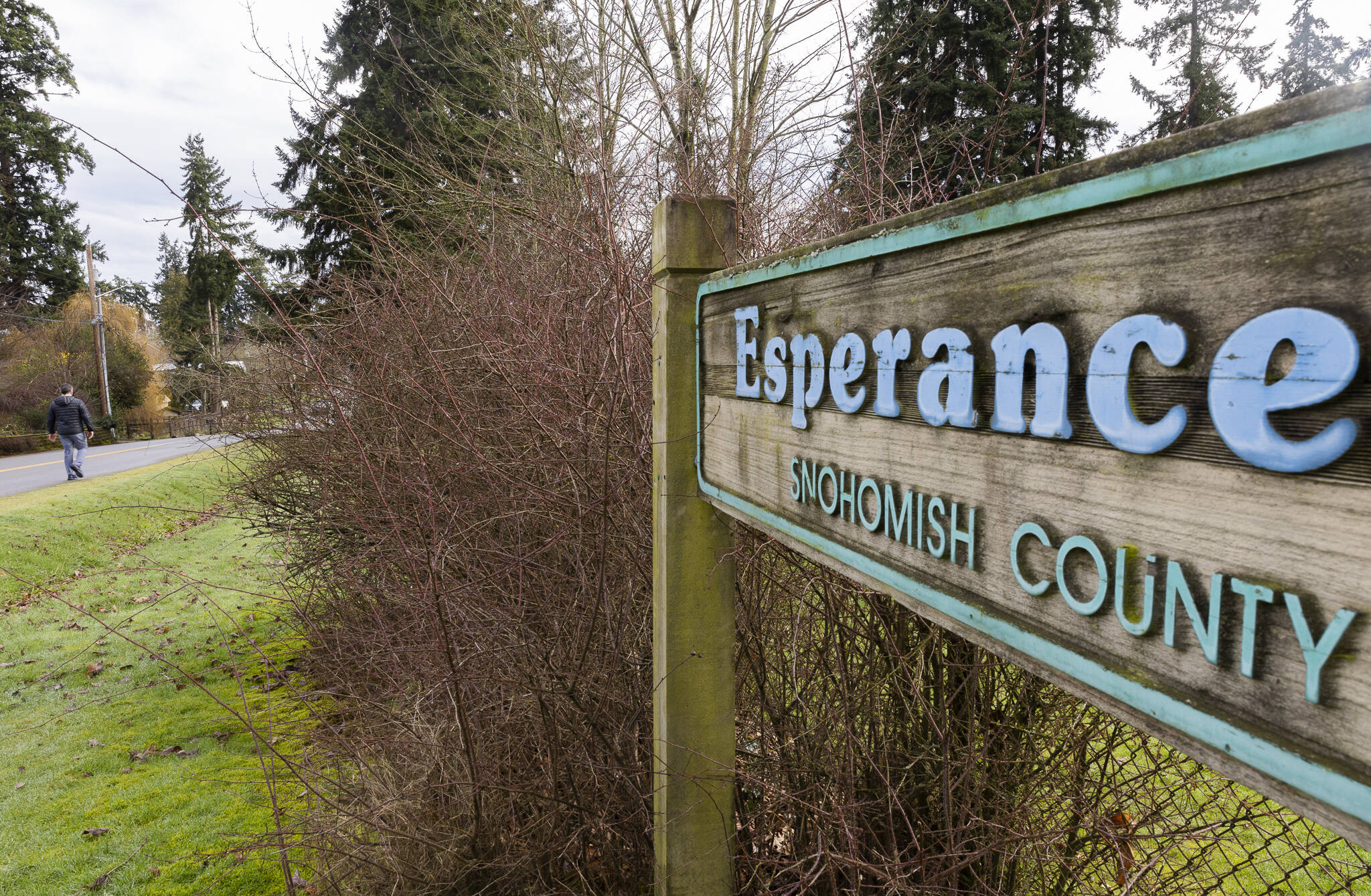
EVERETT — Edmonds city officials have started meeting with stakeholders to discuss annexing Esperance, reviving a conversation that began more than 60 years ago.
Esperance is a 0.7-square-mile area in unincorporated Snohomish County completely surrounded by the city of Edmonds. As of 2020, about 4,000 people lived in Esperance, according to Census data.
The discussions come after Edmonds voters in November struck down a proposed $14.5 million property tax levy lid lift that would have helped the city’s budget deficit. But even before the levy failed, some council members had mentioned annexing Esperance as a potential revenue source.
In June, Mayor Mike Rosen presented the City Council with a list of potential revenues to supplement a levy. The list included annexing Esperance, which the city estimated at the time would bring in about $1 million. In a statement Tuesday, city spokesperson Natasha Ryan said it’s too early to know the budgetary impact of annexation.
Annexation discussions first started in the 1960s. Since then, Esperance residents have voted against annexation five times, with the most recent vote in 2005.
Around the time of the 2005 vote, changes to state law made it possible for the city to annex Esperance without a vote from its residents. The law applies to “unincorporated islands,” or areas that have at least 80% of its boundaries contiguous with one city.
Now, the city could still choose to hold an election or annex Esperance through an agreement with Snohomish County.
“We’re too early to know whether annexation is practicable, or what method would serve the city and residents best,” Ryan said. “We do, however, remain actively interested in pursuing this with the community.”
Annexation discussions within the Esperance community have ramped up over the past year.
Esperance residents started to come together last spring when they heard about potential zoning changes coming from the county. A proposed ordinance was set to make it easier for developers to build townhomes and multi-family housing in certain areas, including Esperance. Colleen McDonald, who’s lived in Esperance for more than 20 years, started to let her neighbors know about the proposed changes.
“The design standards that Edmonds is implementing in terms of meeting the Growth Management Act are much more in line with what the neighborhood wants for itself, like a two-story limit,” McDonald said in an interview Monday. “There are other options they presented that are more palatable than what we’re getting with the upzoning that’s happening now in Esperance.”
In May, about 30 Esperance residents showed up to a planning commission to voice their concerns. Over the summer, McDonald started holding meetings about the zoning changes leading up to another public meeting. The group now calls itself the Esperance Neighborhood Alliance.
In December, the county passed a modified version of the ordinance that excluded Esperance from the zoning changes.
The day before, the county council’s planning and community development committee had a roundtable discussion with Edmonds officials and Esperance community members to discuss annexation.
“It became clear that a conversation about protecting the integrity of the community is a conversation about annexation,” said Emily Benson, a member of the Esperance Neighborhood Alliance, at the roundtable. “Because that’s the door, we’ve found it much more palatable to people who were initially very opposed to annexation.”
Edmonds City Council member Vivian Olson said at the roundtable she was excited about the prospect of working with the Esperance community.
“There is a very strong desire on the part of our council to have Esperance annexed, if they want to be annexed. That’s been our hurdle in the past,” Olson said. “Going into the comprehensive plan in 2024, we were really, really sorry that we didn’t have Esperance already in the fold, where we could be planning together for what makes sense.”
The Growth Management Act is a series of state laws that require cities to develop comprehensive plans for their population growth. At the committee meeting, County Council member Jared Mead said it might be more difficult for Edmonds to annex Esperance if the area’s development is drastically different than that of the city.
“A huge goal of mine is to convince cities to start annexing,” Mead said. “I think that counties are taking too much ownership of too much space, and that’s not the way the Growth Management Act was intended.”
In addition to concerns about upzoning, many residents have complained about police response times, McDonald said. Since Esperance is served by the Snohomish County Sheriff’s Office, McDonald said it can sometimes take more than 45 minutes for police to arrive. Response times could be shorter through the nearby Edmonds Police Department.
Others have raised concerns about the community’s drinking water. The Olympic View Water & Sewer District is building a well and water treatment facility in Esperance. Bob Danson, general manager of the Olympic View Water & Sewer District, said increased development in Esperance could lead to Per- and polyfluoroalkyl substances, or PFAS, contaminating the neighborhood’s water.
“If contamination occurs, cleanup is extraordinarily costly and, at best, may result in the permanent loss of the community’s drinking water source,” he said at an October public hearing.
Other concerns with being part of the county, McDonald said, include a lack of pedestrian safety and increasing traffic. County Council member Strom Peterson, who represents Edmonds, said at the roundtable that Esperance would receive a “significantly higher” level of service from Edmonds than from the county.
“County roads can literally be gravel roads if the funding is not there to maintain them,” Peterson said. “I think this would be a great opportunity for Edmonds and for Esperance to be able to not only plan to improve pedestrian and traffic safety, but also have better access to funding.”
McDonald also pointed to Edmonds’ tree code, which she said would do a better job of protecting Esperance’s tree canopy than regulations at the county level.
Feedback from the community has been mixed, McDonald said, and there’s a lot of information that residents are still working on gathering. For example, it’s unclear how much taxes would increase with annexation.
“It’s been 20 years since the last vote,” she said. “There’s been a lot of turnover in Esperance. … There are many people who still don’t really understand that they don’t live in the city of Edmonds.”
Deeper conversations need to take place before annexation moves forward, Ryan said. Meanwhile, McDonald is working on raising awareness of a potential annexation to Esperance residents.
“We know we’re not reaching as many residents as we’d like to, so we’re working to get the word out so that people realize what’s going on and have a say in the process,” she said.
Jenna Peterson: 425-339-3486; jenna.peterson@heraldnet.com; X: @jennarpetersonn.
Talk to us
> Give us your news tips.
> Send us a letter to the editor.
> More Herald contact information.
























