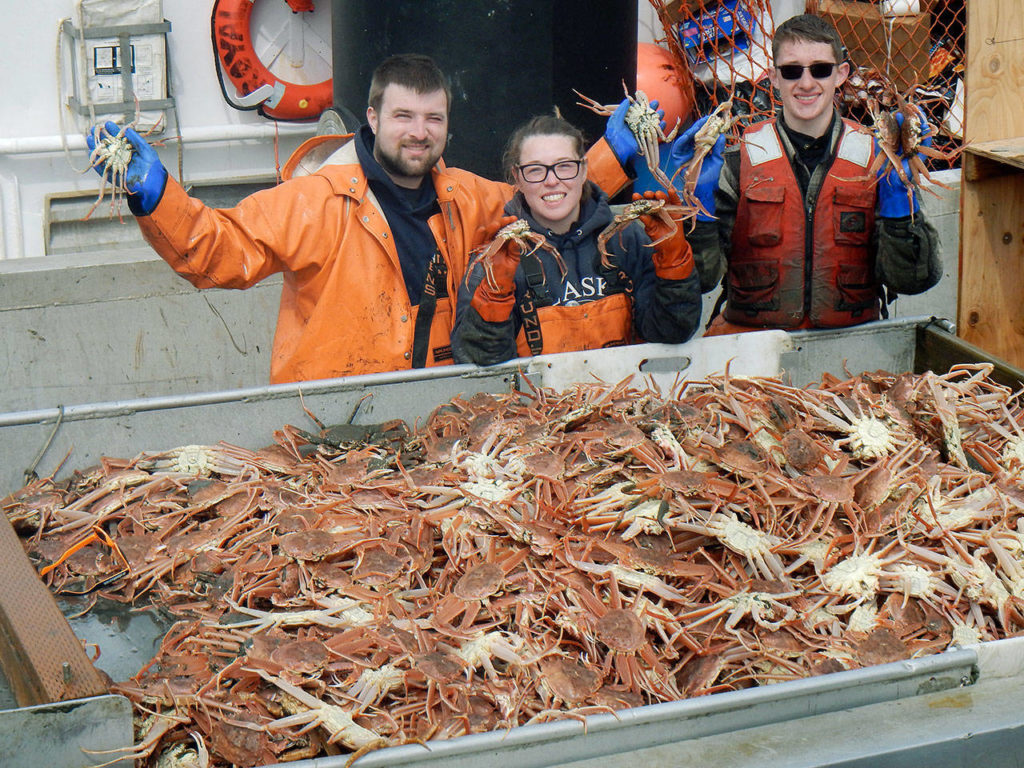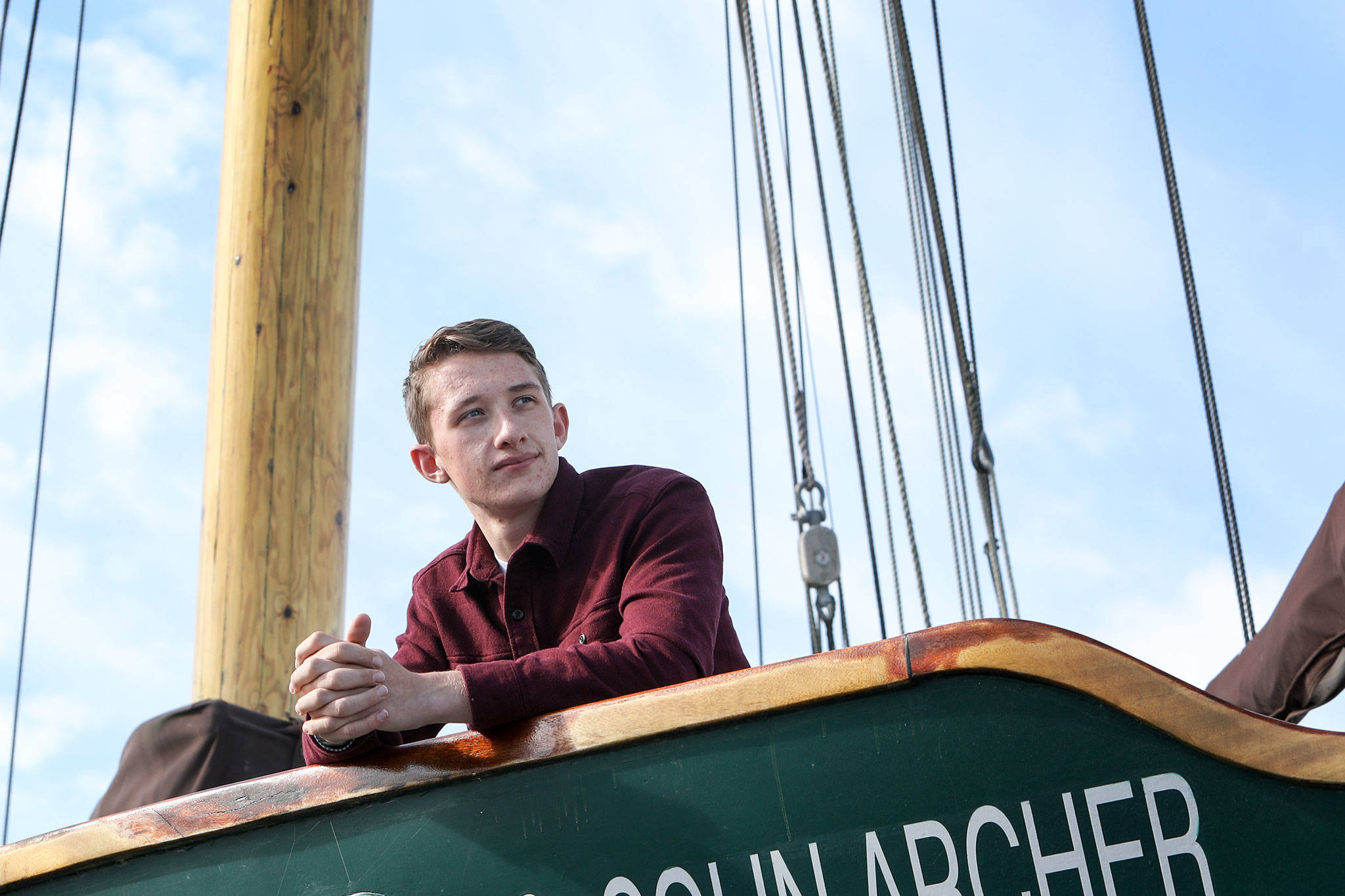
Collin Wojahn spent the summer measuring crabs in the Bering Sea for a nonprofit research foundation. (Lizz Giordano / The Herald)

Collin Wojahn spent the summer measuring crabs in the Bering Sea for a nonprofit research foundation. (Lizz Giordano / The Herald)

Everett teen spent the summer gliding through the Bering Sea

Collin Wojahn, a junior in the ORCA program, counted crab populations for a research foundation.

EVERETT — Collin Wojahn, 17, of Everett, spent the summer traversing the Bering Sea counting crab populations for a nonprofit research foundation. He’s also a Sea Scout and Eagle Scout. In September, he began his first year at Everett Community College’s Ocean Research College Academy. There he hopes to explore careers in the maritime industry before heading to the Seattle Maritime Academy.

Question: You spent your summer on a boat in the Bering Sea. What were you doing?

Answer: I worked for the Bering Sea Fisheries Research Foundation, which does research for fisheries. … I focused on counting crab … We are the middle men. The government generally sets the catch limits really low, where the fishing companies want them really high. So we come in (and) say ‘here’s the data we have.’

Q: What was the process?

A: When we pulled up a net, which weighed anywhere from 700 to 2,000 pounds, it was weigh it to get an idea of the biomass. From there we dropped the crabs on the sorting table. Then you have to sort through everything, which took anywhere from 20 minutes to three hours. You sort the crabs by species and sex into baskets. From there you have to weigh the baskets.

Q: Did the crabs bite?

A: The bigger one kinda hurt, but they aren’t as bad as the Dungeness (crab) here. The crab we have around here are really aggressive. Where over there, they are so slow moving and lazy, you really have to be messing around with it for it to pinch you.

Q: What was the most challenging part of the experience?

A: I was kinda intimidated at first. The boat crew had years of experience out there. The scientific crew all had doctorates or dual masters. And here I am, just graduated my sophomore year.

And the weather. The boat never stops moving. Small waves were probably three to six feet, the biggest we faced were about 30 feet. Which are small compared to up there, because they get 50-foot waves in the winter time. If the boat rolls the right way, when the hull comes down it smacks against the wave. It sounds like a car just crashed into the front of the boat. You’re sleeping, sleeping then all of sudden at 2 o’clock in the morning the whole boat shudders.

Q: What was the best part?

A: There was more food than you could ever eat in the whole trip.

Q: What did you learn?

A: I learned more in that one month than probably in a semester of school. There’s so much to take in. There’s a lot of thinking on your feet and working through it.

Q: What was the longest you went without seeing land?

A: About 20 days. We went out for 10-15 days, then we went to Dutch Harbor to fix our centrifuge, which is kinda like a filter that cleans the diesel before we burn it. We had to go in there and get that replaced, then we could go back out. I think for another 20 days. We saw little islands here and there, but most of the time you couldn’t really see anything. Probably the weirdest thing was not seeing land and all the fog. It was foggy all the time up there.

Q: Why did you want to join the ORCA program?

A: Because of the really good opportunities and to get a head start. You graduate with your high school diploma but also an associate’s degree. So it’s a great way to get ahead and be able to figure out what you want to do.

Q: What are your plans?

A: I’m hoping to go into either diesel mechanics or refrigeration technician as my minor. And for my major get my second mates license. So I can be able to work on a marine vessel, ideally a research vessel.

Lizz Giordano: 425-374-4165; egiordano@heraldnet.com; Twitter: @lizzgior.

Talk to us

> Give us your news tips.

> Send us a letter to the editor.

> More Herald contact information.

More in Local News

Darryl Dyck file photo
Mohammed Asif, an Indian national, conspired with others to bill Medicare for COVID-19 and other respiratory tests that hadn’t been ordered or performed, according to a U.S. Department of Justice press release.
Man sentenced to 2 years in prison for $1 million health care fraud scheme

Mohammed Asif, 35, owned an Everett-based testing laboratory and billed Medicare for COVID-19 tests that patients never received.

Snohomish County Fire District No. 4 and Snohomish Regional Fire and Rescue responded to a two-vehicle head-on collision on U.S. 2 on Feb. 21, 2024, in Snohomish. (Snohomish County Fire District #4)
Family of Monroe woman killed in U.S. 2 crash sues WSDOT for $50 million

The wrongful death lawsuit filed in Snohomish County Superior Court on Nov. 24 alleges the agency’s negligence led to Tu Lam’s death.

Judy Tuohy, the executive director of the Schack Art Center, in 2024. (Olivia Vanni / The Herald)
Director of Everett’s Schack Art Center announces retirement

Judy Tuohy, also a city council member, will step down from the executive director role next year after 32 years in the position.

Human trafficking probe nets arrest of Calif. man, rescue of 17-year-old girl

The investigation by multiple agencies culminated with the arrest of a California man in Snohomish County.

A Flock Safety camera on the corner of 64th Avenue West and 196th Street Southwest on Oct. 28, 2025 in Lynnwood, Washington. (Olivia Vanni / The Herald)
Everett seeks SnoCo judgment that Flock footage is not public record

The filing comes after a Skagit County judge ruled Flock footage is subject to records requests. That ruling is under appeal.

Information panels on display as a part of the national exhibit being showcased at Edmonds College on Nov. 19, 2025 in Lynnwood, Washington. (Olivia Vanni / The Herald)
Edmonds College hosts new climate change and community resilience exhibit

Through Jan. 21, visit the school library in Lynnwood to learn about how climate change is affecting weather patterns and landscapes and how communities are adapting.

Lynnwood City Council members gather for a meeting on Monday, March 17, 2025 in Lynnwood, Washington. (Olivia Vanni / The Herald)
Lynnwood raises property, utility taxes amid budget shortfall

The council approved a 24% property tax increase, lower than the 53% it was allowed to enact without voter approval.

Lynnwood
Lynnwood hygiene center requires community support to remain open

The Jean Kim Foundation needs to raise $500,000 by the end of the year. The center provides showers to people experiencing homelessness.

Logo for news use featuring Snohomish County, Washington. 220118
Vending machines offer hope in Snohomish County in time for the holidays.

Mariners’ radio announcer Rick Rizzs will help launch a Light The World Giving Machine Tuesday in Lynnwood. A second will be available in Arlington on Dec. 13.

UW student from Mukilteo receives Rhodes Scholarship

Shubham Bansal, who grew up in Mukilteo, is the first UW student to receive the prestigous scholarship since 2012.

Roger Sharp looks over memorabilia from the USS Belknap in his home in Marysville on Nov. 14, 2025. (Will Geschke / The Herald)
‘A gigantic inferno’: 50 years later, Marysville vet recalls warship collision

The USS Belknap ran into the USS John F. Kennedy on Nov. 22, 1975. The ensuing events were unforgettable.

Everett police arrest suspect linked to dog found zipped inside suitcase

On Nov. 18, patrol officers responded to a report of a pit bull zipped into a suitcase with a rope around her neck in an Everett dumpster.

Support local journalism

If you value local news, make a gift now to support the trusted journalism you get in The Daily Herald. Donations processed in this system are not tax deductible.