
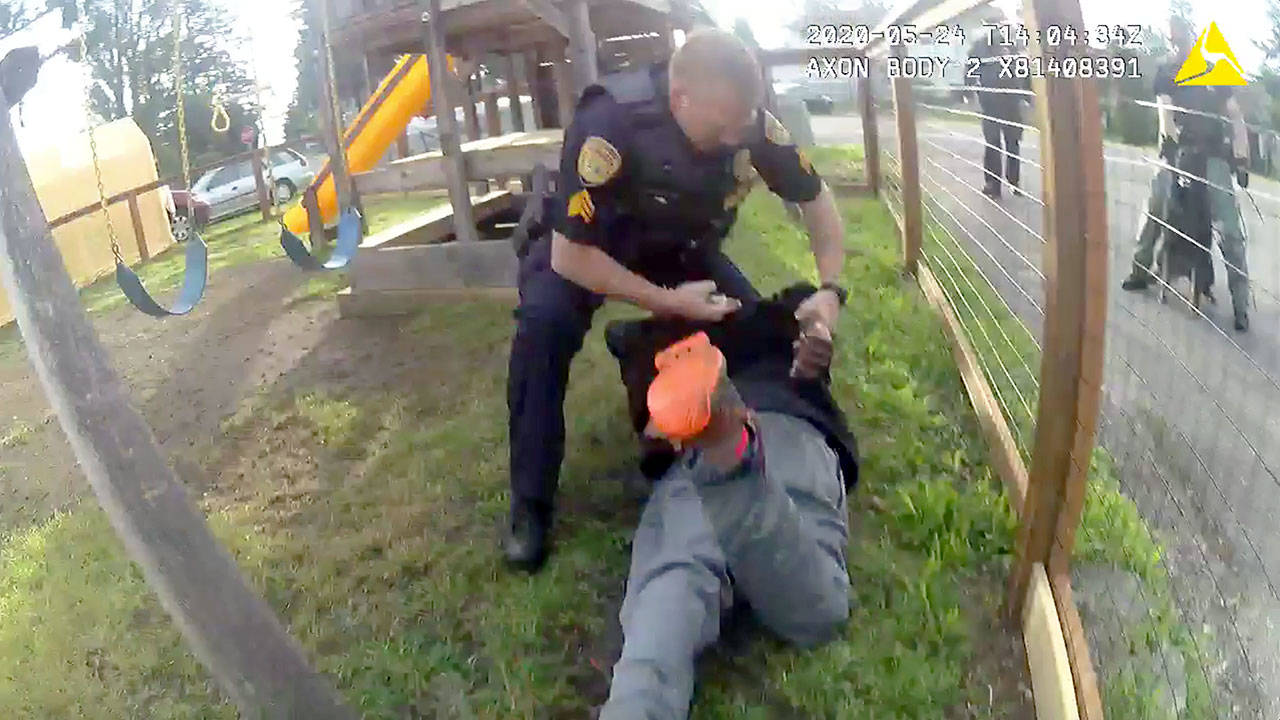
EVERETT — The day before George Floyd was killed by police in Minnesota, an Everett sergeant knelt on the back of a Black man for about 14 seconds as the man cried three times, “I can’t breathe.”
Police Chief Dan Templeman said the technique used to arrest Joseph Michael Hill, 39, was within city policy, a textbook example of a reasonable use of force and a speedy reaction to Hill’s pleas.
Hill’s attorney, Maxwell Mensinger, disagreed. He said it was an unnecessary use of potentially deadly force by an officer when Hill had already surrendered at the end of a foot chase and was face down on his stomach with his hands behind his back.
The arrest was captured by at least two officers’ body-worn cameras, under a new program Everett police expect to expand in coming months. The sergeant faced no discipline for his handling of the domestic violence suspect early on May 24.
Yet the incident, as well as Floyd’s death, led the Everett Police Department to revise a policy manual advising officers when and how to use force that impedes a person’s breathing, codifying a practice to move a restrained person into a position where it is easier to breathe “at the earliest safe opportunity.”
Templeman said the sergeant did exactly that and he adhered to the training taught at the state police academy.
The Daily Herald obtained the footage and written police reports through a public records request.
Someone called 911 saying a man with a knife was chasing a naked woman around 6 a.m. in the 2400 block of Madison Street, the records say. Officers responded to find Hill’s off-and-on girlfriend had suffered bruises and cuts, as if she had been punched and gripped tightly. She told police he was making too much noise early that morning, causing an argument during which Hill started to throw things like paper and bottles of lotion at her. Then he hit her with his fists, she reported, and she physically fought with him. She told police a knife wasn’t used, and no one threatened to use a knife. Hill later told police it was the woman who tossed steak knives at him, and that he took the knives and threw them on the porch.
Templeman noted that police are mandated by state law to book the suspected primary aggressor into jail within four hours of a domestic assault report.
Officers searched the neighborhood for about 50 minutes until they found Hill standing on the roof of a stranger’s home.
“You’re under arrest!” Sgt. Robert Edmonds yelled. “You’re completely surrounded! We got a police K-9! Get down! Get down, you’re under arrest!”
Hill replied that he didn’t do anything and didn’t want to go to jail.
Templeman narrated both videos for a Herald reporter, noting that the sergeant quickly pulled out and reholstered his pistol as he rounded the corner of a house — unsure if an armed suspect might be waiting for him. He switched to a Taser as the man on the other side of the lawn hopped a fence. The sergeant then put away the Taser when he had no chance of a decent shot. All of that happened in the span of five seconds. Edmonds kicked through a wooden fence and chased the man into neighboring yards, breathlessly, for another 30 seconds.
“These officers, at least to me, do not look amped up,” Templeman said. “They do not look like they’re (seeing with) tunnel vision, they do not look emotionally hijacked.”
A Snohomish County sheriff’s K-9 deputy closed in on the fleeing man, shouting, “Get on the ground! Get on the ground! If you don’t get down, you get bit!”
At the sound of the barking dog, Hill obeyed. He stretched out flat on his stomach, on the opposite side of a wire fence. Edmonds jumped the fence and ordered Hill to put his hands behind his back. Hill complied immediately. Edmonds pressed a knee on Hill’s back as he began to cuff him, and Hill cried out, repeatedly saying he couldn’t breathe.
“This officer’s knee is at a 45-degree angle with his knee — not on the head, not on the neck — but in between the shoulder blades on this individual’s back, while he’s trying to take him into custody, again, at this point, not knowing whether or not he’s armed at all,” Templeman said.
It’s exactly what the officer was trained to do, the police chief said.
Mensinger said the angle of the videos does not offer a definitive image of where the knee is pressing — whether the leg is pinning the lower part of the neck, or if it’s pushing Hill’s chest into the ground. Regardless, the attorney said, he cut off Hill’s ability to breathe, even if it was unintended.
“I be having — I be having — I be having a seizure,” Hill said.
Edmonds wrote in his police report that Hill “clearly was not” having a seizure.
“There’s just no way that he’s in a position to gauge that, the genuineness of Joseph’s complaint there,” Mensinger said.
A female officer jumped in to help handcuff Hill. Mensinger said the sergeant could have waited just a moment for backup to cross the fence, to remove a need for any force. Hill continued to repeat the phrase, “I can’t breathe,” as the sergeant lifted him up.
Neither officer noted the statement in their reports. It’s the same plea made by Floyd and Eric Garner, another Black man choked to death by police in 2014. It has become a rallying cry at Black Lives Matter marches across the U.S.
As he helped Hill to his feet, Edmonds said, “You shouldn’t run.”
“It’s such a small quip, but the meaning is unmistakable,” said Mensinger, of the Everett Law Association. “Here’s one translation: ‘I stuck my knee in your back because you ran away from me. If you want to be able to breathe, don’t run away from me.’ Here’s another one: ‘You deserve what I just did to you.’”
That’s not at all how the police chief interpreted the footage.
“Our officers, you’ll see, right when they got those handcuffs on him, they rolled him over and stood him up,” Templeman said.
Both sides can agree there are major differences between what police did to George Floyd and what police did to Joseph Hill.
Officers pinned Floyd for over 8 minutes while he begged for mercy. Hill was pinned for about 14 seconds.
In Minneapolis, one of the officers ground his knee into Floyd’s neck at a 90-degree angle. That did not happen in Everett.
Floyd was accused of trying to pass a counterfeit $20 bill. Hill was wanted for a misdemeanor, but a violent one. Police had no way to know if he still had a knife. However, the officers did not order him to drop any weapons, nor did they make any overt statements on camera to suggest they thought he had a knife.
Police reports say he had nothing in his pockets but a wad of cash.
“There certainly was a department reaction,” the police chief said. “The department reaction is, ‘Let’s make sure we have policies in place that not only protect the officers but protect the individuals we are apprehending.’ Certainly (we’re) looking at our techniques. Is there another way, that maybe we don’t know about, or maybe another option that we could employ?”
In late May, Everett police added a new line to a policy manual: “If the subject complains of breathing difficulty or appears to be in respiratory distress, officers will, at the earliest safe opportunity, move them to a position where it is easier to breathe, provide any necessary first aid, and request aid personnel for a medical evaluation.”
“I’ll be honest with you, it was what we were already doing anyway, but now we have it written in policy,” Templeman said. “So we’re affirmatively directing officers by policy to do that.”
After the death of George Floyd, the Washington State Criminal Justice Training Commission posted a message on its website, “To the people we serve in the State of Washington,” explaining that police trainees are taught about “red areas” on the body that are off-limits unless deadly force is warranted, and that trainers would never tell recruits to place a knee on the back of someone’s neck, “because it’s so obviously inappropriate and dangerous.”
“Effective immediately, our trainers will explicitly state in training that placing the knee on a subject’s neck and applying pressure is deadly and should never be done unless the situation clearly warrants the use of deadly force,” the statement read.
Mensinger argued at a court hearing June 17 that the body-worn footage was relevant in setting bail.
“I believe the footage shows that Mr. Hill may be actually suffering trauma right now, either mental or physical, and he is not equipped to deal with that issue in custody,” Mensinger said. “That is something he can deal with on the outside.”
Municipal Court Judge Laura Van Slyck denied Mensinger’s motion and would not allow the videos to be played in court until he could support the claim of trauma with expert testimony, or otherwise outline a legal basis for the relevance.
Templeman said the Everett Police Department is willing to listen when the community speaks out about perceived injustices — and that the city has been listening and responding with reform since well before Black Lives Matter protests swept across the nation.
Everett police are one of two police agencies in Snohomish County to require 40 hours of de-escalation training for all officers, the police chief said. The state requires eight hours.
People are now scrutinizing police practices that would have been widely accepted just a year ago, for good reasons, Mensinger said.
“The thing is officers just need to be less violent,” he said. “They need to try and not use force, if they don’t need to.”
Hill spent almost a month in jail before posting $10,000 bond Monday night.
Caleb Hutton: 425-339-3454; chutton@heraldnet.com. Twitter: @snocaleb.
Talk to us
> Give us your news tips.
> Send us a letter to the editor.
> More Herald contact information.
























