By Gabe Stutman / Kitsap Daily Reporter
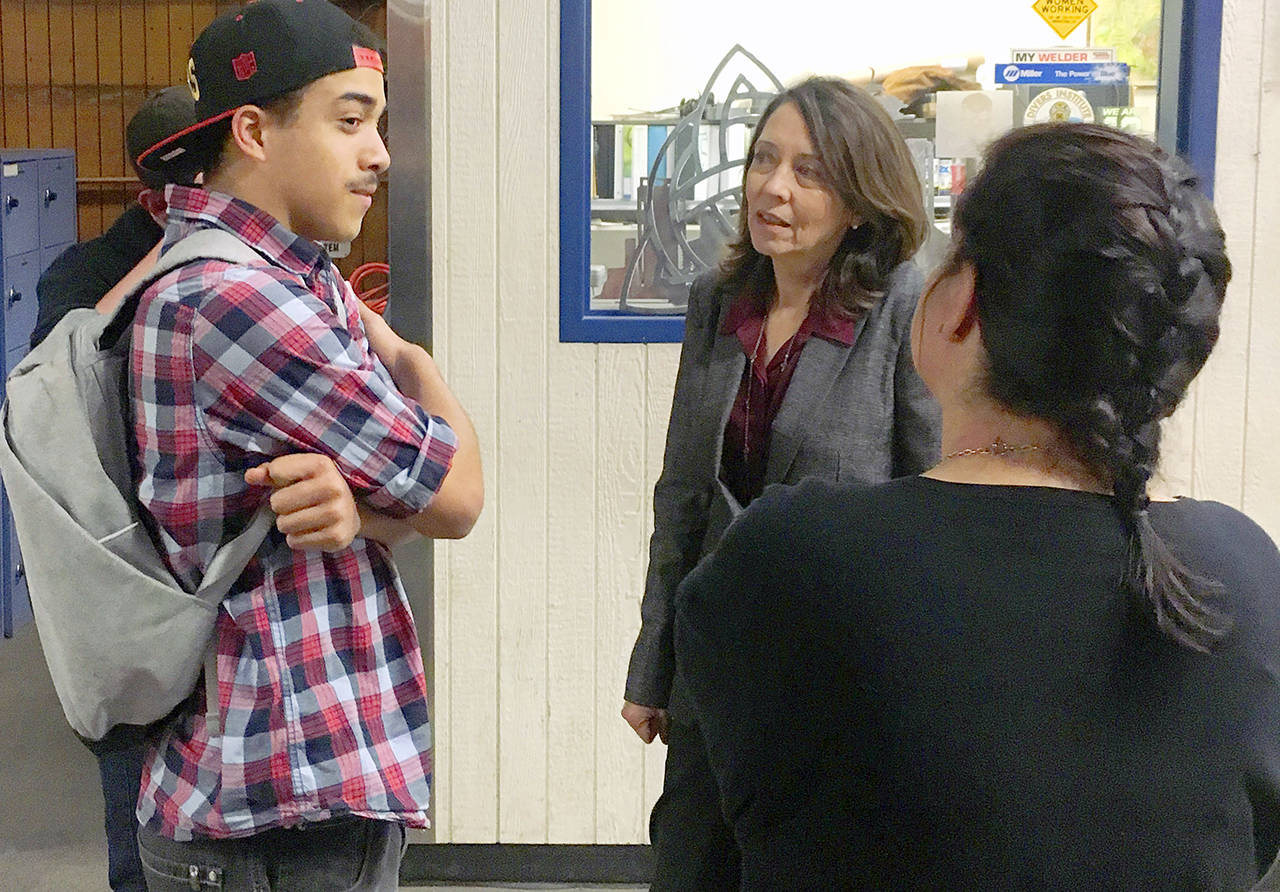
Sen. Maria Cantwell, D-Washington, was in Bremerton on Tuesday touring the West Sound Technical Skills Center, a career training campus in Bremerton for high-school-aged students across the county.
The three-term junior senator from Washington, up for re-election this year, visited a welding class and met with administrators from West Sound Tech and the Bremerton School District. She talked to welding student Izaak McCoy who, wearing a backwards snapback hat and skate shoes, told her proudly that he had three job offers already.
“Welders make a lot of money,” she said to McCoy, who smiled.
Cantwell visited a video game design class, where she asked students what language they were learning. She admitted she always wanted to learn to code.
Cantwell, bullish about job training programs for high schoolers and about what she called an “ethos” of apprenticeship prevalent specifically in Kitsap County, talked to school administrators about ways to support career readiness programs statewide.
She also discussed the midterms, less than two weeks away from an election.
Though safely ahead – Cantwell leads by 14 points against Republican challenger Susan Hutchison, according to the latest Elway poll – she addressed the importance of the upcoming midterms, in which Democrats may retake control of the House, and could make gains in the Senate and in governorships.
She said Republicans’ focus on themes of immigration, law and order, and cultural factors surrounding the confirmation hearings of Justice Kavanaugh had proven ineffective in recent special elections. She said what people are most concerned about are health care and Social Security.
“People have got to get out and make their voice heard on this issue,” she said.
A transcript of the interview is here, edited slightly for clarity and concision:
Let’s start with an education question. Millennials have an average of $42,000 of debt. Obviously, that puts financial strain on millennials but it also hurts the economy because millennials can’t buy houses, can’t buy cars, can’t participate in other things. What is your solution to the college debt crisis facing millennials?
I was the first person in my family to graduate from college. I went to school on financial aid. So, to me it’s a big priority to make college education affordable. And Pell (grants) hasn’t kept pace with the percentage of education it paid for when I was in school. It pays for a lot less. So, we need to keep increasing Pell to attract more people.
But I also think education models are going to change. One of the reasons I wanted to come here today was I already knew that Kitsap was doing a lot of great things at preparing students for the paths that they might want to pursue. I’m very big on apprenticeships. And I knew that culturally, there’s something going on in Kitsap County with apprenticeships that’s just working.
We’re having this big national discussion about ‘should we do more apprenticeships, like the Swiss and German model?’ Or should we do what we already do? And Kitsap County is just this microcosm of how we prepare for the future in a more cost-effective way – both at Olympic College, partnering with WSU and driving down the cost, and what we’re doing here. They’re training people to get credit for high school, for a certification, for a degree and for college credit. That’s what they’re doing in high school.
One of the things I think about high school is if you can take that experience and turn it into more learning, particularly for people who are interested in those experiences, you might be able to drive down college education from being a four-year degree to a three-year degree. And that saves a lot of money.
These programs are connecting young people earlier to their interests, and getting them the skill so that they can go and work in the workforce. We have to drive more into the high-school level on skills training, and on apprentice. That’s my opinion.
What about this idea of public funding for college – somebody goes to the University of Washington and that’s funded by the taxpayer, which is becoming a more popular idea in some circles.
I think most of the ideas – like here in the state and other places – is to try to take those who qualify for federal assistance based on income, and get them qualified for, say, the first two years, which is basically what we’re doing at the community college level.
If you’d say, ‘How much did community college drive down the cost of a four-year education?’ A lot. ‘How much did branch campus drive down the access to four year institutions?’ A lot, in our state, because we have a very robust community college system.
The key thing is now we have this high school chance, to drive some efficiencies by driving down the cost – by getting kids better prepared at the high-school level.
Let me ask you about health care. A recent poll showed that 70 percent of Americans — Republicans and Democrats — support single-payer health care. It’s increasingly becoming popular out there.
However in Congress you see some people express support for it, but really you see Congress moving in the opposite direction – trying to repeal Obamacare, which expanded Medicaid. You see Congress trying to remove regulations or even threatening to cut Medicare or Medicaid in the future. Why isn’t Congress reflecting the popular will on this?
I just know what happened here in Kitsap, because we came here several times and had round-table discussions on this. Kitsap went from being one of the highest uninsured counties in the state to being one of the biggest gains in people being insured because of the Affordable Care Act.
We heard stories from people about exactly what that meant to the community. They told us that there was one person who had been to the emergency room 52 times and had driven up the cost just in the local community. Once they were on the Medicaid expansion, they saw them twice. The difference is getting people access to care so they’re no longer using the emergency room or the hospital as their health care. So it drove down costs. And when it drives down costs, it drives down everybody’s costs. And that was the success.
And now, yes, there are people who want to roll that back because they don’t think it works. So the Medicaid block grant idea that McCain, Collins and Murkowski helped us defeat – it was just, as one hospital told me, a budget mechanism to cut 10 percent every year no matter what.
If you just talk to every community, they’ll tell you. In this community – the hospital, the sheriff, the community leaders – that [the Affordable Care Act] has been a godsend for us. It really straightened out parts of the economic challenge that they faced in the county. It’s a layer of economic stability.
So now we’re still fighting this fight, because people think they want to repeal the Affordable Care Act, including the issue of pre-existing conditions. Which was an attribute of the bill that was very helpful in taking people with cancer, diabetes, and saying, ‘You can’t be prejudiced to pay higher insurance rates just because you were previously ill.’ Even if you were in an employer-based plan, and they repealed that, you would be paying more – the company could come back to you, and your employer, and say, ‘Hey, you should be paying more.’
So, we don’t want that, and we want to keep going forward. I think that the public is looking for ways to keep driving down costs and increase access. We cut our uninsured in half in our state.
We do have a very important election coming up. Republicans are making their closing arguments – it’s a very visceral argument that they’re making to the American public. It could almost be summarized by what Trump said at a Montana rally, it’s about “Kavanaugh, the caravan, law and order, and common sense.” A caravan of migrants coming from Central America is being shown on the news—
There’s been a lot of talk about the same message throughout the last year and a half, as we have faced special elections. If you think about some of those in Pennsylvania, where they were like, ‘Oh, it’s the fear and anxiety of immigrant populations,’ it’s this, it’s that. None of that worked. In the end, people said, ‘We want these priorities of Medicare, Social Security, and Medicaid preserved.’ We are not going to have a $2 trillion debt increase and then put it on the backs of people who are depending on Social Security or Medicare or this expansion of Medicaid as a stabilizing force in our economy.
So now you have inflation and affordability questions, and you have the anxiety of people wondering what that’s going to mean. Here in Kitsap County, [Trump] is basically saying he’s not going to give a federal wage increase to federal workers. He’s basically saying, ‘Oh you guys are the shipyard, and you guys up in Bangor don’t deserve a pay raise,’ or up at Keyport. You guys don’t deserve a pay raise because I gave all the money away. And now I’m going to take it out on you just because you happen to work for the federal government.
When you say he gave all the money away, you’re talking about the tax cut.
Yeah. That’s why he’s saying we have to cut these programs. Because he’s saying that now we have a deficit problem.
Although he did increase military spending.
I’m just saying, I don’t understand their logic on this. We’re fighting to say we’re not cutting those federal wages for people who are facing real inflation issues. That’s what we’re fighting for in the Senate – to give them that pay raise.
But I know what he gets to say, because he’s got a very large megaphone. But I’m saying we’ve had a lot of races in the last year-and-a-half where it turned out after all that noise, really the bottom line was people wanted to know what it meant for them and their health care.
The expansion of access to health care has driven down costs for everybody. Now the uncertainty that he’s created over the last two years has made it go back up again. We’ve got to keep going on this. It’s a stabilizing force here in Kitsap County, and it helps us move forward. People have got to get out and make their voice heard on this issue.
Would you consider donating some of your campaign funds to other races, since you’re up 14 points? Maybe to Kim Schrier who’s running for Congress in the 8th District, in a very close race?
We have lots of things to do in the next few weeks. And part of what we’re doing is also making sure people know to get their ballot in, because the more they get out and vote is a big issue. The more people that get out and vote, the more people that will participate in those elections.
This story originally appeared in the Kitsap Daily News, a sibling paper of The Daily Herald.
Talk to us
> Give us your news tips.
> Send us a letter to the editor.
> More Herald contact information.