Marysville schools face ‘rare and alarming’ audit
Published 5:06 pm Monday, August 12, 2024
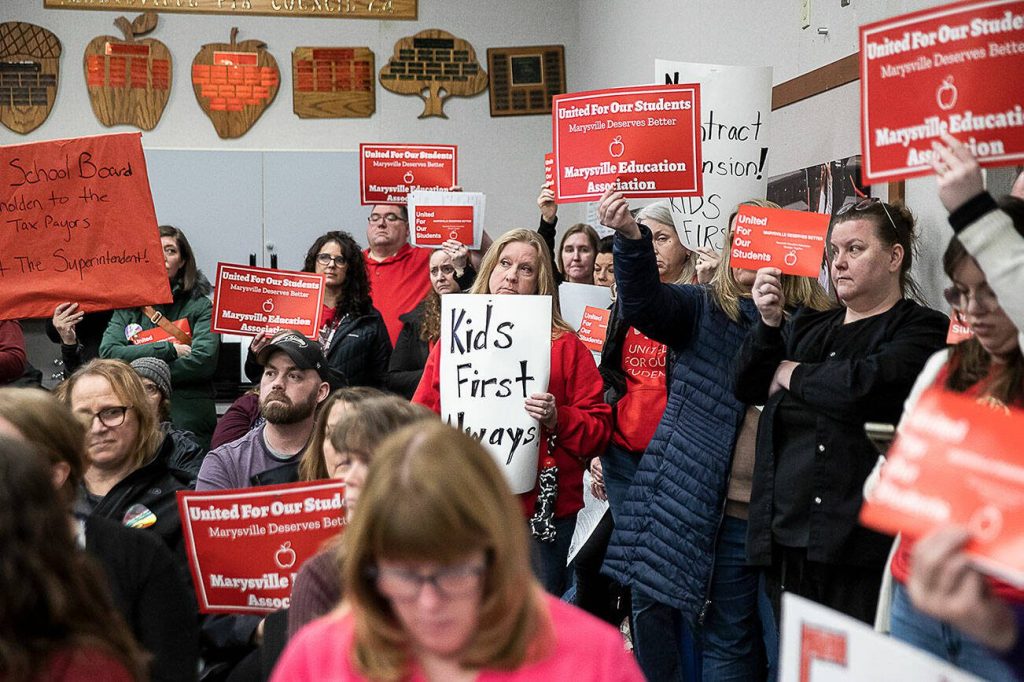

MARYSVILLE — State auditors last week provided the latest hit to the Marysville School District, questioning the district’s ability to continue operating in a “uniquely perilous” financial situation.
In a report released Aug. 5, state Auditor Pat McCarthy called the results of her office’s audit “rare and alarming.”
The audit found no deficiencies in the district’s financial reporting or internal controls, according to the report’s cover letter. However, auditors issued two findings, including one it classified as “extremely urgent.”
“The District’s financial condition places it at risk of being unable to meet financial obligations or provide services at current levels,” the audit said.
Auditors found the school district’s financial condition has “significantly declined,” and caused “substantial doubt about its ability to operate into the future.” Auditors call this a “going concern” finding.
Marysville is the first district to receive such a finding since the Vader School District shuttered in 2007, according to auditors.
“This is the most alarming audit of a public school’s finances in 17 years,” McCarthy said in a press release. “Local leaders have a financial and a community responsibility to right their ship. The stakes are too high for Marysville and its children.”
On Wednesday, the district responded to the audit, criticizing the auditor’s press release for omitting details of the double levy failure that caused the bulk of the budget issues.
“It is disappointing to read a press release and statements in the audit report that place the district in a position that leads the community to question its viability,” the district wrote. “The district has been working hard to address and correct past practices and solidify systems and structures to produce a balanced budget and eventually exit binding conditions.”
The district also called the press release’s emphasis on the district’s current financial state “unusual,” since the audit’s focus was the 2022-2023 school year.
The auditors agreed 2022-2023 was the focus, but noted the report also included un-audited data from the following school year. State auditors said this is standard practice.
“We haven’t seen the district take any proactive action to address their financial condition,” Kelly Collins, director of local audit for the office, said on Friday.
After projecting an $18 million budget deficit last August, the district entered into “binding conditions,” forcing school officials to work with the state to resolve the financial shortfalls. Marysville is the largest school district in the state to ever face these terms. District leaders agreed to provide a financial plan to recover by the end of the 2025-2026 school year.
The financial health of a government body is often measured in “days of operating expenditures,” or how many days of operating costs the district’s general fund account can support. A healthy benchmark is 60 days, according to state auditors.
Marysville could support just 18.6 days at the end of the 2023 fiscal year, and negative 11.6 days, as of this June, according to the audit. This means the district had more expenses than money available in its account.
“A clean audit does not change the fact that we have significant fiscal challenges ahead of us,” district spokesperson Jodi Runyon said. “The district continues to work diligently to make cuts and rightsize its budget.”
A rocky road
A financial crisis has plagued the Marysville School District for several years.
The district lost out on $25 million due to a double levy failure in 2022. While voters passed a downsized four-year levy last year, the district didn’t start receiving that money until June.
The issues continued from there.
In March, the district learned it had lost membership in its risk management pool, a form of financial protection similar to insurance. The risk pool cited a steep rise in claims, poorly maintained buildings and failure to maintain the district’s end of the bargain on a legal settlement.
The next month, the state superintendent’s office found the district’s first budget plan “incompliant,” with fund balance calculations off by as much as $3 million, numerous inconsistencies and insufficient funds left by the end of the 2025-2026 school year.
The district later submitted a second financial plan the state accepted. This budget included the closure of two schools, eliminated some educational programming and cut several staff positions.
Officials later announced Cascade Elementary, Liberty Elementary and Totem Middle School were on the chopping block.
In May, finance director Lisa Gonzales accused the district of “violations of the law, inaccurate state reports, and cronyism” before her contract expired. In June, both the school board President Wade Rinehardt and Executive Director of Human Resources Alvin Cooper resigned.
That same month, the superintendent’s office told the district its actions hadn’t been consistent with its approved financial plan. This, and the loss of these key staff members, made the district “unable to fully comply with its plan to regain financial stability.”
The state established an unprecedented Financial Oversight Committee to oversee Marysville’s path forward.
Committee member T.J. Kelly said last week the district has provided the committee with information in a timely manner. Runyon said the meetings are going well.
If Marysville cannot get the situation under control, the superintendent’s office will take more drastic steps.
Runyon said district officials have already made $6 million in cuts. Additional cuts will focus on staffing after confirming enrollment for the coming school year. Runyon emphasized these cuts will be made at all levels.
A two-way street
In a statement released Thursday, acting school board President Connor Krebbs called for the community to collaborate. He also encouraged the state to “look inward and determine whether or not its school funding decisions are student-focused.”
Ron Friesen, a Marysville resident and Best Schools Marysville volunteer, agreed.
“I agree with the auditors that this is a very, very dire situation, and it is unprecedented in the state,” Friesen said Friday. “What the auditors do not acknowledge is the impact that the state of Washington has had on this as well. We made a mess here, but we had a lot of help from the state.”
Friesen said the double levy failure that caused these financial problems is only a piece of the puzzle, and that the state has failed to support the district given its number of low-income families. This past school year, over 57% of Marysville students came from low-income families, according to state data. In Everett, that’s down to 44.5%. In Lake Stevens, less than one-third.
“Levies should be for extras, not for basics,” Friesen said. “Because levies have to provide basics, we’re losing our extras.”
School district officials said rising inflation and stagnant or declining enrollment has been difficult on many schools nationwide. Since the 2018-2019 school year, Marysville’s enrollment has dropped over 1,200 students, to just over 10,000 this most recent school year, state data shows.
“The financial strain schools are experiencing today is uncharted territory for everyone,” Runyon said.
As a community member, Friesen called for more state funding and more power handed to the teachers and school board.
“I have no confidence that people in the administration office can provide the leadership that’s needed to get us out of this,” Friesen said. “The teachers in the classroom, the people on the front line are going to come up with the solutions.”
The district stands firm it will continue to operate in spite of these challenges.
“Every child will have a classroom and a teacher, and school will start on time,” Runyon said. “The district is committed to providing a high-quality education for all students, even in the face of this financial crisis.”
Correction: A previous version of this story misidentified T.J. Kelly.
Connor Zamora: 425-339-3037; connor.zamora@heraldnet.com; Twitter: @cgzamora02.