
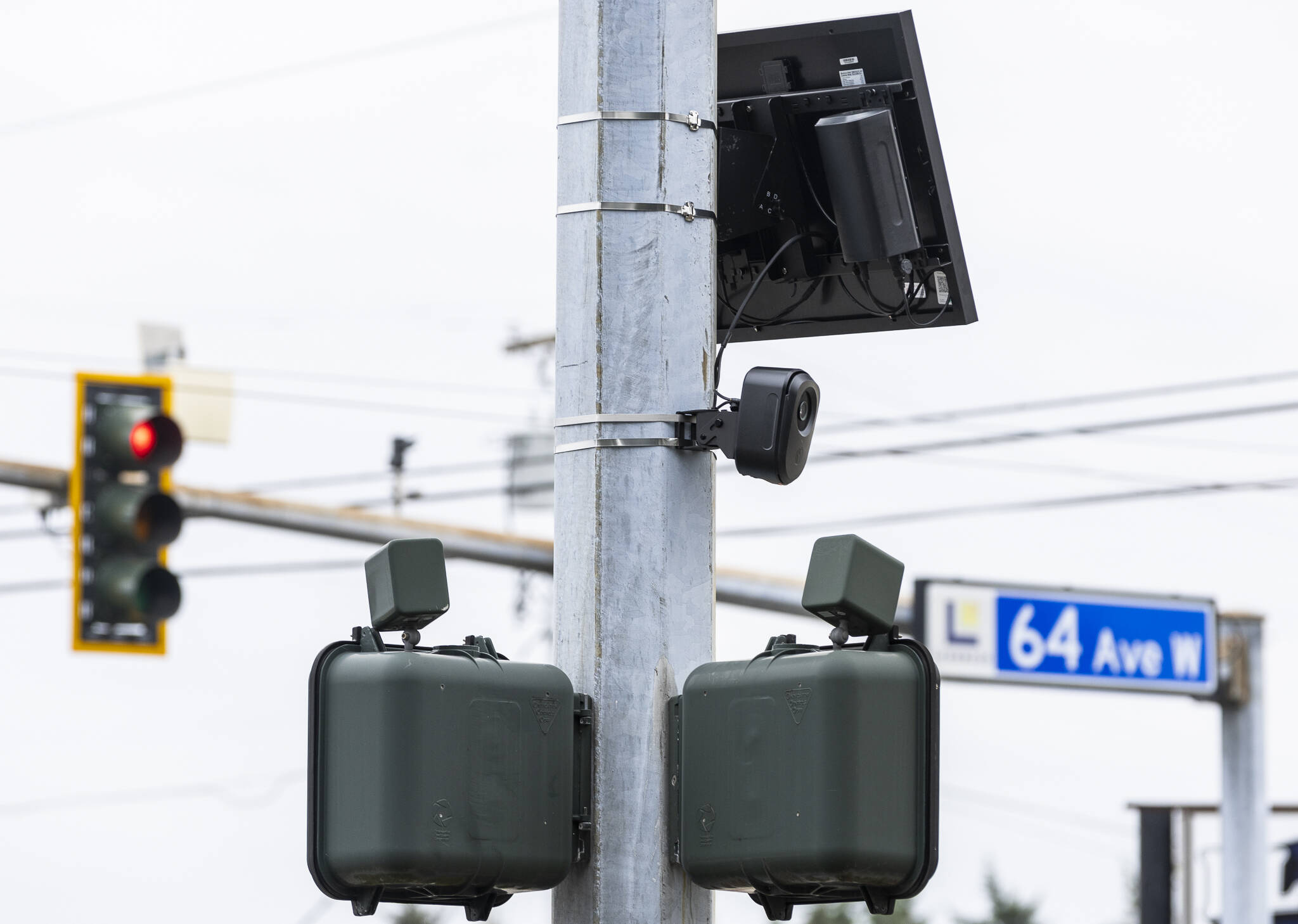
EVERETT — The cities of Stanwood and Sedro-Woolley are appealing a judge’s recent decision that Flock camera footage is subject to public records requests.
The cities filed the appeal Thursday, court records show. The case will now go to the state’s Court of Appeals.
Flock Safety cameras are automated license plate readers that use artificial intelligence to analyze vehicle footage. Many law enforcement agencies across the country have implemented the technology as an investigative tool to help locate stolen vehicles and missing persons.
Earlier this year, Stanwood and Sedro-Woolley received separate public records requests for Flock camera footage from Oregon resident Jose Rodriguez. In light of the requests, the cities decided to together seek a judgment in Skagit County Superior Court that Flock footage is either not public record or exempt from the Public Records Act for privacy reasons.
In a Nov. 6 hearing, Skagit County Judge Elizabeth Neidzwski denied the judgment request, in effect ruling that Flock camera footage is considered public record.
Stanwood and Sedro-Woolley argued Flock footage is only public record once an agency extracts and downloads the data, which happens when officers search for a vehicle in the Flock system. The cities had received requests for all footage in a half-hour or one-hour window, which would require the agency to make additional searches and essentially create new public records, the cities argued. The Public Records Act states that public records include information “prepared, owned, used, or retained” by an agency.
The cities also said the footage should be exempt from the Public Records Act, according to a section that exempts certain intelligence information that could jeopardize the effectiveness of law enforcement or a person’s right to privacy if released.
In her ruling, Neidzwski said an agency does not have to possess a record for it to be subject to the Public Records Act, and cities pay for, create and use Flock camera footage to “further a governmental purpose.”
The ruling has sparked additional conversations in cities throughout the county about their contracts with Flock.
On Wednesday, the Everett City Council unanimously authorized the city to seek a court judgment regarding “the disclosability of Flock camera images.” City spokesperson Simone Tarver declined to comment on pending litigation. No court documents were available as of Monday.
Stanwood’s cameras have been paused since May while the city awaited a judgment. Since the ruling, the cameras are still off and the city doesn’t have a timeline for turning them back on, Stanwood City Administrator Shawn Smith said.
Mountlake Terrace has put its implementation of Flock cameras on hold in light of the public records case, and the town of Woodway has delayed taking a vote on a Flock contract.
In Lake Stevens, some City Council members raised concerns about privacy, saying that members of the public could request Flock footage to track people.
“We haven’t seen yet during this time that the ability of the public to make public disclosure requests is being abused with respect to Flock cameras, but that could happen,” Lake Stevens City Attorney Greg Rubstello said at a Nov. 18 City Council meeting. “People can request all sorts of documents from the city if they want to try to harass or make life difficult for their neighbor or somebody else in the city. But we’re going to keep abreast of this issue as it’s floating through the courts.”
In the past month, community concerns have grown over the misuse of Flock technology. Reports from The Daily Herald and the University of Washington revealed federal agencies — including U.S. Border Patrol and Homeland Security Investigations — gained access to multiple Flock networks in Snohomish County, often without police departments knowing. Out-of-state law enforcement agencies searched local Flock data for reasons directly related to immigration or seemingly on behalf of U.S. Immigration and Customs Enforcement, which could violate state law.
Some cities — including Everett, Lake Stevens, Lynnwood, Mill Creek and Mukilteo — have turned off the setting that allowed out-of-state agencies to search their networks.
On Oct. 30, Lynnwood paused its Flock program. On Nov. 10, the Lynnwood City Council unanimously voted to formally recommend the pause. But some residents are urging the city to cancel its contract with Flock entirely.
“When the decision is made to trade the privacy of everyone who sets foot in the city for the convenience of the Lynnwood Police Department, I believe that’s a bridge too far, where we are not representing our values as a country,” Lynnwood resident Quinn Van Order said at the Nov. 10 meeting. “So I’d encourage you all to cancel the contract.”
The Everett Police Department is testing an automated audit system to review every search to its network, Police Chief John DeRousse said at the City Council meeting Wednesday. The artificial intelligence system flags unclear search reasons for further review.
When an officer makes a search in Flock, they are required to enter a reason for the search. Records from across the county have shown some agencies including vague reasons for their searches, including “investigation,” “criminal justice” or “agency assist” with no case number attached.
Other cities, including Marysville and Arlington, have not publicly announced any changes to their settings since the reports of federal and out-of-state access.
On Wednesday, the 44th Legislative District Democrats announced it adopted a resolution calling for communities across Snohomish County to remove Flock cameras, citing privacy concerns and state law violations. The 44th Legislative District covers Lake Stevens, Mill Creek and Snohomish and parts of Everett and Marysville.
“This was not just a committee vote. Our full membership heard the evidence and said clearly that Flock’s business model is not compatible with a free society,” said Ethan Martez, legislative coordinator for the 44th LD Democrats, in a press release Wednesday. “Every time someone in our community drives to work, to church, to a protest, or to visit family, they should not be automatically tracked and stored in a private company’s database.”
“At minimum,” the organization said, agencies should immediately disable the nationwide lookup tool, prohibit civil immigration use, adopt stricter limits on data retention, and public contracts, policies and audit logs for public review.
Further, the 44th Legislative District Democrats called for state and county officials to investigate potential violations of state law. They also urged state lawmakers to introduce legislation that places a statewide limit or ban on vendor-operated automated licence plate reader networks.
“Our members want real public safety, not permanent tracking,” Martez said. “We are asking local agencies and state leaders to choose constitutional policing, community trust, and immigrant safety over a private mass surveillance network.”
Jenna Peterson: 425-339-3486; jenna.peterson@heraldnet.com; X: @jennarpetersonn.
Talk to us
> Give us your news tips.
> Send us a letter to the editor.
> More Herald contact information.
























