
The Boeing Co. is turning 100 on July 15. Throughout the year, The Daily Herald is covering the people, airplanes and moments that define The Boeing Century. More about this series
For a company associated with things that fly through the air, Boeing has done a lot of work outside the bounds of our atmosphere.
During the 1950s, the United States feared it was suffering from a “missile gap.” In 1955, the Soviet Union detonated the first hydrogen bomb, and in 1957, it became the first nation to put an object into orbit: Sputnik I.
These events worried the United States, and the military put more resources toward developing the ability to deter a Soviet attack.
One of the early projects was the Minuteman, a solid-fuel intercontinental ballistic missile that could be launched at a moment’s notice and remain on alert for years at a time.
The U.S. Air Force awarded Boeing the contract in 1958. The first test launch of a Minuteman came on Feb. 1, 1961, and the first launch from a silo that November.
Just one year later, 10 newly deployed Minuteman missiles became President Kennedy’s “ace in the hole” during the Cuban Missile Crisis. They were the final deterrent that he didn’t have to use during the 13-day standoff with the Soviet Union.
At its peak, the Minuteman program employed nearly 40,000 people in Seattle and at the final assembly site in Ogden, Utah. The U.S. still maintains 450 Minuteman III missiles as part of its nuclear arsenal.
The Minuteman also served another purpose: It proved that Boeing was capable of designing and developing complex projects that involved many parts, contractors, supply chains and quality controls. In other words, systems within systems within systems.
“It’s not just understanding that and choreographing all movement and connections,” said Michael J. Lombardi, Boeing’s corporate historian. “The other part of it is working all the faults out of it so that the system works flawlessly.”
That capability is known inside the industry as Large Scale Systems Integration, or LSSI, and it grew out of Boeing’s transformation during World War II.
“We went from creating a few dozen airplanes by hand per year to the point where we were building thousands of airplanes in a moving line,” Lombardi said.
A Congressional inquiry after the 1967 fire that killed three astronauts on what would have been the Apollo 1 mission, determined that NASA was having trouble building rockets and training astronauts for a mission to the moon.
Boeing’s capabilities with large systems led to the company’s selection by NASA to manage the Apollo program, to handle the nuts and bolts of building moon rockets while NASA focused on the mission.
“Essentially, Boeing donated 1,500 engineers and executives to assist NASA in the management of Apollo-Saturn,” Lombardi said.
Boeing went on to build the first-stage booster for the Saturn V rocket that took astronauts to the moon in Apollo 11. It also joined then-competitors McDonnell Douglas and North American Aviation (both now part of Boeing) as a principal contractor for the entire Apollo project.
Since then, Boeing’s expertise has been crucial for many projects in the U.S. space program:
- The Lunar Orbiters flew five missions in 1966-67 that took the first close-up photos of the moon and helped NASA select the Apollo landing sites. The orbiters were built at the Boeing Missile Production Center in Seattle and tested at the Boeing Space Center in Kent.
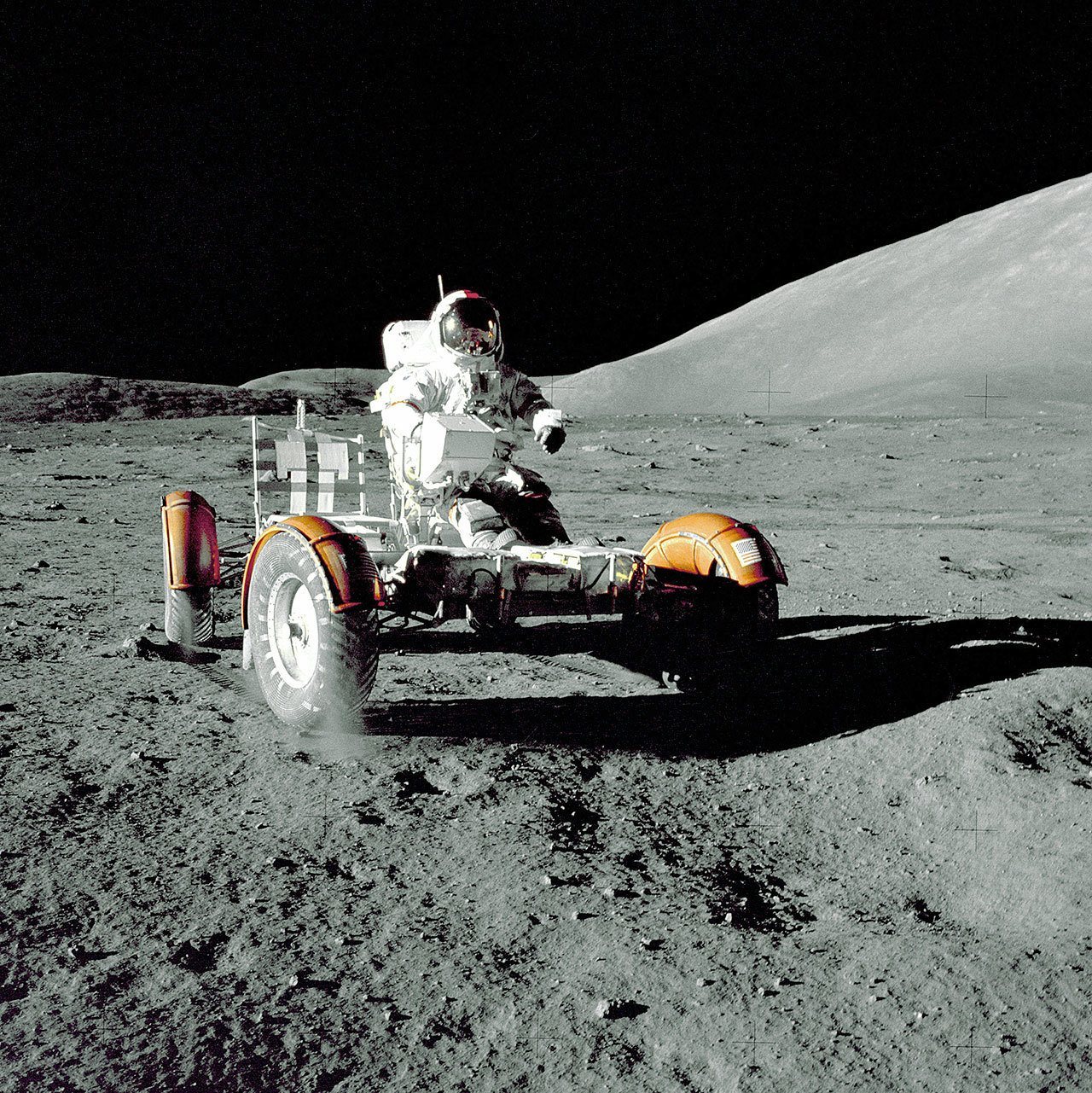
- The Lunar Roving Vehicles were moon buggies that flew on Apollo 15, 16 and 17 and were left parked on the moon for future astronauts to use. They were also built in Kent.
- One early interplanetary probe, Mariner 10 in 1973, was the first to visit multiple planets with a gravity assist; in this case, using Venus’ gravity well to accelerate and propel the probe to Mercury.
- The Inertial Upper Stage Rocket was a rocket that could be launched from a Titan IV booster or the space shuttle. It was used to send the Magellan probe to Venus in 1988, and in 1990, to send the Galileo probe to Jupiter and the Ulysses probe to the sun. Up until 2004, it was also used to put satellites in orbit.
- Boeing was the prime contractor on the International Space Station starting in 1993, and in 2008 was awarded the $650 million contract to deliver and integrate the remaining components of the ISS, which is still operational.
Talk to us
> Give us your news tips.
> Send us a letter to the editor.
> More Herald contact information.
























