‘We don’t have openings’: SnoCo recovery houses struggle with demand
Published 6:37 pm Friday, July 19, 2024


EVERETT — Gabby Bullock couldn’t talk about her kids without crying.
In June, she was preparing to see her 8 and 9-year-old sons for the first time in four years.
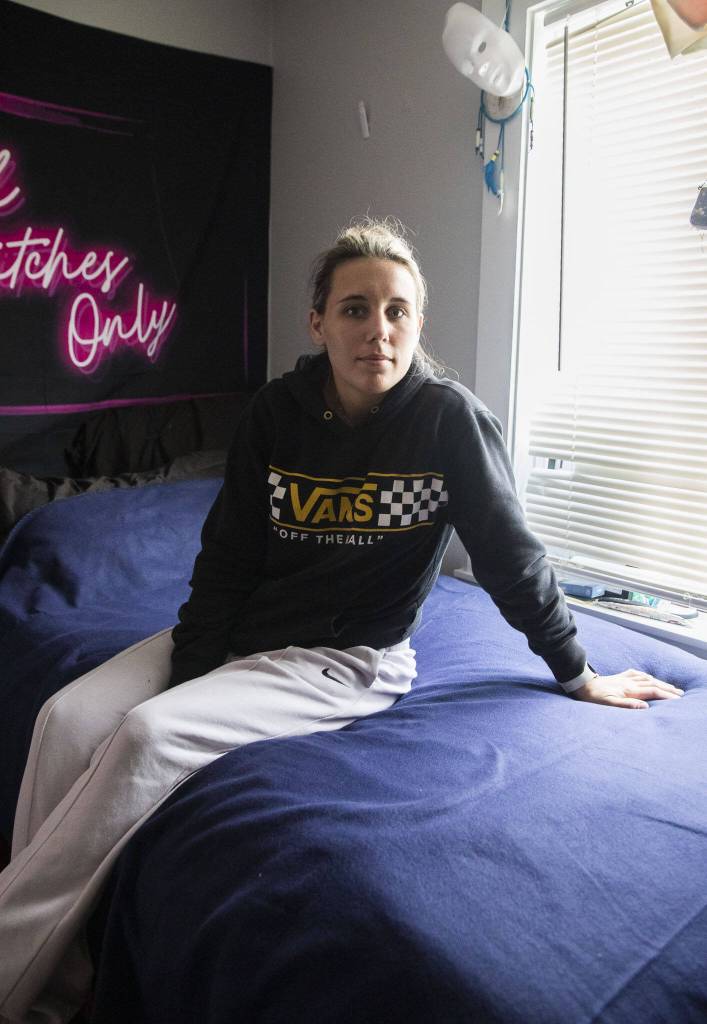
Bullock, 28, wiped away “happy tears” as she sat in the backyard of the north Everett addiction recovery house she’d called home for the past six months.
“It just really proves that what I’m doing is the right thing,” she said. “I know that if I’m doing the right thing that more miracles will happen.”
The home operated by sober living organization Hand Up Housing gave Bullock the stability she needed to focus on her recovery from a yearslong addiction to fentanyl and meth.
But not everyone has access to that resource. Advocates say a shortage of recovery housing in the county leaves many going without — and at risk of relapsing.
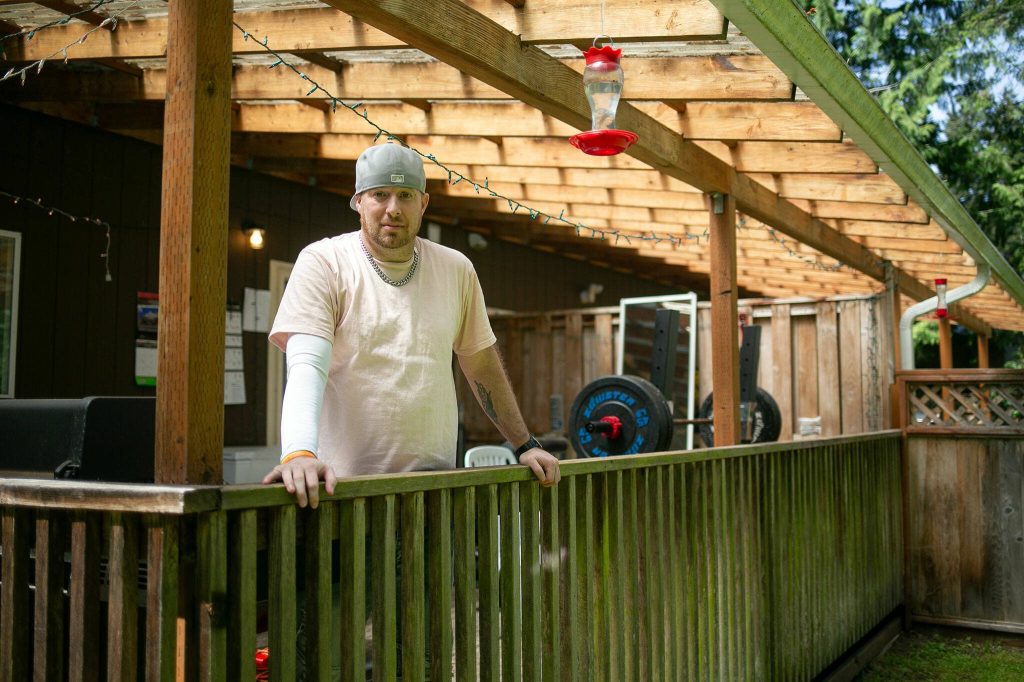
Right now, recovery housing “is tighter than it’s ever been for us,” said Travis Gannon, the founder of Hand Up Housing. “I mean, we don’t have openings. We fill everything that we have and we’re turning away 30 to 50 people a week at this point.”
Data from the county medical examiner’s office shows 167 people have died from drug overdoses so far this year. Of those, about 76% involved fentanyl.
‘Somewhere safe’
The state Health Care Authority maintains a list of accredited recovery houses like Gannon’s, which provide a peer-supported environment for residents to stay sober.
The state registry shows 495 homes with 4,258 total beds, according to the authority. As of May, peer-run “Level 1” homes had an 8.4% vacancy rate, while staffed “Level 2” homes had 11% vacancy.
Of the total recovery homes statewide, 48 are in Snohomish County.
The state Department of Health licenses recovery residences that provide a higher level of support, like medical care. Those homes are separate from the state registry.
It is difficult to track how many people would take advantage of recovery housing if given the opportunity.
For Jason Bliss, sober living homes are a critical part of addiction recovery.
Bliss is the executive director of the Washington Alliance of Quality Recovery Residences, the organization that accredits homes for the state registry.
“You can provide individuals with outpatient services, you can provide them with inpatient services,” Bliss said. “But one thing is a proven fact: If somebody does not have somewhere safe to lay their head down at the end of the night, 90% of the time all of those services are going to be for nothing.”
E.V. Velez, recovery support coordinator for the county drug court program, agreed.
That doesn’t mean everyone who enters a sober living home is going to have a successful recovery. But getting discharged from a treatment program into crisis is a bad start. The longer someone “can maintain that initial burst” of sobriety, the more likely it’ll stick, he said.
Gannon said many residents in Hand Up homes were previously in living situations where they used drugs with others. Recovery homes provide a space where sobriety is the norm and residents can connect with others in the same position.
Once people are on the path to recovery, “they need an address,” he said. “Simple things like that are just massively important.”
‘This is where you’re going’
Despite the need, recovery housing is a limited resource.
Bliss attributed the scarcity to housing costs. In Snohomish County, the median home price was $787,975 in May, according to real estate company Redfin.
Last year, the state appropriated $10 million for the Health Care Authority to offer grants to new recovery homes through June 2025.
The authority contracted with the Washington Alliance of Quality Recovery Residences to distribute the grant money.
The grant application opened in January. By early June, the alliance had distributed all of the funding, Bliss wrote in an email.
The state Department of Commerce got one million dollars in state funding for a similar grant program. Commerce discontinued the program at the end of June with a plan to jointly distribute funding with the authority next year.
Recovery home operators can also apply for a loan of up to $4,000 from the Health Care Authority.
Home prices make starting a new recovery house difficult, Bliss said, noting providers have to find homes big enough to house multiple single people.
When someone is getting out of inpatient treatment, they don’t have the luxury of choice, said Velez, the recovery support coordinator.
“I can’t be like, ‘Well, let’s go apartment hunting,’” he said. “It’s like: literally this is the only bed I have and this is where you’re going. And you’re lucky you have it, because there was three other guys that were also trying to get in there.”
That means people could end up in programs they’re not a good fit for, Velez noted. For example, someone with religious trauma could get put into housing with a faith-based model.
Time is of the essence when someone is waiting for recovery housing, explained Jasmine Donahue, owner of Hope ‘N Wellness, an organization that provides support for people in vulnerable situations, including in recovery.
The time between getting on a waitlist for recovery housing and getting in can be dangerous, she said. When someone is out on the street, they’re at risk of relapse.
“There’s this narrative that if you want help, it’s there,” Donahue said. “That’s just false. It’s a false narrative.”
‘It was time’
Bullock started drinking in her teens, after her dad was arrested for investigation of sexually abusing her, she said. He was sentenced to 20 years in prison for child molestation and rape, according to the state Department of Corrections.
She stopped going to school her sophomore year of high school. Through friends, she met people who introduced her to different drugs, including meth.
Just days after her 19th birthday, Bullock had her first son. Her second boy was born a year later.
During her second pregnancy, Bullock got sober with the help of Swedish Ballard’s Substance Using Pregnant People Program. After that, she moved in with her boyfriend’s mom in Lynnwood, then into her own place.
Everything was going well for a time, she said. She and her boys were happy.
But after about two and a half years, Bullock relapsed. She didn’t have the support she needed to maintain her sobriety, she said. As a result, she lost custody of her two sons.
Bullock’s path to recovery came through the county drug court program.
Last May, she was facing charges of possession of stolen property and identity theft, which she says she racked up trying to get money to support her addiction.
At first, she only agreed to participate in drug court to stay out of prison. Last June, the county Superior Court issued a warrant for Bullock’s arrest due to her failure to appear at a hearing.
She was arrested on the warrant while trying to steal from a Home Depot, she said.
It was “really stupid,” she said, but “it was time.”
‘You are not alone’
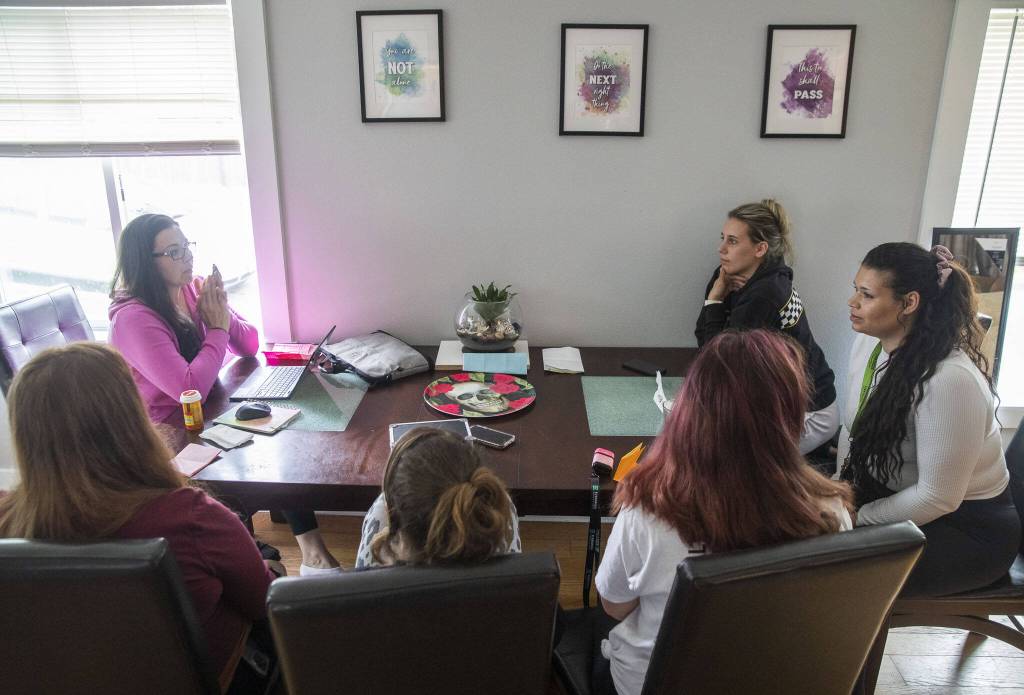
In June, six women sat around a table in a north Everett home.
Framed colorful posters bearing inspirational slogans decorated the wall beside them.
You are NOT alone;
Do the NEXT right thing;
This too shall PASS.
Just minutes before, the house was full of energy as children played inside. Kids often stay with their moms in the Hand Up Housing sober living home on weekends.
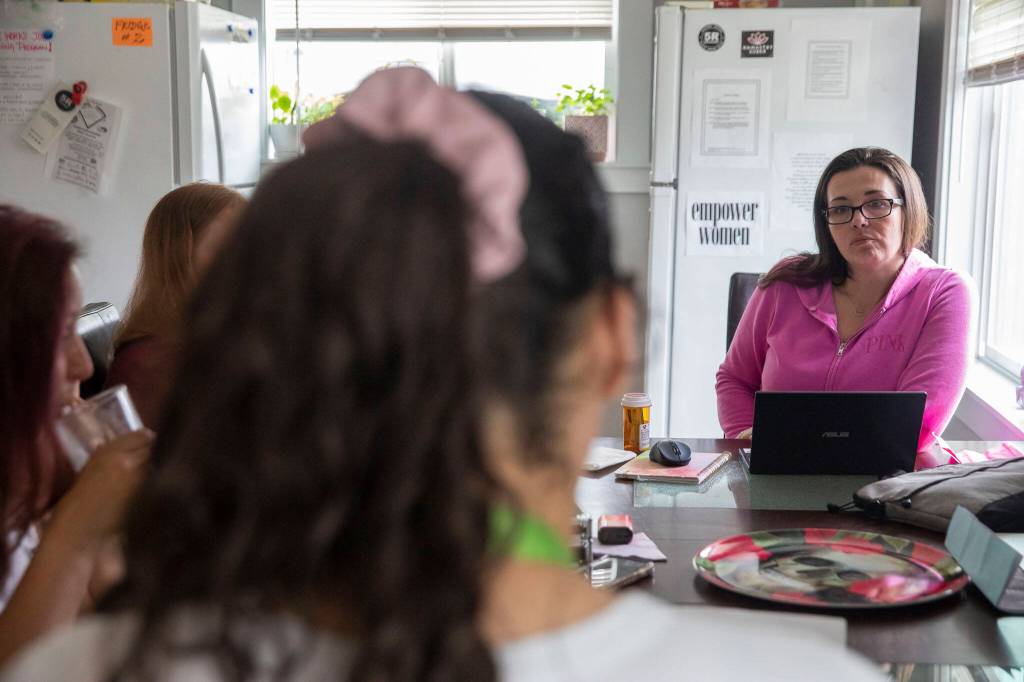
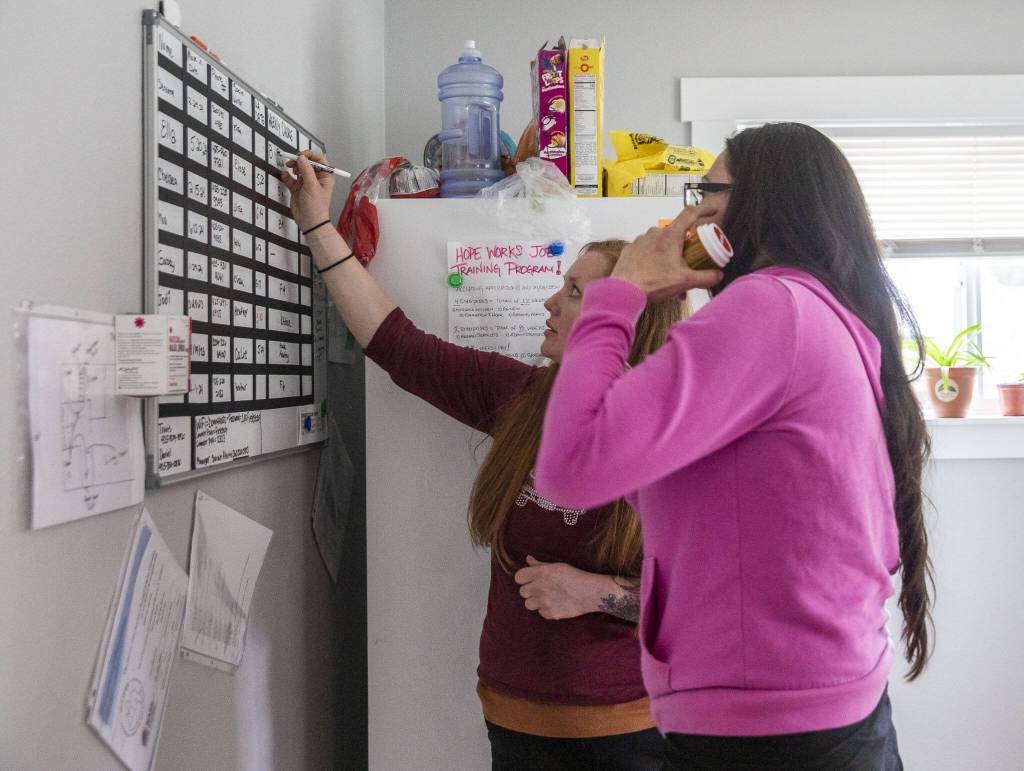
Now, the adults in the room were focused for the start of their weekly house meeting, a check-in with each resident. Bullock sat at one end of the table, waiting for her turn.
After her arrest, she ended up in an inpatient treatment program. She stayed in the county Diversion Center when she got out, then a different sober living house. In January, she moved into the Hand Up Housing home.
At the meeting, one resident had just put in an application for an apartment.
“I don’t know if it’s gonna happen, though,” she said. “I don’t feel like I’m ready to move out, but I feel like it’s a good start to see what the whole process is going to be.”
Peer Leader Sarah Aburto took notes on her computer.
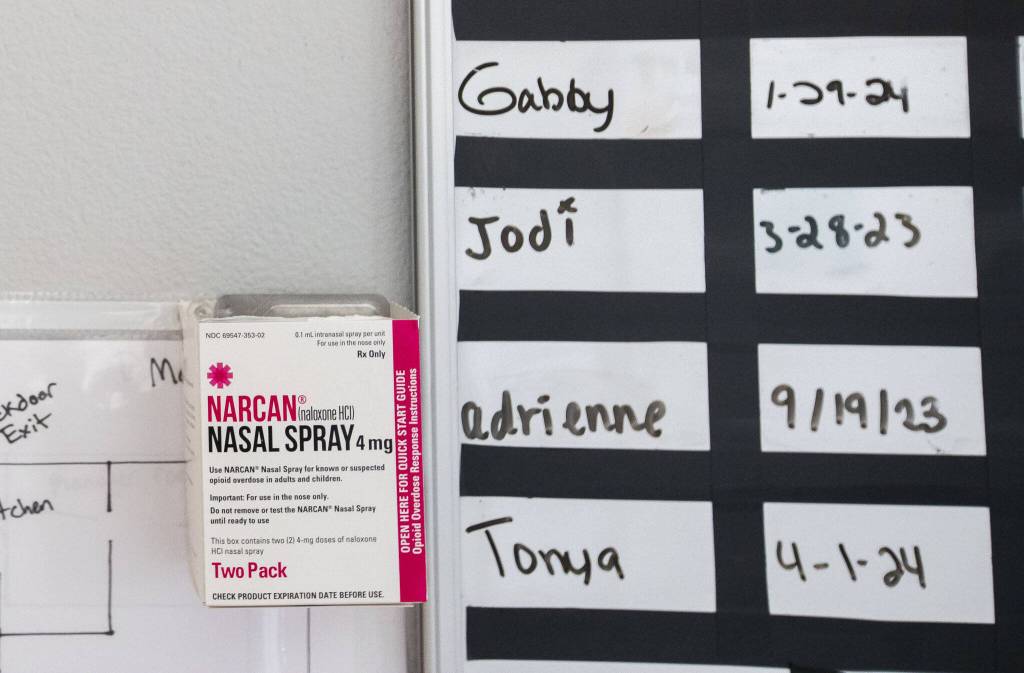
For some residents, she counted Suboxone strips tucked into orange pill bottles. The drug is used to treat opioid use disorder. If someone in the house is taking medication, Aburto does a weekly “med check” to make sure they’re taking the appropriate amount.
When it was Bullock’s turn, she handed Aburto a piece of paper tracking her recovery activities for the week.
“Only 12 this week,” Aburto said in joking surprise. “I wonder why.”
She asked Bullock to share with the group. Bullock had recently started her job building Pallet shelters in Everett, getting up at 3 a.m. to go to work. Aburto, a lead manufacturing specialist for Pallet, landed her the position.
“I love it,” Bullock told her housemates. “Keeps me busy.”
In September, Bullock will start an apprenticeship program at a trade school in Marysville, with Pallet’s support. She does not yet know what her specialization will be.
“And I get to see my kids this weekend, on Sunday,” Bullock told the group. “I’m going to lunch with them.”
Along with structure, Hand Up Housing has also given Bullock a strong support system.
She can turn to fellow residents “in times of temptation or struggle,” she said. In May, they comforted her when she was having trouble getting an in-person visit with her kids.
In mid-June, Bullock and her sons had their lunch together. It was a little awkward, she said, but it went well. She knows it will take time for them all to feel comfortable together again.
She’s not giving up.
Sophia Gates: 425-339-3035; sophia.gates@heraldnet.com; Twitter: @SophiaSGates.