Reef net boats sit off the shore of Lummi island on Aug. 20. (Hailey Hoffman / Cascadia Daily News)

Reef net boats sit off the shore of Lummi island on Aug. 20. (Hailey Hoffman / Cascadia Daily News)

Lummi Island celebrates its unique reefnet fishery

The ancient practice, developed by Northwest Indigenous fishermen, is considered a highly sustainable way to catch salmon.

  • By Brendan Gardner Cascadia Daily News
  • Tuesday, August 23, 2022 1:30am
  • Northwest

By Brendan Gardner / Cascadia Daily News

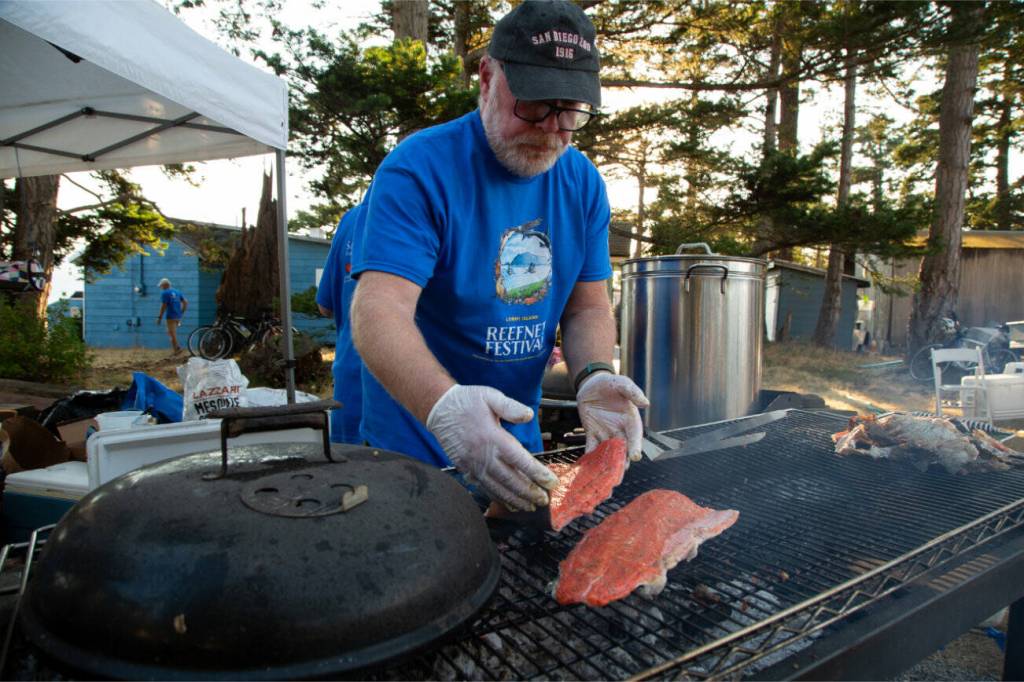
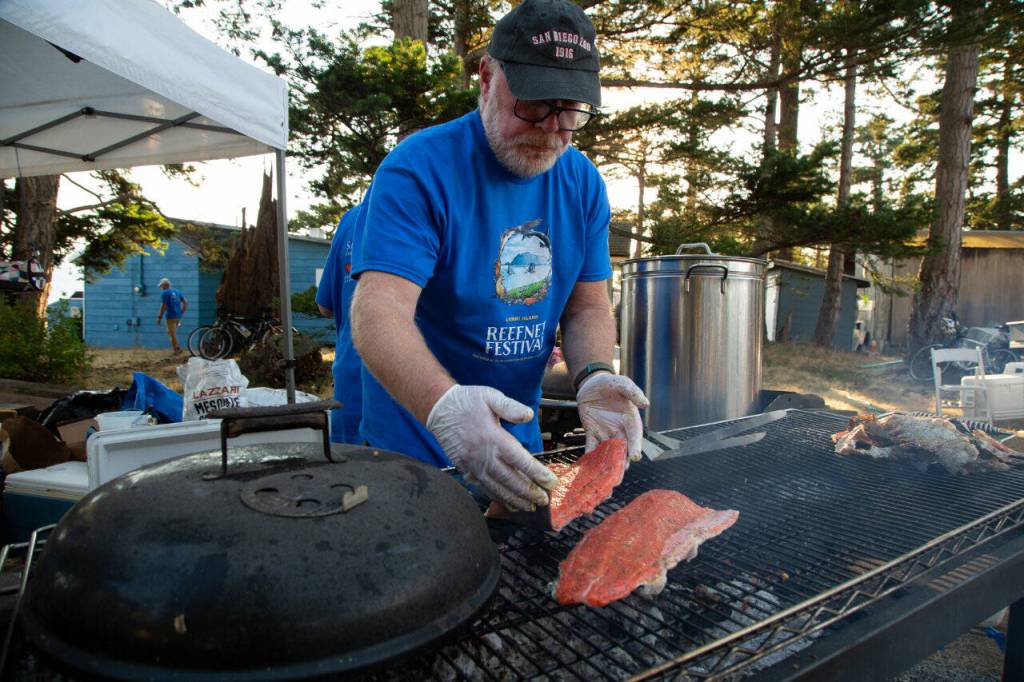
LUMMI ISLAND — Local residents gathered on west Lummi Island to enjoy sustainably caught salmon, music and other performances at the sixth Reefnet Festival Aug. 20, organized by the Salish Center for Sustainable Fishing Methods.

The festival, intended to celebrate sustainable salmon fishing methods, featured reefnet-caught salmon and other foods, several live bands and Lummi Nation tribal blessings, according to the event website.

Reefnet fishing is an ancient practice that dates back to the original Indigenous inhabitants of the Pacific Northwest. The technique relies on a net suspended between two stationary platforms, upon which are situated tall spotting towers. When someone standing atop a tower spies a group of salmon, they alert their crew and the net is hauled to the surface.

The practice is considered a highly sustainable way to fish, according to longtime fisherman Riley Starks, executive director of the Salish Center for Sustainable Fishing Methods.

The Salish Center is a nonprofit advocacy group that works to encourage sustainable fishing and to restore the marine ecosystems of the Salish Sea. Because reefnetting involves watching specifically for salmon, the practice greatly minimizes bycatch, or capture of undesired sea life.

This makes reefnetting much more environmentally friendly than indiscriminate commercial gillnetting, which can harm fisheries by accidentally catching and killing unneeded fish and other marine animals.

“[Reefnetting] is the most sustainable salmon fishing in the world, and it’s the oldest,” Starks said. The practice is also strictly regulated by the Washington Department of Fish and Wildlife to ensure salmon runs remain sufficiently high, further enhancing its sustainability relative to large-scale commercial fishing.

The festival was first held in 2004 and continued annually until it was halted by the Great Recession.

“With the Great Recession, things kind of collapsed on the island,” Starks said. “We haven’t really been able to do [the festival] until this year.”

He said the festival plans to be held annually from 2022 onwards.

When Starks first got into fishing 50 years ago, the number of people reefnetting was much greater than it is now. Reefnetting is more of a community than commercial fishing, he said, and he wanted to bring it back.

But it hasn’t been all downhill for sustainable fishing the last few decades, Starks said. Catches have almost tripled following the prohibition of harmful bottom-trawling fishing boats in Puget Sound, indicating that local fisheries are much healthier than they used to be.

“Almost all of the stories about the Salish Sea are stories of doom and gloom, about the orcas dwindling, the salmon population dwindling,” Starks said. “While that’s all true, what people ignore is all the success stories there are.”


Talk to us

> Give us your news tips.

> Send us a letter to the editor.

> More Herald contact information.

More in Northwest

Washington state lawmakers in the House chamber on the first day of the 2026 legislative session. (Photo by Jacquelyn Jimenez Romero/Washington State Standard)
More bills falter as time dwindles for Washington Legislature

The third deadline in as many weeks came Tuesday in the Washington… Continue reading

Senate Majority Leader Jamie Pedersen, D-Seattle, makes remarks on Monday during the floor debate over legislation he sponsored to tax personal income over $1 million a year. (Photo by Bill Lucia/Washington State Standard)
Washington state Senate approves tax on personal income over $1M

The bill will next go to the House, as Gov. Bob Ferguson is indicating he’d like to see more changes.

Sen. John Lovick, D-Mill Creek, on the Senate floor on Feb. 12, 2026, remarks about his bill to set stricter standards for sheriffs. The legislation was approved, sending it to the House. (Photo by Bill Lucia/Washington State Standard)
Stricter standards for Washington sheriffs approved in state Senate

A lead law enforcement group and Republicans are opposed. The bill would provide a way for the state to remove elected sheriffs and restrict volunteer posses.

A voter puts a ballot in the drop box at the Ballard branch of the Seattle Public Library in King County in August 2024. This voting location is one of the most popular in the county. (Laurel Demkovich/Washington State Standard)
Tighter rules for challenges to voter registrations clear WA House

A spike in challenges by conservatives is fueling Democrats’ desire to make changes that will curtail frivolous claims. The bill next goes to the Senate.

The Washington state Capitol on Friday. (Photo by Bill Lucia/Washington State Standard)
WA income tax on higher earners clears first legislative hurdle

Democrats rejected GOP amendments before pushing their tax on millionaires through a Senate committee. The bill was revised to expand an exemption for small businesses and make other changes.

Washington Gov. Bob Ferguson, left, shakes hands with Cowlitz Indian Tribe Chairman Bill Iyall after signing an executive order to improve the state’s relations with tribal governments on Oct. 22, 2025. (Photo courtesy of Washington governor’s office)
Washington tribes could get more say in management of state logging lands

A bill to add two tribal representatives to the Board of Natural Resources is awaiting a Senate vote. Supporters say the change could add valuable perspective to the panel.

A view of the Washington state Capitol building in Olympia, obscured by a slight mist, Jan. 27, 2025. (Photo by Bill Lucia/Washington State Standard)
The bills that didn’t survive the WA Legislature’s first major deadline

A 60-day legislative session can be a cruel thing if you’re hoping… Continue reading

Washington State Capitol building in Olympia. (Courtesy photo)
Ferguson rejects WA lawmakers’ initial crack at income tax legislation

The Democratic proposal targets household earnings over $1 million.

Senate Majority Leader Jamie Pedersen, D-Seattle, during Senate floor debate on Jan. 28, 2026. (Photo by Bill Lucia/Washington State Standard)
WA Senate leader explains dim outlook for a new tax on big businesses

Senate Majority Leader Jamie Pedersen previously backed the payroll tax, but suggests there’s no political path for it. He and others are forging ahead with an income tax proposal.

State Sen. John Lovick, D-Mill Creek, looks on toward the end of the roll call vote for his Senate Bill 5067, which would lower the blood alcohol limit for drunk driving to 0.05% from 0.08% in Washington. The bill passed the Senate on a 26-23 vote on Jan. 28, 2026. (Photo by Bill Lucia/Washington State Standard)
Lower drunk driving limit approved by WA Senate

The bill drops it to 0.05%, and the state would join Utah with the toughest standard in the nation. It still needs House approval.

Bill Lucia / Washington State Standard
State Sen. Yasmin Trudeau, D-Tacoma, makes floor remarks on Feb. 4, 2026 about Senate Bill 6002, which would set state regulations for license plate readers. The bill passed 40-9, with only Republicans opposed.
WA Senate OKs guardrails for license plate readers

The legislation passed Wednesday mandates that reader data be deleted after 21 days and says it can’t be shared except in court proceedings.

Washington state Supreme Court Justice Colleen Melody is sworn in Wednesday, Jan. 21, 2026, in Olympia, Washington. (Photo by Jake Goldstein-Street/Washington State Standard)
Washington’s newest Supreme Court justice is sworn in

Colleen Melody is officially the Washington state Supreme Court’s newest justice. Melody… Continue reading

Support local journalism

If you value local news, make a gift now to support the trusted journalism you get in The Daily Herald. Donations processed in this system are not tax deductible.