
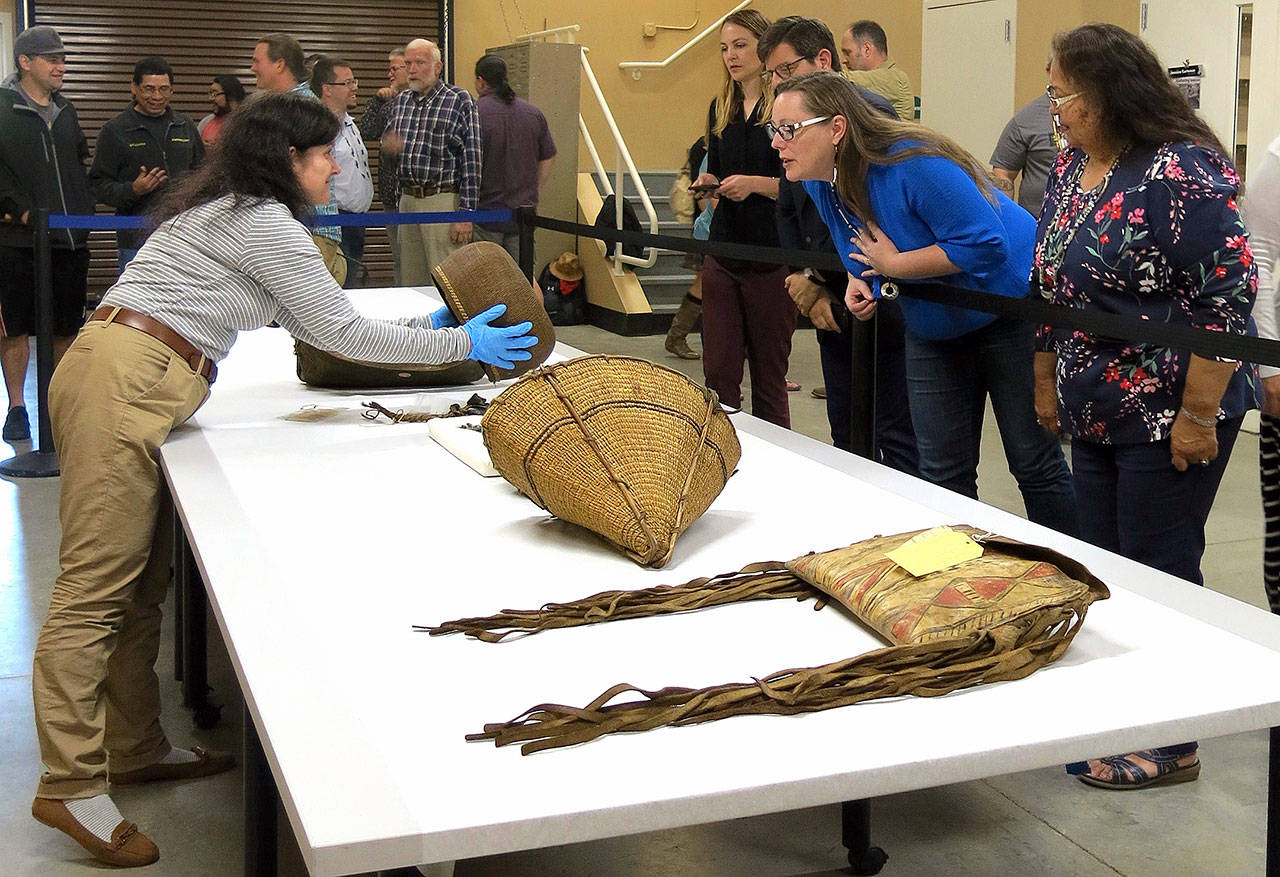
In this May 23, photo, Assistant Collections Manager for the British Museum Cynthia McGowan, handles a woven basket in Grand Ronde, Oregon, that was collected from the Confederated Tribes of the Grand Ronde in the 1870s. Looking on are tribal chairwoman Cheryle Kennedy (right), tribal council member Kathleen George (center) and tribal attorneys Rob Greene and Jennifer Biesack. Tribal artifacts hidden away in the archives of the British Museum in London for nearly 120 years are being returned to the Oregon tribe from the British Museum and go on display Tuesday. (AP Photo/Gillian Flaccus)

In this May 23, photo, Assistant Collections Manager for the British Museum Cynthia McGowan, handles a woven basket in Grand Ronde, Oregon, that was collected from the Confederated Tribes of the Grand Ronde in the 1870s. Looking on are tribal chairwoman Cheryle Kennedy (right), tribal council member Kathleen George (center) and tribal attorneys Rob Greene and Jennifer Biesack. Tribal artifacts hidden away in the archives of the British Museum in London for nearly 120 years are being returned to the Oregon tribe from the British Museum and go on display Tuesday. (AP Photo/Gillian Flaccus)

Oregon tribe displays its artifacts loaned from London

The objects will go on display Tuesday on the small Confederated Tribes of the Grand Ronde reservation.

  • GILLIAN FLACCUS Associated Press
  • Tuesday, June 5, 2018 4:22pm
  • Northwest

By Gillian Flaccus / Associated Press

GRAND RONDE, Ore. — Tribal artifacts that have been hidden away in the archives of the British Museum in London for nearly 120 years are being returned to a Native American tribe for an exhibit at its own museum — a facility the tribe expanded and upgraded in part to reclaim these pieces central to its complicated heritage.

The 16 objects will go on display Tuesday on a small Oregon reservation after a decades-long campaign by the Confederated Tribes of the Grand Ronde to bring them back from Europe.

The intricate bowls, woven baskets and other pieces were collected by the Rev. Robert W. Summers, an Episcopal minister who bought them from destitute tribal members in the 1870s and sold them to a colleague. The colleague later gifted the objects to the British institution.

The “Rise of the Collectors ” exhibit, on display at the Chachalu Tribal Museum & Cultural Center in Grand Ronde, also includes basketry collected by Dr. Andrew Kershaw, who worked on the reservation in the 1890s as a doctor and agent for the federal Bureau of Indian Affairs. Grand Ronde is about 70 miles southwest of Portland.

Together, the two collections are part of a larger plan by the Grand Ronde to reclaim and examine its history for future generations — a mission that echoes efforts by other tribes around the U.S. Two years ago, a Parisian auction house withdrew a ceremonial shield from an auction after the Acoma Pueblo, a tribe in rural New Mexico, moved to halt its sale. And tribes from Alaska to Connecticut have used a U.S. law passed in 1990 to reclaim Native American remains and sacred or funerary objects.

The Confederated Tribes of the Grand Ronde wanted the objects back permanently but worked out an initial yearlong loan because a full return of items from the British Museum requires parliamentary action, said David Harrelson, manager of the tribe’s cultural resources department.

The tribe never made a formal request to have the objects repatriated and instead chose to work with the European institution. The temporary exhibit is regarded as a first step to more collaboration between the Grand Ronde and the British Museum.

“It’s a real privilege to be a part of this, where this material heritage is coming back to this community,” said Amber Lincoln, curator of the Americas section of the British Museum. She and a colleague traveled to Oregon with the objects.

“This is what we work for, to bring people together … so that we all learn.”

In Oregon, the U.S. government in 1856 forced members of nearly 30 tribes and bands onto a new reservation to clear out land for white settlement. The mass relocation created a jumble of peoples who brought with them traditions and languages from what is now Northern California to southern Washington, a 350-mile span.

The government terminated treaties with those tribes about a century later and restored them in 1983, marking an end to a turbulent period that remains a fresh wound for many here. The Confederated Tribes of the Grand Ronde now has 5,100 members.

Around the same time, tribal members still in Oregon first learned of the Summers collection and mounted a campaign to repatriate the objects.

The federal law passed to help tribes reclaim artifacts from American museums didn’t apply to overseas institutions, so tribal representatives traveled to London, hosted British Museum officials in Oregon and pursued talks over a period of years. The museum was welcoming, but the tribe lacked a secure space to keep the objects.

After the tribe opened a casino in 1995, it had the funds to build a tribal museum — a key requirement for hosting the objects that led to the loan agreement last year. A small museum opened on tribal land in 2014, and an expanded space with a special security vault for the artifacts was completed last month.

“In my heart, I felt like, ‘Those are ours, and we need repatriate — whatever means we can to have those returned here,’” said Cheryle Kennedy, chairwoman of the Confederated Tribes of the Grand Ronde. “It’s really the spirit within our people that I felt crying out.”

Summers was passionate about collecting tribal artifacts and focused on finding items made before contact with Europeans — which means many of the objects on display were created before the tribes were forced onto the reservation, said Travis Stewart, interpretive director for the exhibit and a tribal member who selected the items on loan from the British.

That makes their temporary return even more symbolic, said Stewart, whose ancestors appear posing with basketry in a photograph in the exhibit.

“There are spiritual teachings we lose, there are cultural teachings we lose,” he said. “The fabric, the materials that these things are made of are from those people’s homes.”

Summers was intent on preserving that heritage through his collecting, a topic he returns to repeatedly in detailed notes also featured in the exhibit.

He made many trips to Grand Ronde while stationed at a church in the nearby town of McMinnville, but ultimately sold his collection to the Rev. Selwyn Charles Freer as Summers’ health failed. Summers’ wife, Lucia, created a hand-illustrated catalog of the collection after her husband’s 1898 death.

Freer in 1900 gifted the hundreds of items, as well as Lucia Summers’ illustrations, to the British Museum.

Now, the tribe hopes the loan — as well as its newly expanded museum space — will give it the track record it needs to secure similar loans from other institutions.

“I’m hopeful,” said Kennedy, the tribal chairwoman. “The healing of our people is happening.”

Talk to us

> Give us your news tips.

> Send us a letter to the editor.

> More Herald contact information.

More in Northwest

The U.S. Capitol building in Washington, D.C., on May 7, 2025. (Photo by Jennifer Shutt/States Newsroom)
End of shutdown ignites sparring among congressional lawmakers

Meanwhile, U.S. Rep. Marie Gluesenkamp Perez was among six Democrats who sided with Republicans in voting the legislation out of the House.

Attorney General Nick Brown has proposed new advice for locales on how to interpret state public records law, with a focus on providing records faster. (Stock photo)
Need for speed: Plan to unclog WA public records system gets mixed reviews

Washington’s attorney general is seeking to reduce public record backlogs as concerns… Continue reading

Washington state Commissioner of Public Lands Dave Upthegrove waves to the crowd during inauguration ceremonies at the Washington state Capitol, in Olympia, on Jan. 15, 2025. (Photo by Ryan Berry/Washington State Standard)
Dave Upthegrove on land sales, federal funding cuts and wildfire immigration raids

Washington state’s new public lands commissioner came into office with his own ambitious agenda. It’s playing out against a shifting backdrop in D.C.

The so-called “big, beautiful bill” that congressional Republicans approved in July included a total of $50 billion for the Rural Health Transformation Program. The money is meant to offset some of the expected damage to rural hospitals from the law’s steep cuts to Medicaid. (Olivia Vanni / The Herald)
Washington makes pitch to feds for $1B in rural health funding

The money was included in Republicans’ “big, beautiful bill.” The state’s goals include strengthening the rural health workforce and improving care in tribal communities.

Screenshot from the state Employment Security Department’s website at esd.wa.gov. (File photo)
Expected slide in WA unemployment trust fund balance could trigger new tax

Washington businesses would need to shoulder roughly $700 million in additional taxes… Continue reading

The Washington state Capitol. (Jerry Cornfield/Washington State Standard)
State Democrats mull imposing income tax on higher earners

The idea is brewing ahead of the 2026 legislative session. It would target those making above $1 million. The state is one of nine that does not tax wages.

Washington state Commissioner of Public Lands Dave Upthegrove speaks at a press conference on wildfire issues Monday in Tumwater. (Photo by Bill Lucia/Washington State Standard)
Climate dollars eyed to backfill WA wildfire funding

Washington’s lands commissioner, Dave Upthegrove, is on a mission to secure $60… Continue reading

Washington Gov. Bob Ferguson, left, shakes hands with Cowlitz Indian Tribe Chairman Bill Iyall after signing an executive order to improve the state’s relations with tribal governments on Wednesday. (Photo courtesy of Washington governor’s office)
WA governor moves to improve state consultation with tribes

A new directive expands tribal relations training for state workers among other actions. Tribal leaders voiced support.

New map tracks measles exposures across Washington

Afraid you may have been exposed to measles? Washington’s Department of Health… Continue reading

A combine at work in wheat fields in the Walla Walla region during 2018. (Washington State Department of Agriculture)
State halts rebates to farmers hit with fuel fees under WA climate law

Instead, a new online directory shows retailers who provide the farm fuel exemption by not imposing surcharges.

Washington transportation officials say a lack of funding means dollars intended for preservation and maintenance are the ones diverted to deal with emergency situations. Before (left) and after (right) photos of the mudslide and cleanup on State Route 20 following an Aug. 11 mudslide. (Washington State Department of Transportation)
‘Early stages of critical failure’: Outlook grim for road upkeep

Billions more dollars are needed for preserving highways and bridges, WSDOT says. The agency’s leader didn’t request more maintenance money for 2026.

Washington state Attorney General Nick Brown, seen here during a January interview, is sparring with members of Congress over the state’s immigration policy (Photo by Ryan Berry/Washington state Standard)
Washington AG pushing new law to protect workers from immigration raids

The proposal would require businesses to tell employees if ICE is coming to inspect company records in search of employees who are not legally able to work in the country.

Support local journalism

If you value local news, make a gift now to support the trusted journalism you get in The Daily Herald. Donations processed in this system are not tax deductible.