
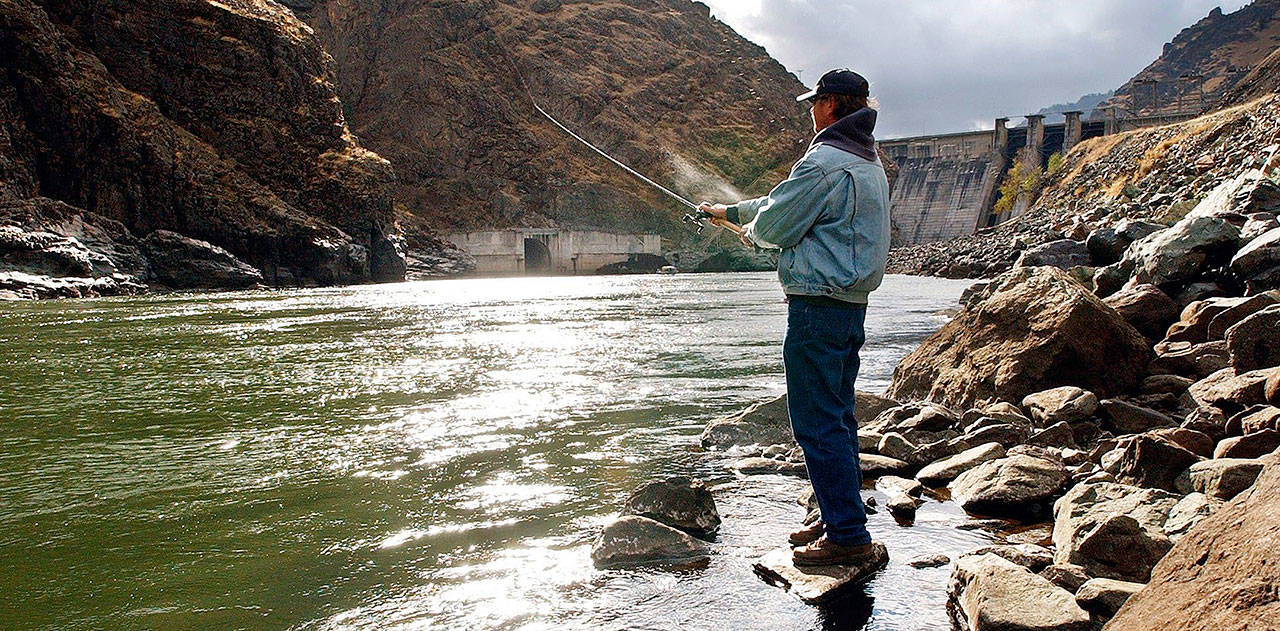
Fisherman Larry McBrom works along the Snake River shoreline below Hells Canyon Dam in southwestern Idaho on Jan. 25, 2006. Authorities have released recovery plans for federally protected Snake River chinook salmon and steelhead with the goal of making sure each species is self-sustaining in the wild. (Darin Oswald / The Idaho StatesmanFile)

Fisherman Larry McBrom works along the Snake River shoreline below Hells Canyon Dam in southwestern Idaho on Jan. 25, 2006. Authorities have released recovery plans for federally protected Snake River chinook salmon and steelhead with the goal of making sure each species is self-sustaining in the wild. (Darin Oswald / The Idaho StatesmanFile)

Recovery plans for Snake River salmon, steelhead released

The final plans were released Tuesday by National Oceanic and Atmospheric Administration Fisheries.

  • By KEITH RIDLER Associated Press
  • Tuesday, December 12, 2017 2:36pm
  • Northwest

By Keith Ridler / Associated Press

BOISE, Idaho — Authorities have released recovery plans for federally protected Snake River chinook salmon and steelhead intended to make sure each species is self-sustaining in the wild.

The final plans released Tuesday by National Oceanic and Atmospheric Administration Fisheries include spring and summer chinook, fall chinook and steelhead. Authorities listed the three runs as threatened in the 1990s.

On a larger scale, the documents will be used by NOAA Fisheries to develop a biological opinion in late 2018 that will direct how federal agencies operate 14 federal dams in the Columbia River Basin to protect salmon and steelhead.

The documents will also be used in creating an environmental impact statement, or EIS, by other federal agencies and ordered by a federal judge in 2016 concerning the 14 dams. The court ruled that the U.S. government hasn’t done enough to improve Northwest salmon runs and ordered the environmental review that’s due out in 2021, urging officials to consider removing four big dams on the Snake River.

NOAA Fisheries in the documents released Tuesday evaluates dam breaching but doesn’t take an official position. In general, the documents say removing the dams could improve runs but by how much varies based on complex factors.

The salmon and steelhead that are the focus of the documents are part of a commercial and sport fishery, and are also important to tribes in the region that hold treaty rights.

In general, federal officials said during a conference call Tuesday, fall chinook are doing better than spring and summer chinook and steelhead.

“We are really on track to recover (fall chinook),” said Ken Troyer, Northern Snake River Branch chief for NOAA. “The challenges are greatest for spring and summer chinook and steelhead.”

The 366-page fall chinook plan identifies three main strategies, and chooses to implement the third one that’s intended to boost the number of naturally reproducing spawning fish in the Snake River below Idaho Power’s Hells Canyon Complex of hydroelectric dams.

The plan says that young fish released in specific areas will return to those same areas to spawn as adults. That, officials say, will help boost the numbers of naturally reproducing fish and eventually lead to a self-sustaining population needed to achieve recovery.

That plan “is the most likely and timely path to recovery,” said Rosemary Furfey, Snake River Recovery Coordinator for NOAA.

The Hells Canyon Complex cut off upstream spawning habitat and in the document is listed as a reason for the decline of the fish. Problems confronting fisheries managers in returning salmon above the dams is that the area is heavily used for agriculture and is too environmentally degraded to support salmon.

“At this time, we recognize that the habitat is not conducive to fish populations and having fish survive,” said Ritchie Graves, Columbia Basin Hydropower Branch chief for NOAA.

Also, Idaho lawmakers previously approved a law preventing the return of listed species to Idaho without the state’s approval. Idaho Gov. C.L. “Butch” Otter has said he doesn’t want listed fish above the dams, which could force expensive habitat restoration.

The 284-page recovery plan for spring and summer chinook and steelhead mainly looks at protecting existing tributary habitat and restoring degraded habitat. Those species travel into the Clearwater River and its tributaries in northern Idaho and the Salmon River and its tributaries in central Idaho. Fish also go into the Grande Ronde River in Oregon.

Troyer said that Idaho has habitat that’s in great shape, but “we see a lot of potential for habitat improvement and fish survival. We don’t know exactly what that is. But I do feel there is a lot left to be done in Idaho.”

The plans released Tuesday are the final two recovery plans from NOAA Fisheries for the Columbia River Basin’s 13 endangered and threatened salmon and steelhead runs.

David Wilson, spokesman for Bonneville Power Administration, said the agency will include the most recent plans in the environmental impact statement and will continue to coordinate with NOAA to recover listed species.

Talk to us

> Give us your news tips.

> Send us a letter to the editor.

> More Herald contact information.

More in Northwest

The Beacon Pacific Village housing complex where Washington Gov. Bob Ferguson announced new proposed housing investments on Thursday, Dec. 18, 2025, in Seattle, Washington. (Photo by Jake Goldstein-Street/Washington State Standard)
Ferguson proposes $244M boost for housing programs

Some of the money will be dedicated to flood recovery. The governor is also starting the process to create a state Department of Housing.

Road damage along U.S. 2 in Tumwater Canyon, in a photo shared by Washington State Department of Transportation on Dec. 16, 2025. (Photo courtesy of WSDOT)
Highway 2 closure across WA’s Cascade mountains expected to last months

Parts of U.S. 2, an important road cutting across Washington’s Cascade mountains,… Continue reading

Masked federal agents arrive to help immigration agents detain immigrants and control protesters June 4 in Chicago. California in September became the first state to ban law enforcement officers from wearing face coverings, in response to immigration raids where federal agents wore masks. (Jamie Kelter Davis/The New York Times)
Ban on police face coverings pitched ahead of WA’s 2026 legislative session

The Trump administration is challenging a similar law passed in California, amid worries over masked immigration agents.

Police are failing to solve most violent crimes in WA

Over 49,000 incidents remain unsolved since 2022, including murders, rapes and robberies.

A Flock Safety camera on Oct. 28, 2025 in Lynnwood, Washington. (Olivia Vanni / The Herald)
Washington lawmakers want to regulate license plate readers

Washington state lawmakers next year hope to rein in law enforcement’s use… Continue reading

Democratic state Rep. Shaun Scott of Seattle (left) is proposing a new payroll tax on large employers in Washington. He took part in a discussion on the state’s tax system during the Budget Matters Summit on Nov. 12, 2025 in Seattle. (Photo courtesy of Washington State Budget and Policy Center)
WA Dems’ latest run at taxing the state’s largest companies

Rep. Shaun Scott’s proposal mirrors an approach Senate Democrats drew up then discarded last session.

Washington Gov. Bob Ferguson appointed Colleen Melody to the state Supreme Court on Nov. 24, 2025. Melody, who leads civil rights division of the state Attorney General’s Office, will assume her seat following the retirement of Justice Mary Yu at the end of the year. (Photo by Jerry Cornfield/Washington State Standard)
Gov. Bob Ferguson makes his pick for WA Supreme Court seat

Colleen Melody, who leads the civil rights division at the state attorney general’s office, will succeed Justice Mary Yu, who is retiring.

Jsason Phipps of the City of Mount Vernon tightens straps on the flood wall along the Skagit River in downtown Mount Vernon on Thursday. The river is forecast to crest on Friday morning after several days of heavy rain pushed waterways in the region to record levels. (Grant Hindsley/The New York Times)
Record flooding forces rescues across Western Washington

Waterways crested at record levels in several flooded small towns across western… Continue reading

Florida Lt. Gov. Jay Collins, left, participates in the extradition from California of Harjinder Singh, accused of causing a crash that killed three people in Florida. (Photo via Collins’ X account)
WA erred in granting hundreds of commercial driver’s licenses to noncitizens

The issue has flared up after a fatal truck crash in Florida earlier this year.

The state ferries Klahowya (center right) and Hyak (left center) are taking up valuable space at the Eagle Harbor maintenance yard of Washington State Ferries. Both retired ferries have been for sale for more than four years. (Photo by Tom Banse for Washington State Standard)
For sale: Two retired state ferries. Dreamers need not apply

The vessels are lingering on the market as Washington State Ferries scrutinizes potential buyers. Past purchases haven’t always ended well.

Washington began selling a specialty plate honoring Pickleball on Nov. 19, 2025. This is a sample of a personalized plate. (Seattle Metro Pickleball Association)
It’s an ace. Pickleball gets its own Washington license plate

The design celebrates the state’s official sport. Other new plate designs are on the way.

Gov. Bob Ferguson signing Senate Bill 5480, a bill exempting medical debt from credit reports, on April 22. (Photo by Jacquelyn Jimenez Romero/Washington State Standard)
WA’s new ban on medical debt in credit reports at risk of federal override

The Trump administration wants to reverse Biden-era guidance on the issue.

Support local journalism

If you value local news, make a gift now to support the trusted journalism you get in The Daily Herald. Donations processed in this system are not tax deductible.



















