The man who had an Asian giant hornet nest near his house
Published 1:30 am Monday, November 2, 2020


By Kie Relyea / The Bellingham Herald
BLAINE — Jaime Polinder drove past the Asian giant hornet nest in the cavity of an alder tree on his property plenty of times. His house was about 100 feet from it, his children’s playset about 40 feet. The kennel for his two Labs was about 50 feet away.
And, yet, neither he nor his wife Michelle knew the nest — the first nest of the invasive hornets to be found in the U.S. — was on their property off of Burk Road, southeast of Blaine, until state entomologists discovered it in October and told them.
“It’s the luck of the draw in year 2020, I guess,” said Polinder, a seed-potato farmer for Dick Bedlington Farms in Lynden.
“We had never spotted one ever,” Polinder said of the hornets, which are popularly known as “murder hornets.” “We’d never seen one and I’m always outside, always in that area all the time.”
Washington State Department of Agriculture entomologists destroyed the nest early on Saturday, Oct. 24. They removed 98 hornets from the site over two days that weekend.
They found the nest after they captured live hornets, tied radio trackers on them and followed one back to the Polinder property on Thursday, Oct. 22.
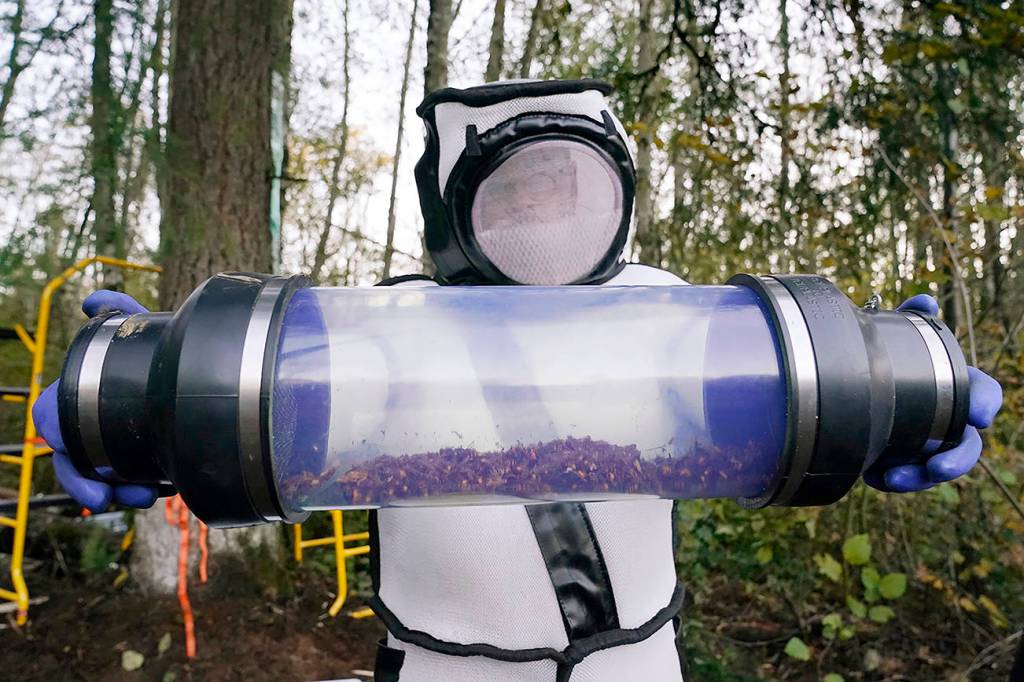
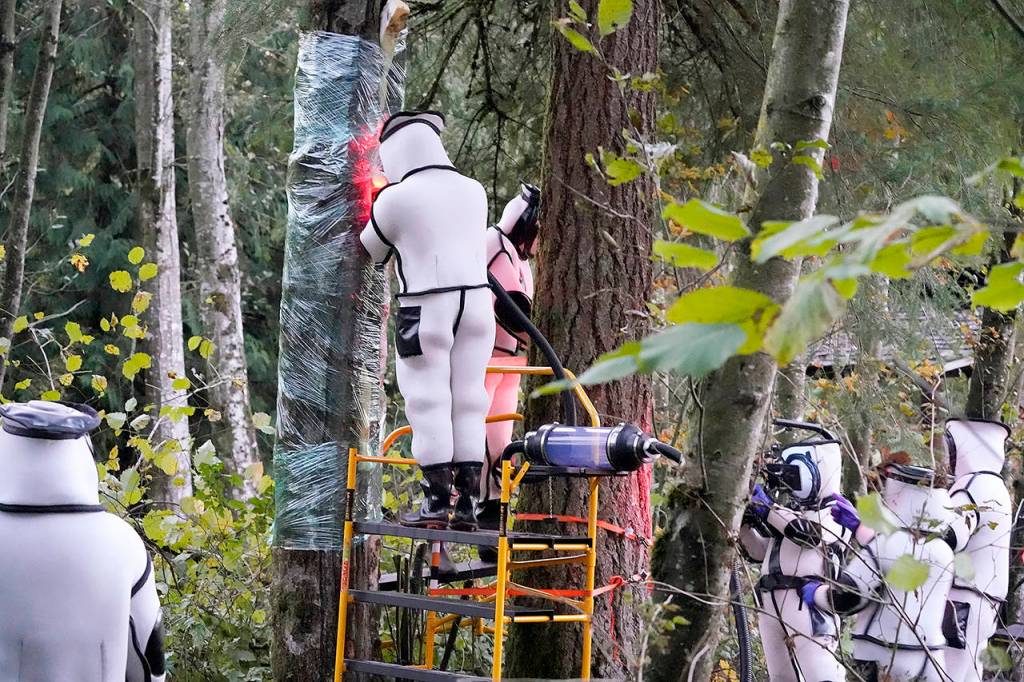
On Saturday, Oct. 24, the 31-year-old Polinder watched as scientists pulled on thick suits to protect themselves against being stung and worked in frigid temperatures to remove the nest, which involved sealing the tree with foam, vacuuming out live hornets and then pumping carbon dioxide into the tree.
A camera crew from the Discovery channel also was there and Polinder was told the segment would air sometime in December.
“It was so cold they weren’t moving at all Saturday morning,” he said of the hornets. “It was perfect conditions to do it as far as I’m concerned.”
Scientists said they weren’t stung during the nest removal, crediting the cold temperature for the hornets’ docility.
On Wednesday, Oct. 28, Polinder watched again as general contractor J.T. Muenscher cut down the tree that held the nest, allowing scientists to study what was inside.
Videos posted by the state agency on Wednesday showed two queens, possibly a virgin queen and the mated queen that had established the nest.
Additional live hornets also were found in the nest, even though scientists previously believed they had killed them all after pumping carbon dioxide gas into the tree on Saturday, Oct. 24, as part of their work to destroy the nest, and then again on Thursday, Oct. 29, after they opened up the tree to study the nest.
“They do seem fairly resistant” to the gas, said Karla Salp, spokesperson for the state agency, adding that the hornets may have managed to live because they emerged from their protective cells in the nest after carbon dioxide was pumped into the tree.
The Asian giant hornets were more resistant to the gas than bald-faced hornets, which died when entomologists tried to sedate them with the gas during the summer as they experimented with attaching trackers to them in preparation for the fight against Asian giant hornets, according to Salp.
Asian giant hornets were first found in Whatcom County in winter 2019, representing the first detection in Washington state and the U.S.
The state is racing to trap them and find their nests to prevent the hornets from spreading outside of Whatcom County to the rest of Washington and the U.S. The hornets also have been found just over the Whatcom County border, in British Columbia, Canada, including in Langley in spring.
On Thursday, Oct. 29, when they opened up the tree at the Washington State University Puyallup Research and Extension Center to study the nest, scientists found additional hornets, including more queens, according to Salp.
The video posted on Thursday showed larvae as well as individual cells that were white with some adult hornets looking like they were nearly ready to emerge. Salp said they hoped they got to the new queens before they left the nest, but they don’t know that for certain.
Queens can create new nests.
An analysis of the nest and its contents will include determining how many queens, drones and workers were in there, Salp said to The Bellingham Herald.
Scientists also found in the nest the radio tag they had tied, using dental floss, onto the Asian giant hornet that led them to the nest. “It appeared to have been chewed off,” they said on a blog post.
Agriculture officials also will record the size of the nest, and will post their data online at agr.wa.gov/hornets.
State officials believe there could be three more nests in Whatcom County, based on their trapping efforts this year. They will continue to set traps through November at least.
Nests usually last a year and the hornets that remain in them generally die.
Up to 2 inches long, the Asian giant hornet, or Vespa mandarinia, is the world’s largest hornet species. They are identifiable by their large yellow/orange heads. Their native range is Asia.
The hornets are known for their painful stings. They will attack people and pets when threatened. People should be extremely cautious near them, agriculture officials said, and those who have allergic reactions to bee or wasp stings should never approach an Asian giant hornet.
Asian giant hornets are feared for the threat they pose to honeybees and, by extension, the valuable crops in Washington state that the bees pollinate They also prey on local pollinators such as wasps, posing a threat to the local ecosystem.
They usually nest in the ground.
As for Polinder, he was philosophical about the first Asian giant hornet nest being found in a tree on his property.
“You take what life throws you is what I say. You’ve got to make the best out of every bad situation,” he said, before adding of the hornets: “Keep an eye out for them.”
Report hornets
State agriculture officials say each report leads them closer to finding a nest as it did with the nest destroyed Saturday southeast of Blaine.
Make reports at agr.wa.gov/hornets, which is preferred, and hornets@agr.wa.gov, or by calling 800-443-6684. Officials said it’s more important at this time of year to track the hornets or capture them while they’re alive instead of killing them.
When reporting, note the direction the hornets fly, which helps in tracking efforts.
An emergency line also has been set up for Washington state beekeepers to immediately call when they see their hives being attacked by Asian giant hornets. That phone number is 360-902-1880.