By Seth Perlow / Special To The Washington Post
At presidential inaugurations, important people in important outfits gather for something momentous: the transfer of power. When a poet gets invited to such events, it is not always clear how they can contribute. Poets specialize in grand pronouncements, but inaugurations feel so starchy that it’s hard to enjoy what even the best writers offer up on these occasions. Such was the hurdle that 22-year-old poet Amanda Gorman faced, and completely dismantled, at the Biden-Harris inauguration.
No matter which president they help to celebrate, all inaugural poets face the same unforgiving task. Writing in a genre that many associate with the intimacies of love and grief, they seek to mingle uplifting political maxims with sweeping pictures of the national situation; but without devolving into meaningless abstraction or alienating too many citizens who voted for the other guy. No inaugural poet has truly flopped, but these constraints have led to more than a few trite images and tired metaphors. There’s a road we all walk together, or else a majestic mountain range, or a door of opportunity opening for a child.
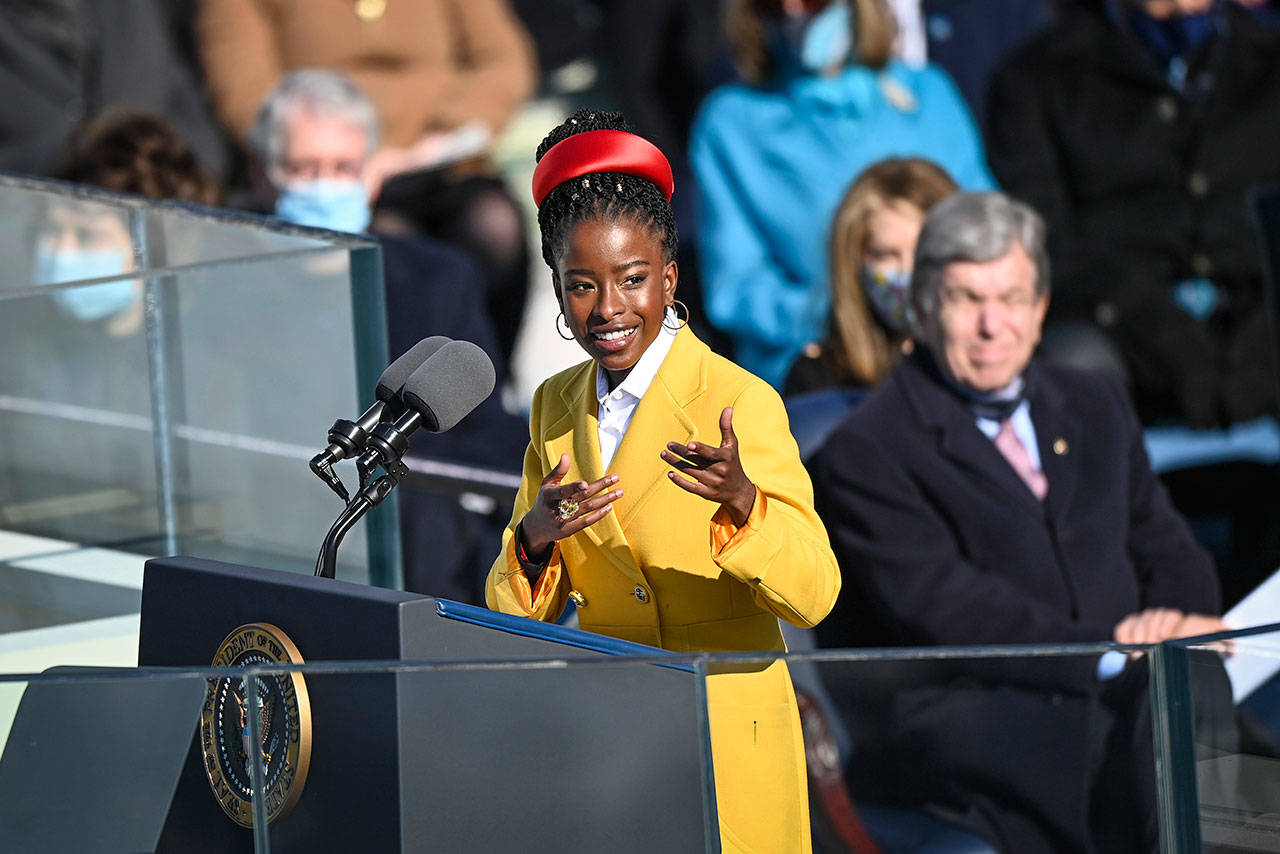
“The Hill We Climb” contains as many of these generic Americanisms as the rest, from the rhetoric about healing divisions to the promise that “there is always light,” always hope, “if only we’re brave enough to see it.” Despite the cliches, Gorman distinguished herself by performing with remarkable dynamism and grace. Instead of merely reading her poem from the page, she brought the language to life. Her delivery made poetry a more vital, stirring part of the ceremony than it usually is.
Gorman drew upon the contemporary style of spoken-word poetry, which emphasizes the rhythms and rhymes of the poet’s voice as she speaks. Spoken-word poets treat poems as performances, rather than texts for silent contemplation. Many people learn in school to read poems like regular prose, without pausing at line breaks or stressing the rhymes, but spoken-word poets do the opposite, foregrounding the rhythmical, musical qualities of language. This approach works perfectly for an inauguration: It makes a poem an event in itself, something we experience together.
Her poem is rich with audible wordplay: “We’ve braved the belly of the beast. / We’ve learned that quiet isn’t always peace, / and the norms and notions / of what ‘just is’ / isn’t always justice”; and the striking energy of her voice conveyed the power of her message. Others have noted that Gorman had not finished the poem on Jan. 6, when Trump’s terrorists attacked the Capitol, and have praised her for not shying away from conflict. But what really makes the poem sing is its sound. Our ears easily catch the rhymes of “beast” with “peace” and “just is” with “justice,” as well as the alliterations of “braved … belly … beast” and “norms and notions.” All this aural play enabled Gorman to perform the poem, rather than merely recite it. Every previous inaugural poet has moved their hands only to turn pages. She gestured expressively as she spoke, instead of clamping onto the lectern.
Only six U.S. presidential inaugurations have included a poetry reading. The first was Robert Frost’s reading at the inauguration of John F. Kennedy in 1961. Frost had written a poem for the occasion, “Dedication,” but the sun’s glare on the snow prevented the 86-year-old poet from reading the text. He instead recited a different poem, “The Gift Outright,” from memory. Both poems deliver a Eurocentric, colonialist message that today’s audiences would rightly criticize. Many have praised Frost for his grace under pressure, but I suspect that “Dedication” would have made a better impression because it rhymes a lot: “Come fresh from an election like the last, / The greatest vote a people ever cast, / So close yet sure to be abided by, / It is no miracle our mood is high.” Like parts of Gorman’s poem, these lines sound almost cloying when we read them silently; but a great delivery can imbue words with conviction, even a sense of spontaneity.
After Frost, no poet read at a presidential inauguration until 32 years later, when Maya Angelou recited “On the Pulse of Morning” at Bill Clinton’s first swearing-in. Angelou is the only inaugural poet whose delivery comes near to Gorman’s. She sounded careful and deliberate at first, with a tone of declamation that underscored the size of her audience, the 800,000 present in person and the almost 30 million watching at home. But as Angelou gained confidence and momentum, she placed more emphasis upon the galloping rhythms of her words: “Here, on the pulse of this new day / You may have the grace to look up and out / And into your sister’s eyes, and into / Your brother’s face, your country / And say simply / Very simply / With hope / Good morning.” (In a possible nod to Angelou’s theme of morning, Gorman’s poem begins, “When day comes.”)
Since Angelou, every inauguration of a Democratic president (and no inauguration of a Republican) has included a poetry reading. Barack Obama’s first swearing-in featured Elizabeth Alexander, whose “Praise Song for the Day” remains my favorite inaugural poem. Alexander builds from evocative details to a moving crescendo. Near the start, we hear that “Someone is stitching up a hem, darning / a hole in a uniform, patching a tire, / repairing the things in need of repair.” By the end, Alexander speaks not of everyday acts of care but of what drives them, of “Love beyond marital, filial, national, / love that casts a widening pool of light.” Her poem is a “praise song for walking forward in that light.” As a written text, Gorman’s poem might not hold up as well as Alexander’s, but the younger poet’s performance clearly stands out. While her predecessors read in a staid, academic style, Gorman animated the language, more like a preacher or, indeed, a politician. (Gorman says she intends to run for president in 2036.)
Gorman’s spoken-word style reflects her personal story. An African American from Los Angeles, she was named the first national youth poet laureate in 2017, at age 19. Like President Biden, she has experienced a speech impediment; she cites that and an auditory processing disorder as increasing her sensitivity to the sounds of language. The spoken-word performance style draws upon multiple African American traditions, including hip hop and church oratory. Spoken-word poetry is also quite popular among the young people whom one might expect a youth poet laureate to reach. My students sometimes send me links to spoken-word videos on YouTube or Tik Tok, asking how these relate to the more conventional poets I usually study and teach. I am not always sure how to answer, but Gorman’s performance suggests that spoken-word techniques can help to increase poetry’s stature and spread its joy to broader audiences.
It is a truism among academics that poetry is foremost an art of the spoken word, but we rarely live up to this ideal. Yes, the inaugural poems by Angelou, Alexander and the rest exhibit beautiful aural effects. But so many of our encounters with poetry are silent and solitary. We read the assigned poems in private. If we like them, perhaps we bristle as a fellow sophomore botches the recitation in class. This buttoned-up style has dampened every inaugural poetry reading; until now. With her exceptional performance, Gorman reminds us how poetry, delivered well, can enrich public life.
Seth Perlow teaches English at Georgetown University. He is the author of “The Poem Electric: Technology and the American Lyric.”
Talk to us
> Give us your news tips.
> Send us a letter to the editor.
> More Herald contact information.