
By The Herald Editorial Board
Unsurprisingly, federal agents working under the Department of Homeland Security — specifically those participating in immigration operations, such as Immigration and Customs Enforcement and Customs and Border Patrol in Minneapolis and other major U.S. cities — are facing significant public push-back, if not regarding their mission then plainly because of their tactics.
Along with the recent shooting deaths of U.S. citizens Renee Good and Alex Pretti in Minneapolis, DHS’s federal agents are facing criticism over less-lethal but still heavy-handed tactics that have victimized people regardless of citizenship or legal status.
A New York Times poll taken after Good’s shooting but before Pretti’s showed that 61 percent of more than 1,600 registered voters said that ICE agents had gone too far, including 71 percent of independents, even as 50 percent of respondents said they approved in general of the Trump administration’s deportations of those living in the country without documentation. Only 19 percent of Republicans in that poll said ICE had gone too far.
Following Pretti’s death however, another poll, this at request of Sen. Tom Cotton, R-Ark., saw a shift among Republicans. The America One Policies PAC poll said 41 percent of its respondents said they supported continuation of immigration enforcement but felt “ICE’s tactics need to be toned down to avoid unnecessary harm and confrontation.” Of the poll’s Republicans and independents, 88 percent agreed with the statement.
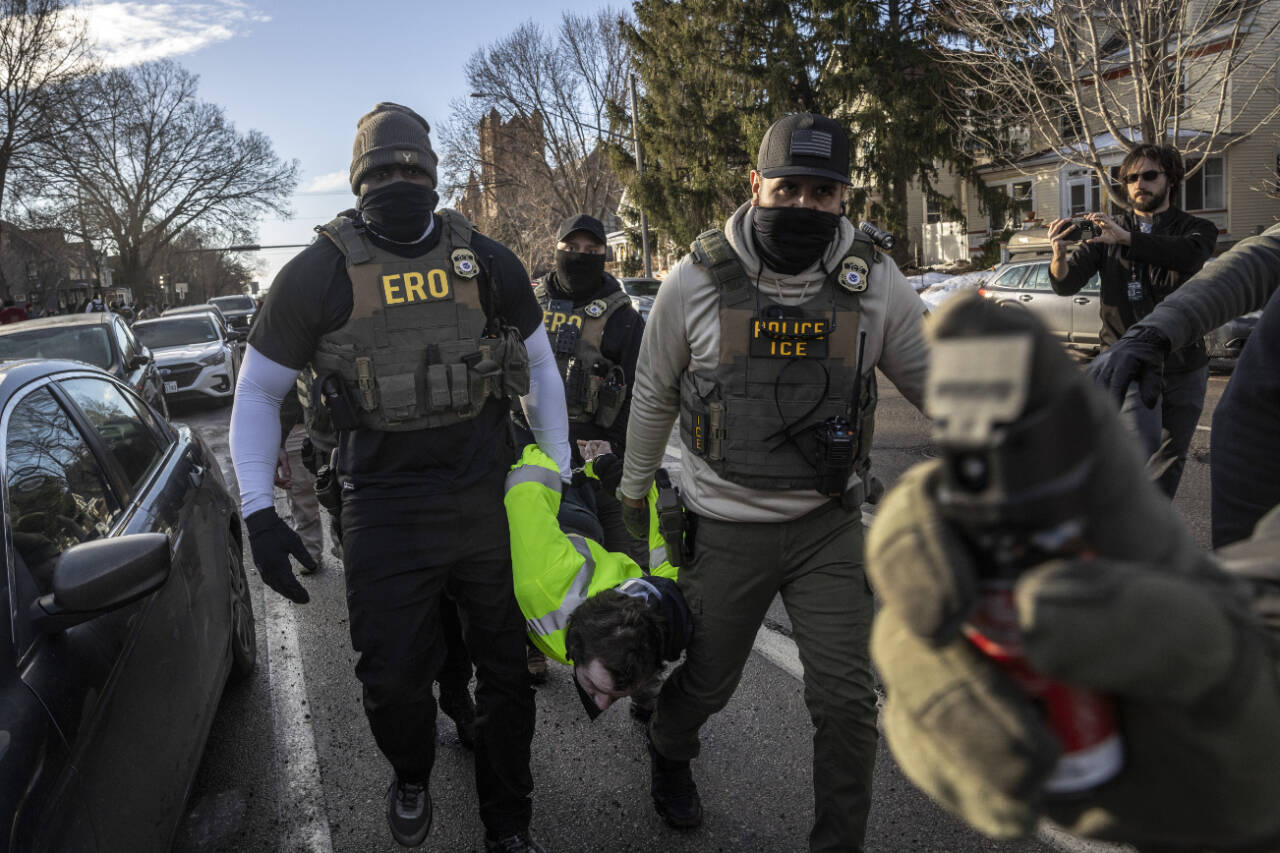
Beyond ample instances of brutality, what’s adding to public discomfort is the routine avoidance of accountability displayed by those federal agents, specifically the lack of personal identification and the use of face coverings.
A Pew Research Center poll in late January found that 61 percent of respondents said it is unacceptable for officers to wear face coverings that conceal their identities while patrolling communities.
That sentiment was echoed last week in a vote in the state Senate on legislation that would prohibit local, state and federal law enforcement officers from wearing face coverings while interacting with the public. The vote in the Senate, 30-19, was along party lines, with no Republican votes in support, moving the bill on to consideration by the House.
The objections from Republicans, law enforcement officials and others weren’t arguing against accountability, but instead raised concerns for unintended consequences, specifically for state and local law enforcement who do routinely wear identification and don’t wear masks.
“Holding officers accountable for wrongdoing requires us to know who did the wrong,” James McMahan, policy director for the Washington Association of Sheriffs and Police Chiefs, said during a Jan. 13 hearing before the Senate’s law and justice committee. McMahan noted that state law already requires officers be reasonably identifiable. What the association objected to, he said, was the lack of recognition for the unanticipated need for officers to use masks in certain situations, including frigid weather.
Along with barring masks, the legislation would allow anyone arrested or detained by a masked officer to sue for damages, McMahan said, suggesting the bill be amended to allow such lawsuits only when officers weren’t otherwise wearing identification.
That exception, among others, was adopted in the bill that passed out of the Senate.
And along with other exceptions — including for masks worn to avoid transmission of a contagious disease or exposure to hazardous materials; or the gear worn by special weapons and tactics teams and helmets worn by motorcycle or bicycle officers — there may be instances not yet identified that could still be added to the legislation.
But one objection raised by some in the Jan. 13 hearing centered more on the apparent threat posed to law enforcement if officers are forced to drop their masks.
“The bill recklessly endangers the lives of the members of our law enforcement community and their family members,” said Pete Serrano, assistant U.S. attorney for the state’s eastern district, noting recent claims by DHS that ICE officers were facing a 8,000 percent increase in threats against them and a 1,300 percent increase in assaults.
No doubt there have been threats and attacks against federal immigration agents, but there are doubts about the extent and seriousness of many of those reports.
The Brennan Center for Justice noted than a earlier claim by ICE of an 8,000 percent increase in threats counted not just threats but any statement against ICE. Only four examples of threats were cited by DHS in an August report.
Likewise, the Los Angeles Times reviewed thousands of pages of court records and found that the percentage increase in assaults was misleading, pointing out that the majority of assaults resulted in no injuries, similar to the incident in August where a protester in Washington, D.C., threw a submarine-style sandwich at a border patrol agent. The man was found not guilty of misdemeanor assault in November.
Again, serious threats and assaults against federal agents have certainly happened, but such incidents are within the capability of law enforcement at the appropriate level to address with investigations and the filing of charges where necessary.
Allowing federal agents to continue to mask up — along with harming their own accountability with the public — threatens to sour public opinion against all law enforcement, especially when some law enforcement officials attempt to score political points. During an earlier hearing in the House regarding legislation to set standards for candidates for county sheriffs, Pierce County Sheriff Keith Swank told lawmakers that if the mask ban were adopted he would encourage his deputies to wear masks, “just to see what you do” to enforce the ban.
Law enforcement is an exceedingly difficult job, and it’s one that depends on the public’s support and the accountability of officers. Reasonable identification of officers is key to that accountability.
Congress, as it negotiates a deal to end the partial government shutdown, may also require federal agents to end the use of face coverings, but state lawmakers shouldn’t count on Congress to pass such a measure of for the Trump administration and a performative Department of Homeland Security and Secretary Kristi Noem to respect a ban.
A state law, allowing lawsuits against those who wear face masks without properly identifying themselves, remains in the interests of the public and law enforcement.
Talk to us
> Give us your news tips.
> Send us a letter to the editor.
> More Herald contact information.
























