
By The Herald Editorial Board
It might not register as high drama among those who enjoy a good courtroom scene in television or movies, but U.S. Supreme Court oral arguments have their followers when a case involves constitutional questions regarding rights, duties or economic concerns.
On the docket here, recent oral arguments before the high court could determine the constitutional power of the president to use the specific tool of tariffs that are set against other countries but ultimately paid by American consumers.
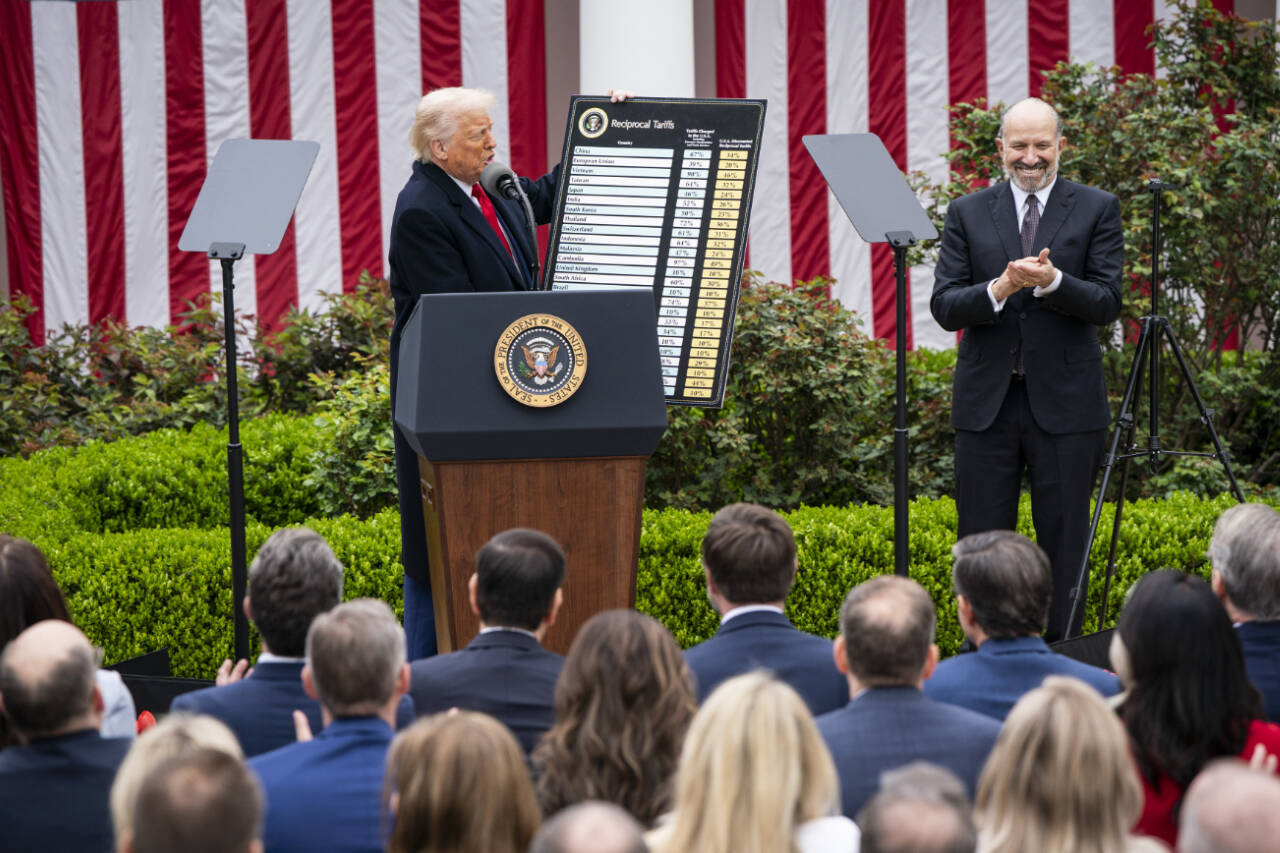
Specifically, the court’s justices questioned attorneys for each side Nov. 5, regarding President Trump’s “Liberation Day” tariffs, announced April 2. In setting those tariffs, Trump cited the International Emergency Economic Powers Act adopted by Congress in 1977 to impose a base of 10 percent tariffs, then adding country-specific rates, declaring an emergency to regulate trade.
The court now has to determine if that act, specifically the words “regulate … importation,” assumes the power to impose tariffs, although not specifically mentioned in the act.
Although justices’ questions and comments during oral augments don’t carry the force of a ruling, they can signal the court’s thinking in coming months, and the general agreement is that two or three of the court’s conservative justices could join its three liberal justices to rule against the president and negate the specific tariffs.
Among those watching the court are those who also closely watch issues of trade for Washington state, including Lori Otto Punke, president of the Washington Council on International Trade, the Northwest’s leading association advocating for trade and investment policy.
State of trade: Washington is dependent on trade. About 40 percent of jobs in Washington state — manufacturing, food and agriculture, retail, technology and science — are tied to international trade. In recent years, according to the WCIT’s online trade dashboard and other reports, exports from Washington, joined with those from Oregon, totaled more than $135 billion and supported 900,000 jobs in Washington and another 500,000 in Oregon.
A report by the state Office of Financial Management, released in September, forecasts the following effects if Trump’s “Liberation Day” tariffs are implemented and maintained through 2029:
• A 16 percent increase in grocery prices over the coming two years;
• A 20 percent to 25 percent increase in prices for used cars; and 6 percent to 8 percent increases for new vehicles over the next two years;
• A loss of 31,900 jobs in the state by 2029, with agriculture, food processing and aerospace as the hardest hit job centers;
• A $2.2 billion reduction in general fund revenue for the state by 2029 because of reduced sales and business activity; and
• Slower growth in the state’s gross domestic product, about 1.2 to 1.8 percentage points lower through 2029.
Trading partners: As well, the tariffs, imposed and threatened, imperil past trade deals, including the three-nation deal Trump signed with Canada and Mexico in 2020 that renegotiated the earlier NAFTA pact. If the USMCA doesn’t hold, businesses and their employees in Washington state can expect reduced demand for their exports to Canada, Mexico and China, as they levy their own surcharges on Washington-made products and services in retaliation.
Washington’s $7.9 billion in exports to Canada in 2024 — the state’s No. 2 export market — included electricity, aircraft and parts, fuel oil, paper, fruit, other produce and fish and seafood. For the state’s largest export market, China, Washington sold $12 billion in goods in 2024, representing 21 percent of the state’s worldwide exports, followed by Canada, Japan at $5 billion and Mexico at $4.3 billion.
No silver bullet: Yet, Otto Punke is realistic that even a ruling that limits the president’s powers to set tariffs won’t be a cure-all for trade in the state or the nation.
“I don’t know that it’s going to be a silver bullet in terms of fixing the bigger issues and challenges here,” she said in an interview this week.
Most Washington residents understand trade at a basic “apples and aerospace” level, Otto Punke has previously told The Herald. But the products and services leaving Washington — as well as other U.S. goods that transit through the state’s airports and maritime ports — represent a broadly diversified economy, including forest products, high technology, clean tech, medical equipment, military equipment, food and agricultural products, beer, wine, spirits and more.
Tariffs as a multi-tool: Trump has defended his tariffs with a range of justifications, including international pressure to push for increased efforts against the smuggling of fentanyl into the country, correcting the United States’ trade imbalance with other nations and raising revenue for the federal government.
Regarding Trump’s oft-repeated concern about an imbalance in trade, in recent years Washington had been a net importer after 2019, according to WCIT’s Northwest Trade Dashboard, but turned that around in the fourth quarter of 2023 with more than $1 billion in exports over imports, mostly from transportation and agriculture.
And while Trump’s Liberation Day tariffs have brought in an estimated $195 billion though Sept. 30, the president may have already “spent” many times over what’s come in.
Trump has, in comments and posts to social media, earmarked those funds for financial aid to farmers, paying down the national debt and most recently providing $2,000 payments to low- and middle-income Americans. The tariff dividends alone could cost the federal government $600 billion a year, according to the Committee for a Responsible Federal Budget.
Those pledges are likely to conflict with the expectation, that if the Supreme Court rules against his Liberation Day tariffs, that revenue would have to be returned to those who paid those taxes, namely importers and businesses.
“I thought it was interesting that the solicitor general (who represented the Trump administration during the Supreme Court’s oral arguments regarding the case) was kind of saying, ‘Oh, it’s not really about the revenue,’ that it’s just dealing with a national emergency,” Otto Punke said.
Other options for tariffs: Yet even if the Supreme Court rules against the emergency powers act as a route for tariffs, said Otto Punke, it won’t reverse other tariff tools or prevent Trump from finding another path to put the same pressure on U.S. trading partners.
Trump use of IEEPA provided him more latitude because other tariff tools require more study, negotiation and buy-in from Congress. Using that law allowed him to move ahead without Congress, which in recent decades has been inclined to delegate more tariff and trade responsibility to the executive branch.
That may be changing, Otto Punke said.
“I do feel like Congress is going to start demanding that they pay the proper role they have,” she said. And she hopes to see trade and tariffs become an election issue for the midterm congressional election and for the 2028 election.
May it please this court: There’s yet another court that also is considering arguments: the court of public opinion.
“I do think that you are starting to see the administration grow in its concern in terms of the economy,” she said.
What might have a more profound impact on Trump’s tariff policies, she said, is the reaction of Americans paying for those tariffs in higher costs for goods and services, regardless of whether they’re domestic or imported
Americans tend to vote their pocketbooks, she said.
“If that tariff policy is negatively impacting that, maybe the president is willing to negotiate a few more of these agreements with other countries and pull back from using that as a blunt instrument,” she said.
A better path, Otto Punke said, would concentrate on agreements and regulatory barriers and look to improve conditions for U.S. businesses and manufacturing.
“That would be a really nice carrot to help revive American manufacturing and American business,” she said. “Tariffs are a big stick. There’s not a lot of carrot in that.”
Talk to us
> Give us your news tips.
> Send us a letter to the editor.
> More Herald contact information.
























