
By The Herald Editorial Board
Washington state officials and its Department of Ecology appeared surprised by an announcement last week from the federal Environmental Protection Agency that some might have assumed would be viewed as a victory in those officials’ eyes; essentially, the EPA declared “you were right; we were wrong.”
Instead of celebrating the decision, Gov. Jay Inslee, Attorney General Bob Ferguson and Ecology Director Maia Bellon were critical of the EPA’s plans to rescind an Obama-era directive that required the state to set more stringent standards for water quality than the state had established in 2016. In a joint statement, Inslee and Ferguson warned that the EPA was risking “almost certain litigation;” not an idle threat from an attorney general who is the lead attorney on 13 lawsuits against the Trump administration and has joined 24 others by other states’ attorneys general and has yet to lose a case.
What gives?
This all relates to the back-and-forth between the state and the Obama administration to update what’s known as the Clean Water Act’s “fish consumption rule,” intended to set a level for pollutants in water — and seafood — that would allow an average person a certain amount of daily consumption of water and fish that would not increase that person’s risk of cancer beyond 1 in 1 million.
Previously, the standard was based on a fish-consumption rate of just 6.5 grams a day, about four fish sticks a week. The new standard is a generous but more realistic 175 grams daily, about a 6-ounce serving.
Washington state and its Department of Ecology went to the effort to set 192 “human health criteria” for 97 pollutants, only to be told by the EPA in late 2016 that it had approved only 45 of the state’s criteria while rejecting 143 and deferring action on another four. Among others pollutants, the EPA wanted tougher standards for PCBs, mercury and arsenic. The EPA standard for PCBs, for example, was 25 times more restrictive than the state’s.
The Department of Ecology was working on implementing those more stringent standards when it was told last week: never mind.
If state officials weren’t celebrating, others, particularly among industry, business groups and local governments were. A coalition of those groups, following the EPA’s 2016 decision, had petitioned the EPA to reverse its decision and accept the state’s water quality criteria, particularly because the state’s initial rule, while still protective of water quality, was within the ability of industry and local governments to meet.
Industries, among them pulp-and-paper mills and wood-product companies, estimated the EPA standards for PCBs alone would increase the compliance costs for 73 major water-discharge permits from $6 billion to $11 billion. And because local governments are often at “the end of the pipe” and responsible for treating wastewater, complying with the EPA standards for PCBs, arsenic and mercury could cost those cities and counties in Western Washington as much as $7.4 billion to upgrade wastewater treatment plants, The Lens reported in November, 2016.
Even then, that level of spending would likely still fall short because technology isn’t currently available that would meet the EPA’s original criteria for pollutants.
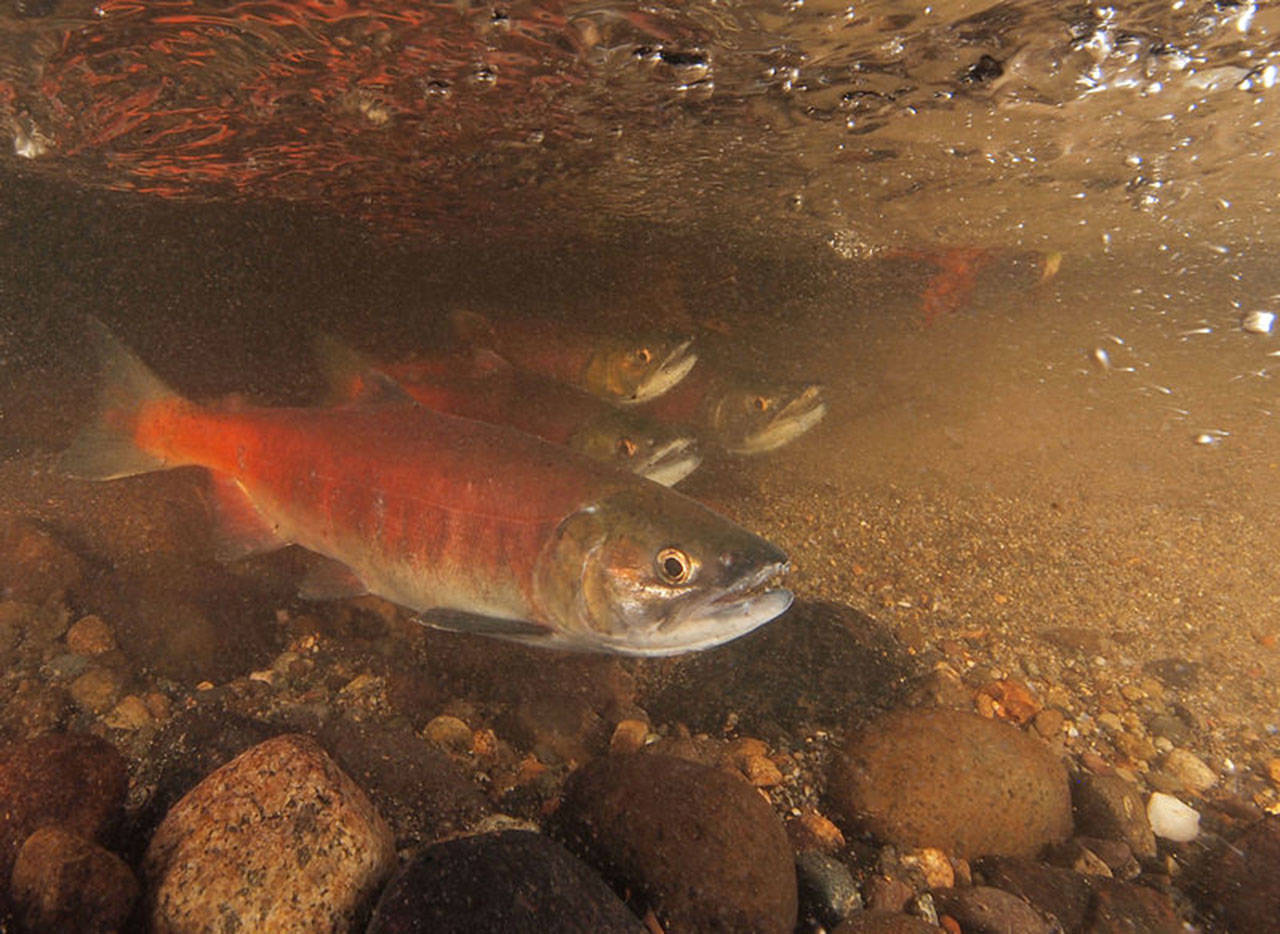
In the two years since the EPA’s initial decision, the concern regarding pollution and water quality — in particular for the state’s Southern Resident orcas and the salmon on which they (and we) feed — has only grown and explains why Inslee and others would want to hold everyone to a higher standard than even they first sought.
But their other complaint is that the EPA reversed itself without consulting the state or its Native American tribes before announcing this rule change.
“Like all federal agencies, the EPA has a legally binding trust responsibility to the tribes that requires government-to-government consultation and the protection of tribal treaty rights and resources,” Lorraine Loomis, chairwoman of the Northwest Indian Fishers Commission, told The Seattle Times. “They are not living up to this responsibility that is rooted in the U.S. Constitution.”
It’s that same lack of due diligence by the Trump administration — termed “quick and dirty deregulation efforts” by law professor Jonathan Adler in the National Review — that has tripped up most of its attempts to repeal, modify or delay rules adopted during the Obama administration and earlier. Of 41 court outcomes over challenges to Trump administration deregulation efforts — mostly over EPA orders — the federal government has been successful in only three, according to a running tally of cases by New York University’s Institute for Policy Integrity; 38 have been unsuccessful.
Where the Trump administration has failed at deregulation, it has largely been on the grounds that agencies had not followed the procedures long required to change rules, the Brookings Institution reported last fall.
Two years ago, The Herald Editorial Board argued that the state of Washington was in the best position to write the rules that would protect water quality, public health and the environment, especially when it looked as if the Trump administration intended to gut the whole of the Clean Water Act and the EPA’s budget to boot. That opinion hasn’t changed.
But now the threat has become those ham-fisted federal agency attempts at deregulation, which have had the result of creating confusion and uncertainty for states, citizens, businesses and the nation’s interests.
Throughout the process to update the fish consumption rule, the Department of Ecology and state and tribal officials had shown a willingness to work with the Obama-era EPA, an openness to work on new regulations that likely would have been extended to Trump’s EPA; had current EPA officials only asked.
Talk to us
> Give us your news tips.
> Send us a letter to the editor.
> More Herald contact information.