MONROE — When you’re training dogs, you have to focus outward on another being, explained one prisoner at the Monroe Correctional Complex.
After a while, you no longer feel like you’re making a conscious effort to stay positive, James said. It just happens.
“You can’t afford to just be a miserable guy in a cell doing time,” he said.
(The Department of Corrections directs media not to publish full names of certain prisoners if victims have registered with the department.)
One morning in February, a handful of dogs joined over a dozen prisoners, dressed in uniform beige pants and gray sweatshirts, for their weekly training class. In a visiting room full of tables and blue padded chairs, the incarcerated students listened intently to their instructors. The dogs, in green vests, were mostly attentive too — and sometimes made themselves known with a bark.
Since 2010, incarcerated men in Monroe have helped train the service animals, guided by dog trainers from Sue Meinzinger’s nonprofit, Summit Assistance Dogs. The dogs live with their incarcerated handlers at the prison for this part of their training.
Meinzinger founded the nonprofit in 2000, as a way to provide mobility service dogs to disabled clients for free.
“I liked the idea of serving incarcerated people and felt that it would be a huge benefit to them and to society,” Meinzinger said.
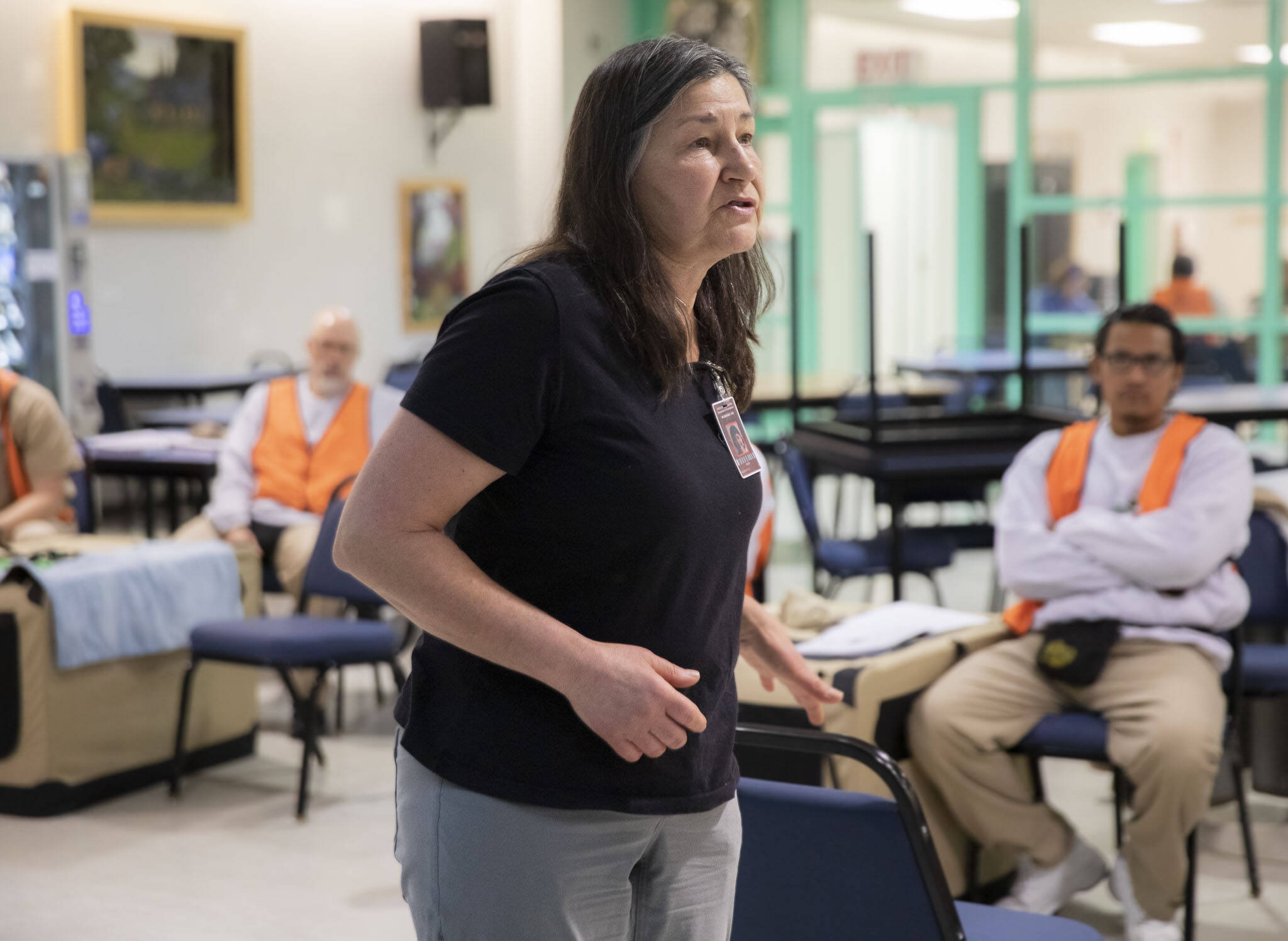
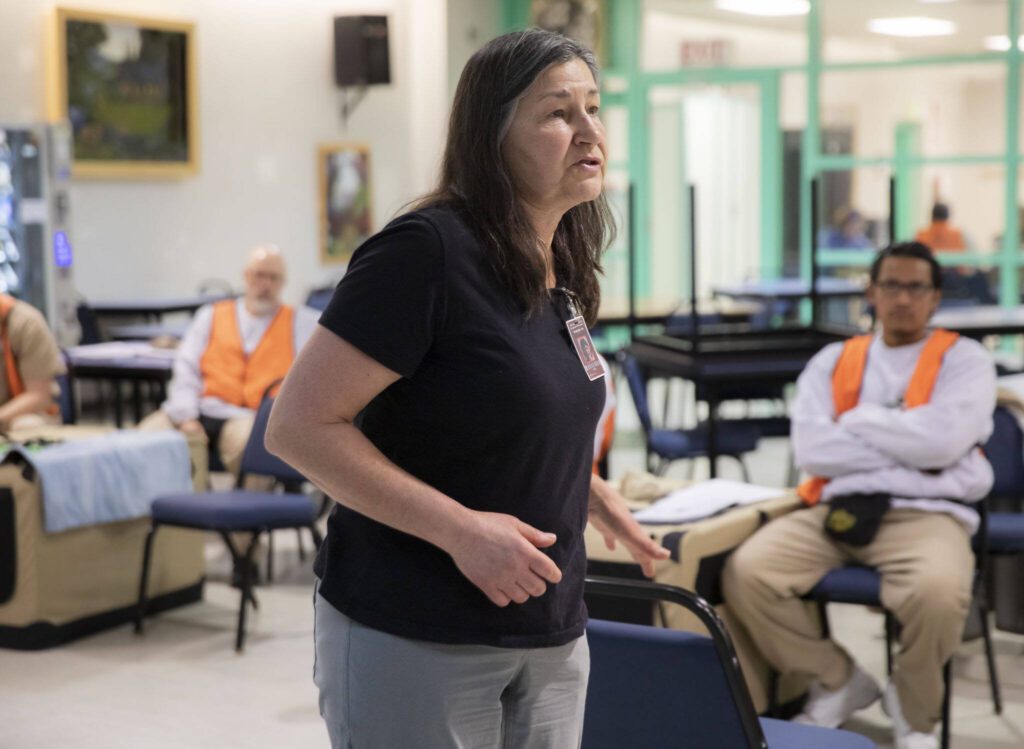
Sue Meinzinger, the founder and executive director Summit Assistance Dogs, talks prisoners through the first training exercise of the day during a weekly meeting of the Summit Assistance Dogs program at the Monroe Correctional Complex on Tuesday, Feb. 6, 2024 in Monroe, Washington. (Olivia Vanni / The Herald)
Before COVID-19, the program had 22 to 24 participants, she said. Now, about 35 take part.
To join, prisoners must be in good standing, meaning no major infractions in the past five years. They must also clear a medical and mental health screening.
Participating in the program has “definitely had a positive, often life-changing, effect on the thousands who have” taken part, Corrections spokesperson Christopher Wright wrote in an email. It “gives (the) incarcerated a sense of hope and purpose.”
James, serving a 30-year sentence for convictions including murder, started training dogs about three years ago. He was inspired to join by other prisoners, who he saw become more proactive, more positive and more social, he said in an interview.
Truman, the dog James helped care for earlier this year, was just like another guy in the cell, he said.
Truman’s primary handler, Andrew, said dogs strain at the leash to get back to their person after they’ve been away. (Corrections’ policy also prohibits publicizing Andrew’s last name. He is serving a 46-year sentence for convictions including assault, robbery and kidnapping.)
Andrew, who has been in the program over a year, just wanted Truman to be happy. He took Truman with him wherever he could, including to his janitor job at the prison.
“I don’t think about much else,” he said. “I worry constantly about my dog.”
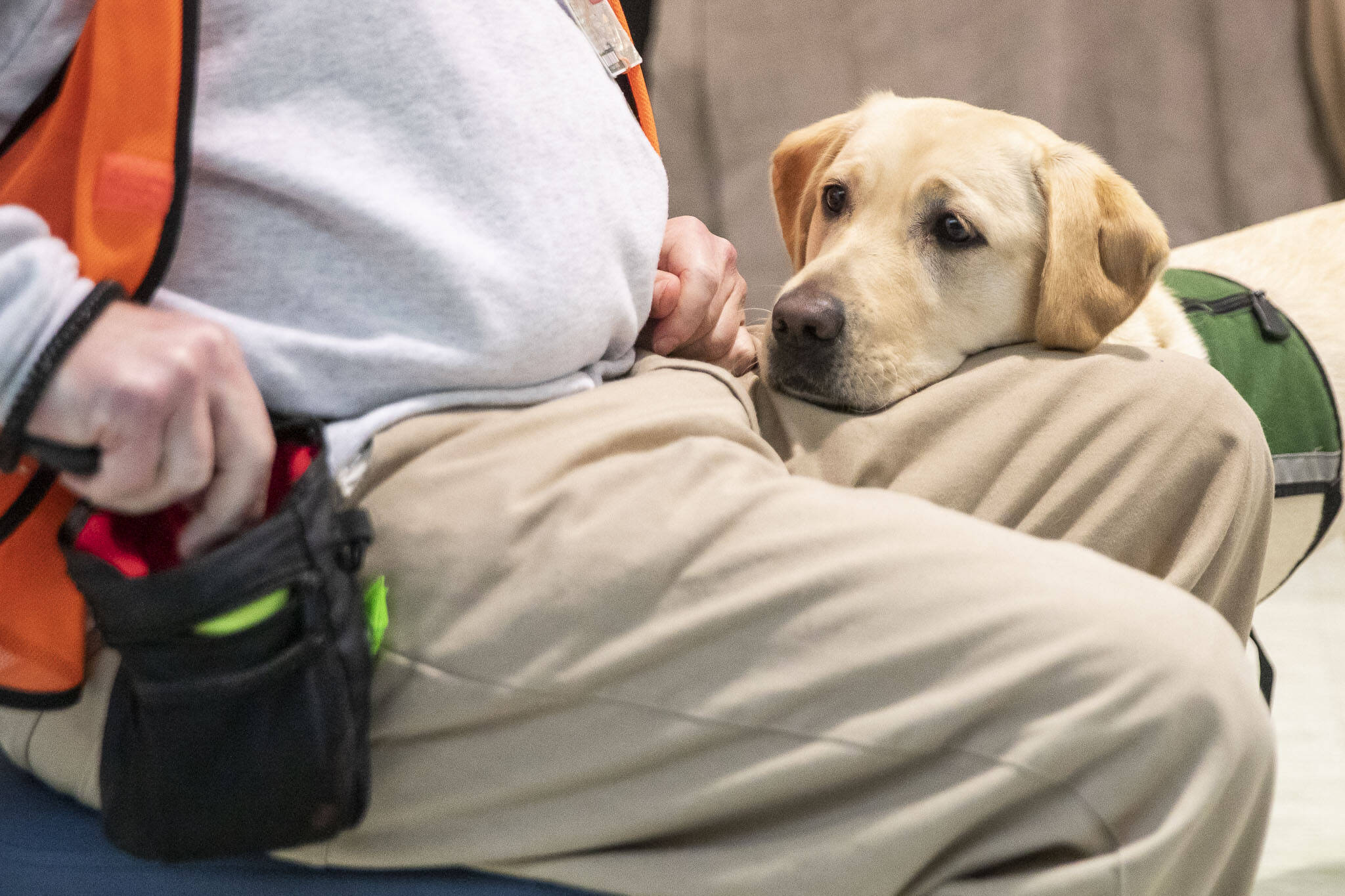
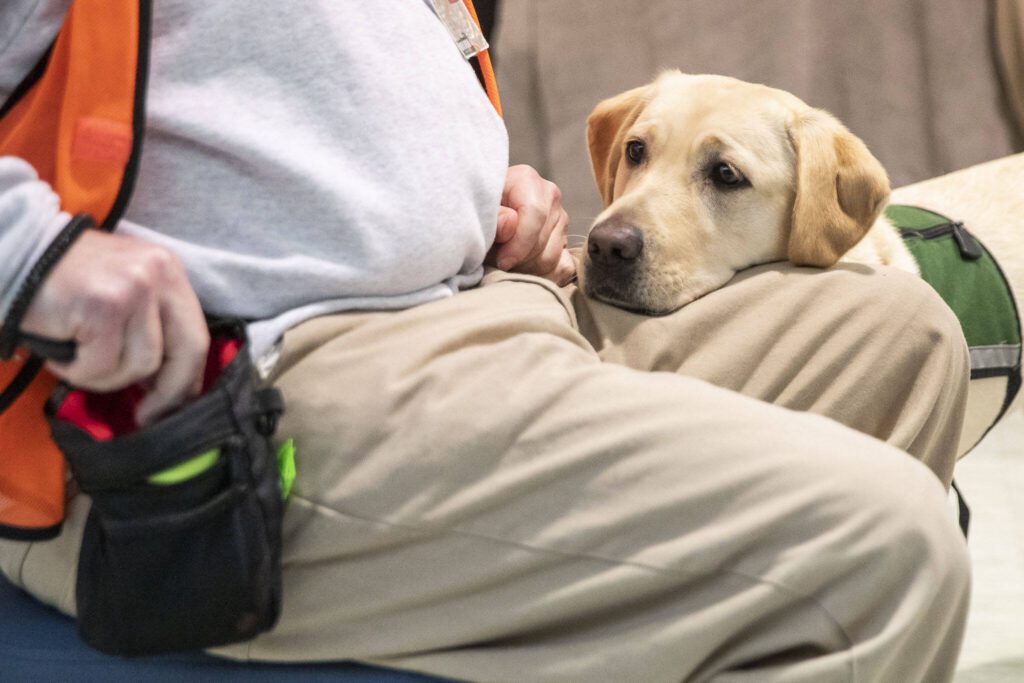
A dog rests its head on his trainer’s leg waiting for a treat during a weekly meeting of the Summit Assistance Dogs program at the Monroe Correctional Complex on Tuesday, Feb. 6, 2024 in Monroe, Washington. (Olivia Vanni / The Herald)
‘Shaping’
At the February class, Meinzinger led the group through a lesson about “shaping” — guiding a dog toward a behavior by rewarding incremental progress.
Training concepts don’t just apply to the dogs. Prison doors make a loud sound before they open, evoking emotions for prisoners, one student suggested. It was an example of “classical conditioning,” when a stimulus prompts an involuntary response.
Another suggested an example of “operant conditioning,” where you learn to associate a stimulus with a voluntary behavior. Prisoners have to wait for officers to accompany them outside. Waiting, he explained, is learned behavior.
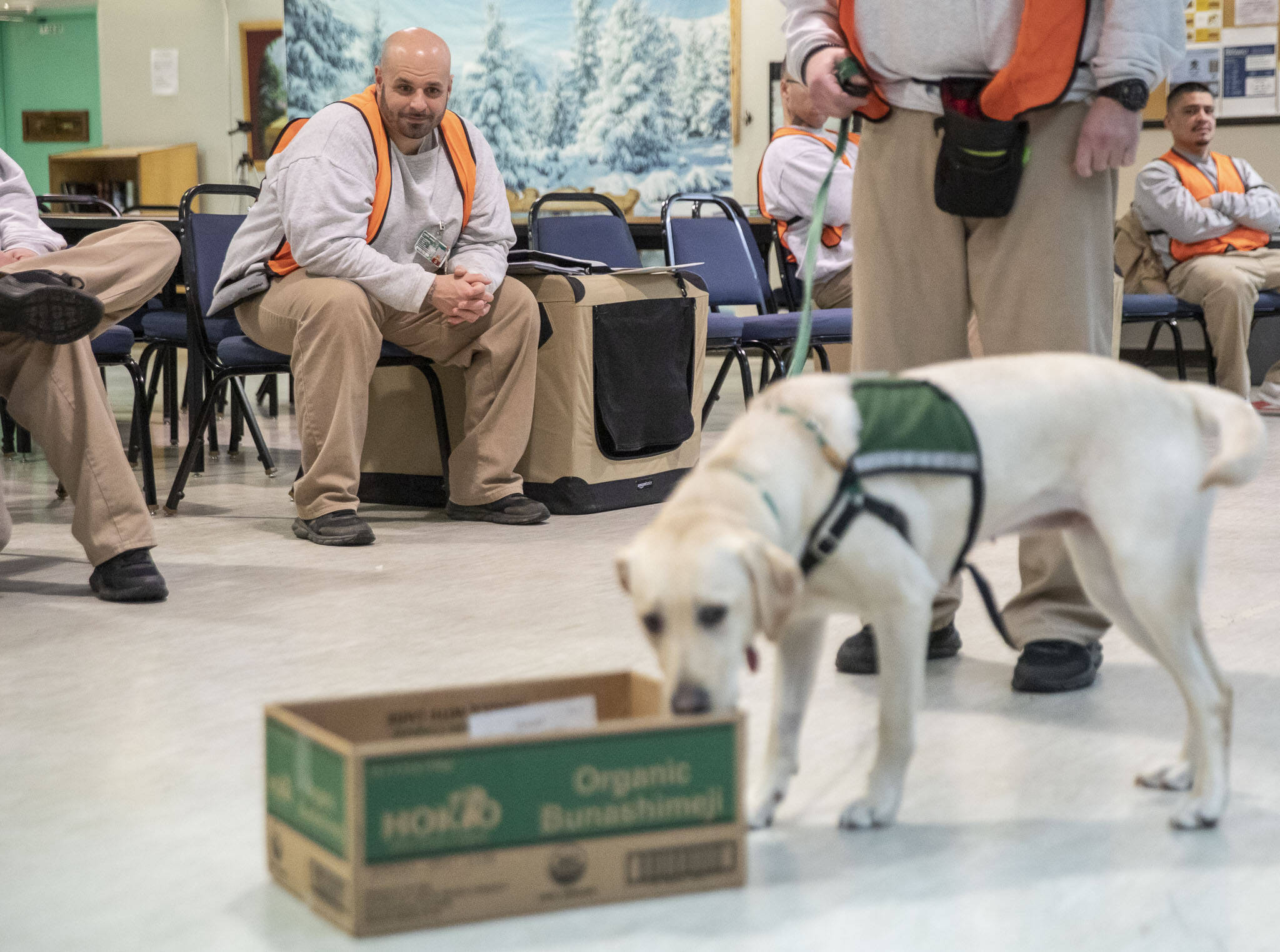
Later, Meinzinger led a demonstration where one volunteer from the group played the dog, or the “learner.” The other, cast as the “trainer,” held one of the clickers that handlers use to reinforce desired behaviors in dogs. The learner left the room, while the trainer came up with the desired behavior. In the first round, the goal was to get the learner to put his foot in a cardboard box on the floor.
When the learner walked back in, the trainer began to click as the learner stepped closer to the box. He reached his hand toward it — no click.
In short order, he figured it out, stepping a foot into the box and ending the exercise.
This time, the learner got the idea quickly. But relying on clicks can be frustrating.
Meinzinger stressed the importance of knowing your learner. You have to know if the learner will be resilient enough to keep trying if they don’t get many clicks. If the trainer misses a click, the learner could misunderstand the desired behavior.
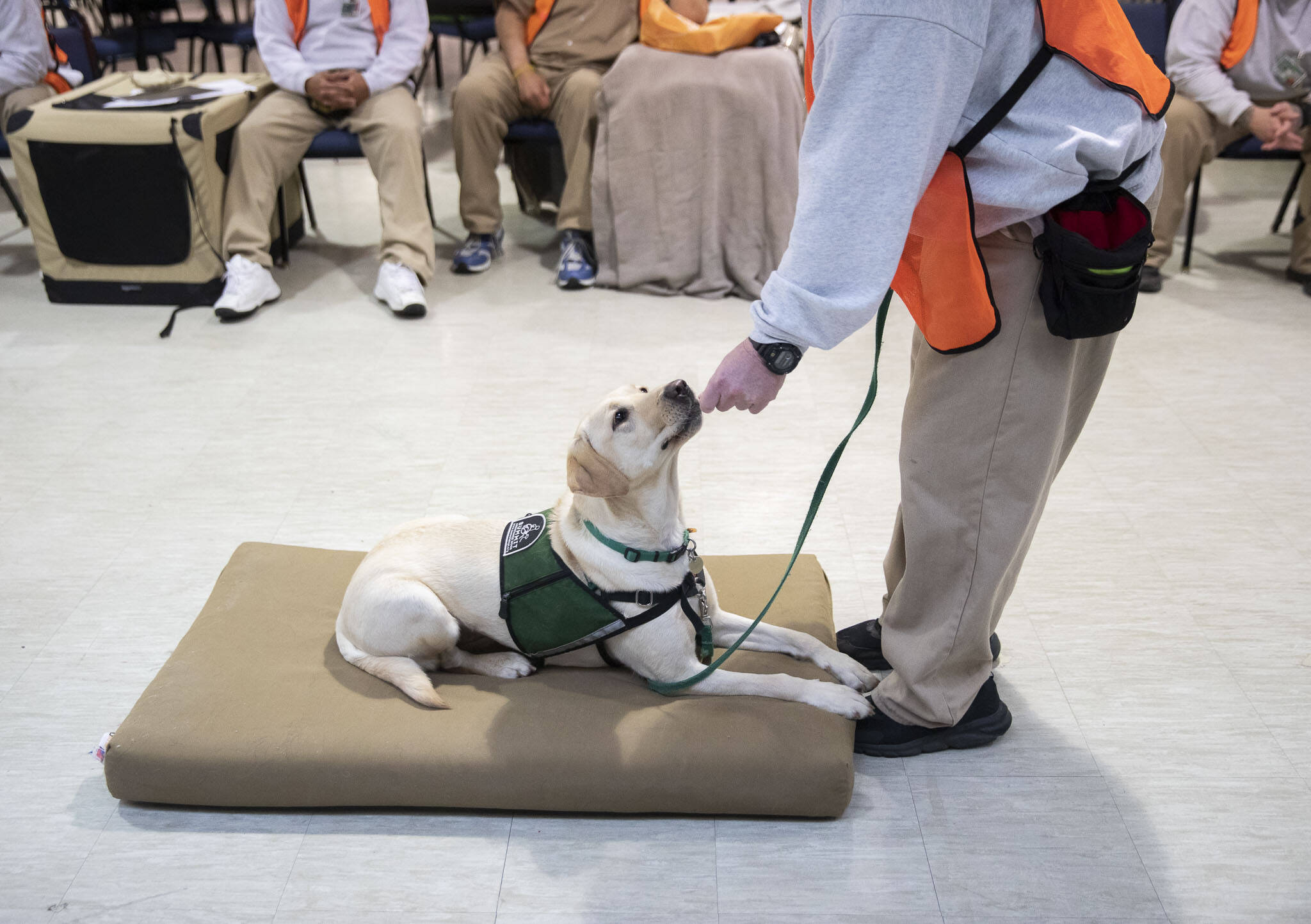
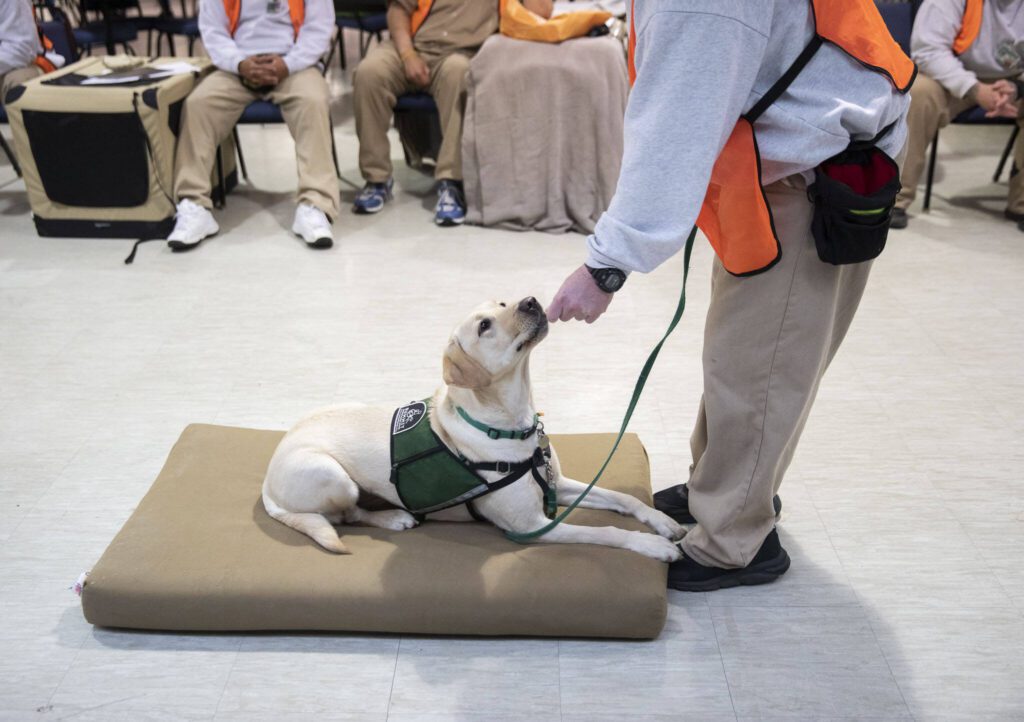
A trainer entices their dog to lay down on a mat for a training exerciser during a weekly meeting of the Summit Assistance Dogs program at the Monroe Correctional Complex on Tuesday, Feb. 6, 2024 in Monroe, Washington. (Olivia Vanni / The Herald)
A Dominican nun, Sister Pauline Quinn, is often credited with coming up with the idea of rehabilitating prisoners through dog training. She helped found Prison Pet Partnership in 1981 at the Washington Corrections Center for Women in Gig Harbor. The organization officially started offering programming in the prison three years later.
Originally, it was all about service dog training, though it has since grown to include pet training, grooming and boarding. Today, prisons across the country have dog programs.
Quinn “dedicated a lot of her life” to starting dog programs in prisons, Meinzinger said. Quinn approached Meinzinger in 2009 to ask if she’d be interested in running one at the Monroe prison.
Meinzinger had never worked in a prison. The prisoners she met at Monroe were well-spoken, intelligent, creative.
“You just realize that, ‘Wow, there’s just a lot of talent there that is just untapped because they’re incarcerated,’” she said.
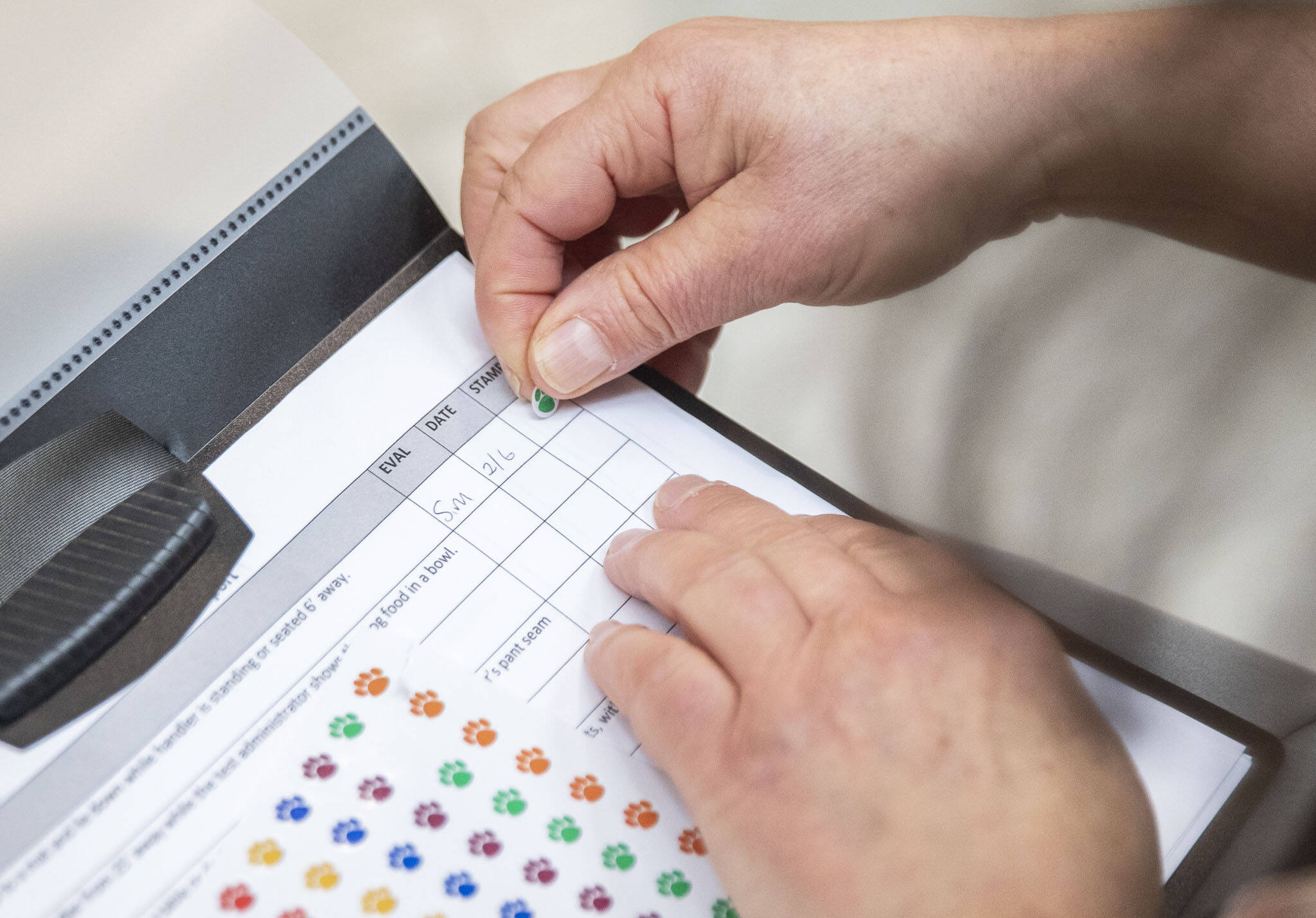
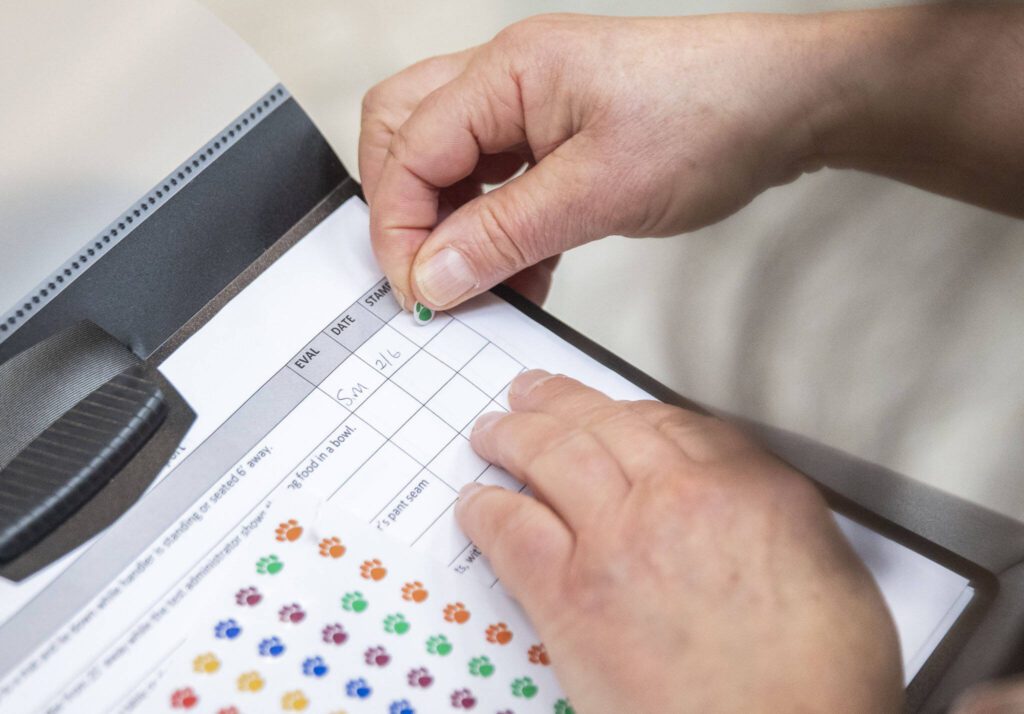
Sue Meinzinger places a paw sticker on a training tracking sheet on Tuesday, Feb. 6, 2024 in Monroe, Washington. (Olivia Vanni / The Herald)
‘Something meaningful’
Summit teaches a communication style that might be new to many in the program, Meinzinger said. It’s based on positive reinforcement.
It also gives prisoners a potentially employable skillset, allowing them to “have aspirations for something meaningful when they get released,” she said. Last fall, Summit started offering certificates for men who pass a basic training test. So far, five men have earned a certificate.
Training mobility service dogs is a much longer process than training guide dogs for the blind, Meinzinger said.
Someone with a vision impairment is more likely to be strong enough to manage an exuberant dog. Someone with a mobility impairment, on the other hand, usually requires a calm service animal. Mobility dogs also need to learn more commands than guide dogs, Meinzinger said.
Volunteers take on the basic obedience training and socialization the puppies need, she said. When the dogs are about a year old, they move on to mid-level training at the prison. There, they’ll learn more cues.
As part of Summit, prisoners take on one of two roles. Each dog has two handlers, who must share a cell. They live with and train the dogs.
Others are dog walkers, a job with less responsibility.
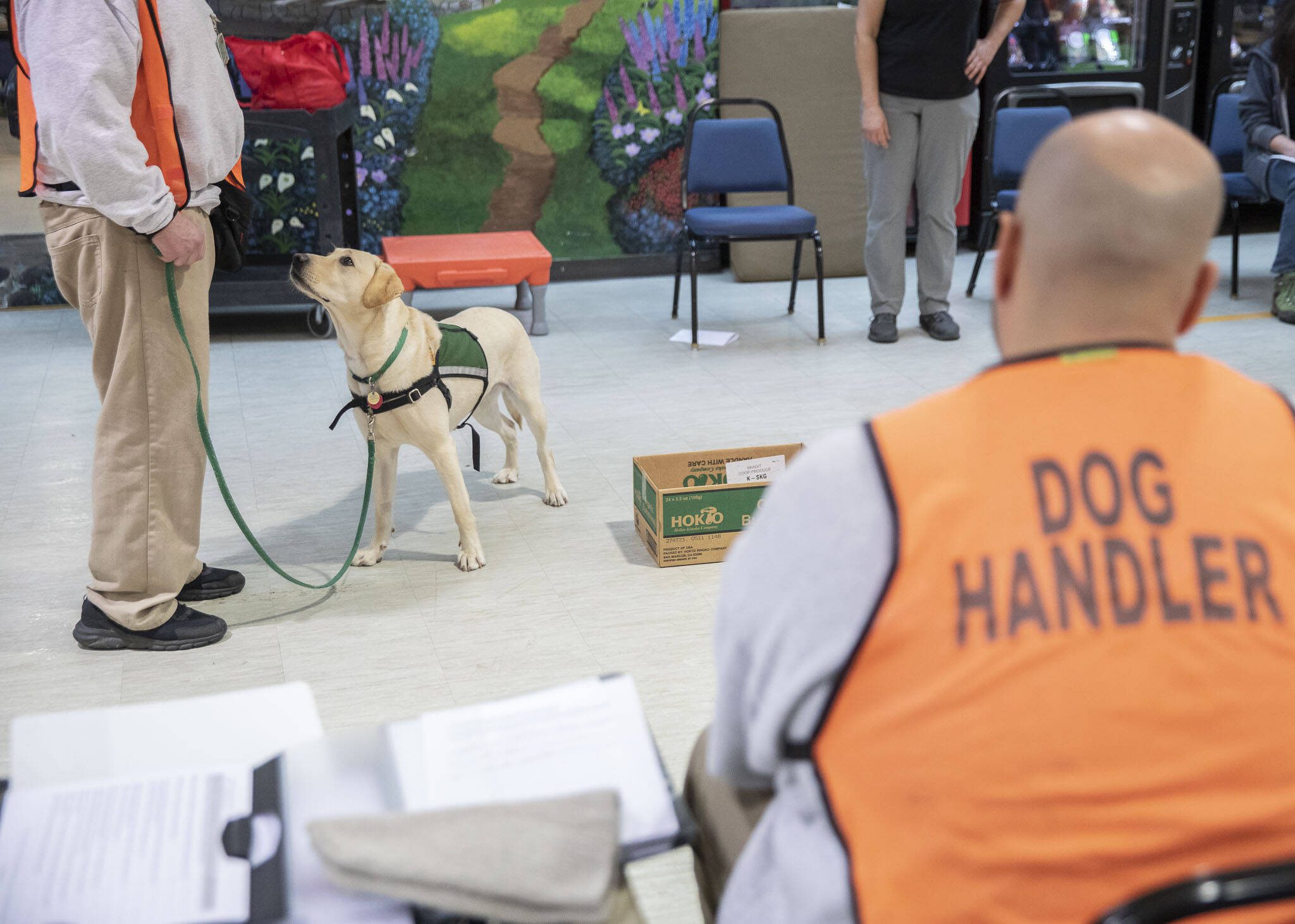
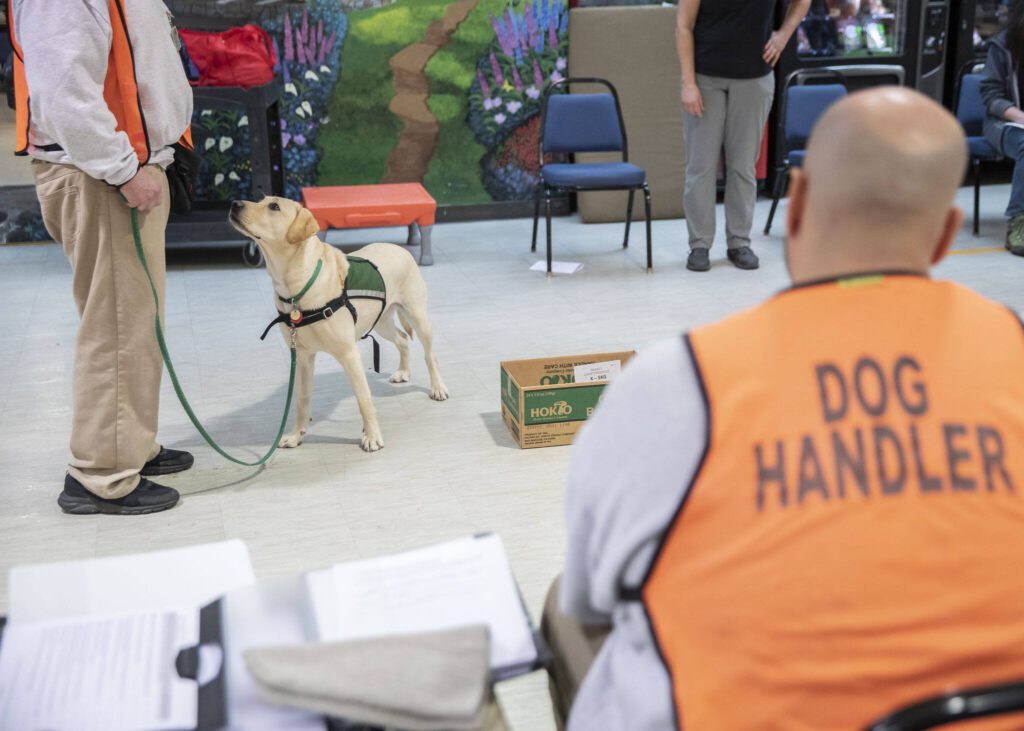
A dog looks up at its trainer for the next command during a training exercise at a weekly meeting of the Summit Assistance Dogs program at the Monroe Correctional Complex on Tuesday, Feb. 6, 2024 in Monroe, Washington. (Olivia Vanni / The Herald)
Dogs go into the prison for 10 weeks at a time. They may return for multiple 10-week stays. Most are Labradors, though some are golden retrievers or mixes of the two breeds.
The dogs won’t graduate to service work until they go through advanced training for another six to eight months after they get out of prison.
With clients, the dogs tug open doors, retrieve or carry items and flip light switches on and off — among other tasks. They can also assist in pulling a wheelchair or steadying someone as they transfer to a bed or chair.
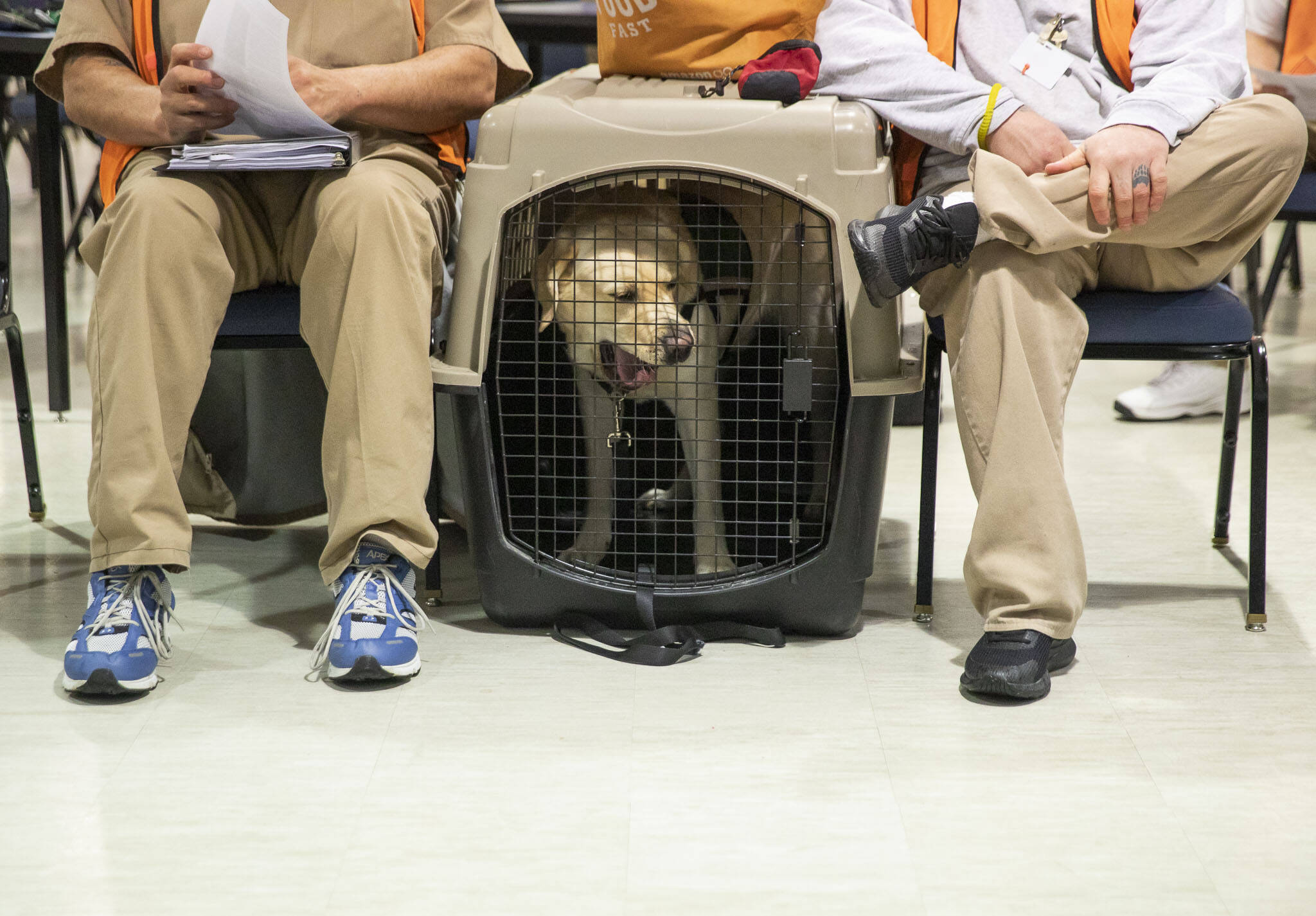
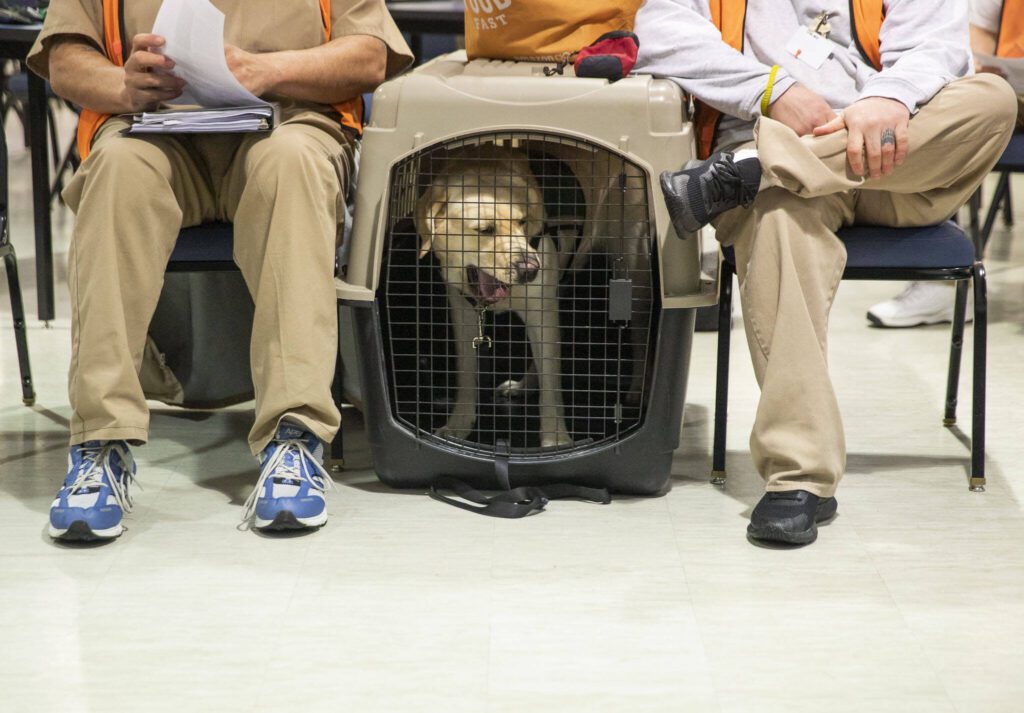
A service dog in training yawns in its crate while it waits for its turn at a training exercise on Tuesday, Feb. 6, 2024 in Monroe, Washington. (Olivia Vanni / The Herald)
‘To give back’
The program “seems to bring staff and offenders together,” James said. It’s hard to see each other as adversaries when a dog is there.
Taking part in Summit can also be a good motivator for prisoners to stay out of trouble, he said. A major infraction means getting kicked out of the program.
Andrew hopes his new skills will help him when he is released, after decades behind bars. He was candid, though, that not every incarcerated participant takes the program as seriously. It’s frustrating, he said, to watch others not put in enough effort when there’s a waiting list to get in.
David Pillatos, a fellow participant, agreed. Some only take part in Summit so they’ll get a good note in their file, he said.
Pillatos, who is serving a 30-year sentence for murder, has quit the program before because of conflicts with other prisoners. Like Andrew, he hopes to use the skills he’s gained after prison. He’s working on an associate’s degree in business management from Edmonds College while inside, he said, and plans to start a dog training and boarding business when he gets out.
Andrew has also participated in dog training programs at the Clallam Bay and Stafford Creek prisons, he said. But those programs are different. There, prisoners prepare shelter dogs for adoption.
At Monroe, the dogs are trained for a specific purpose, Andrew said. Working with them brings a sense of accomplishment.
“There’s not many opportunities in prison,” he explained, “to give back to (a) community you’ve taken from.”
Sophia Gates: 425-339-3035; sophia.gates@heraldnet.com; Twitter: @SophiaSGates.
Want to contribute?
Summit Assistance Dogs runs a fundraising campaign in May called Unleash Your Love. Donations help fund the nonprofit, including the dog program at the Monroe Correctional Complex.
Talk to us
> Give us your news tips.
> Send us a letter to the editor.
> More Herald contact information.
Gallery