
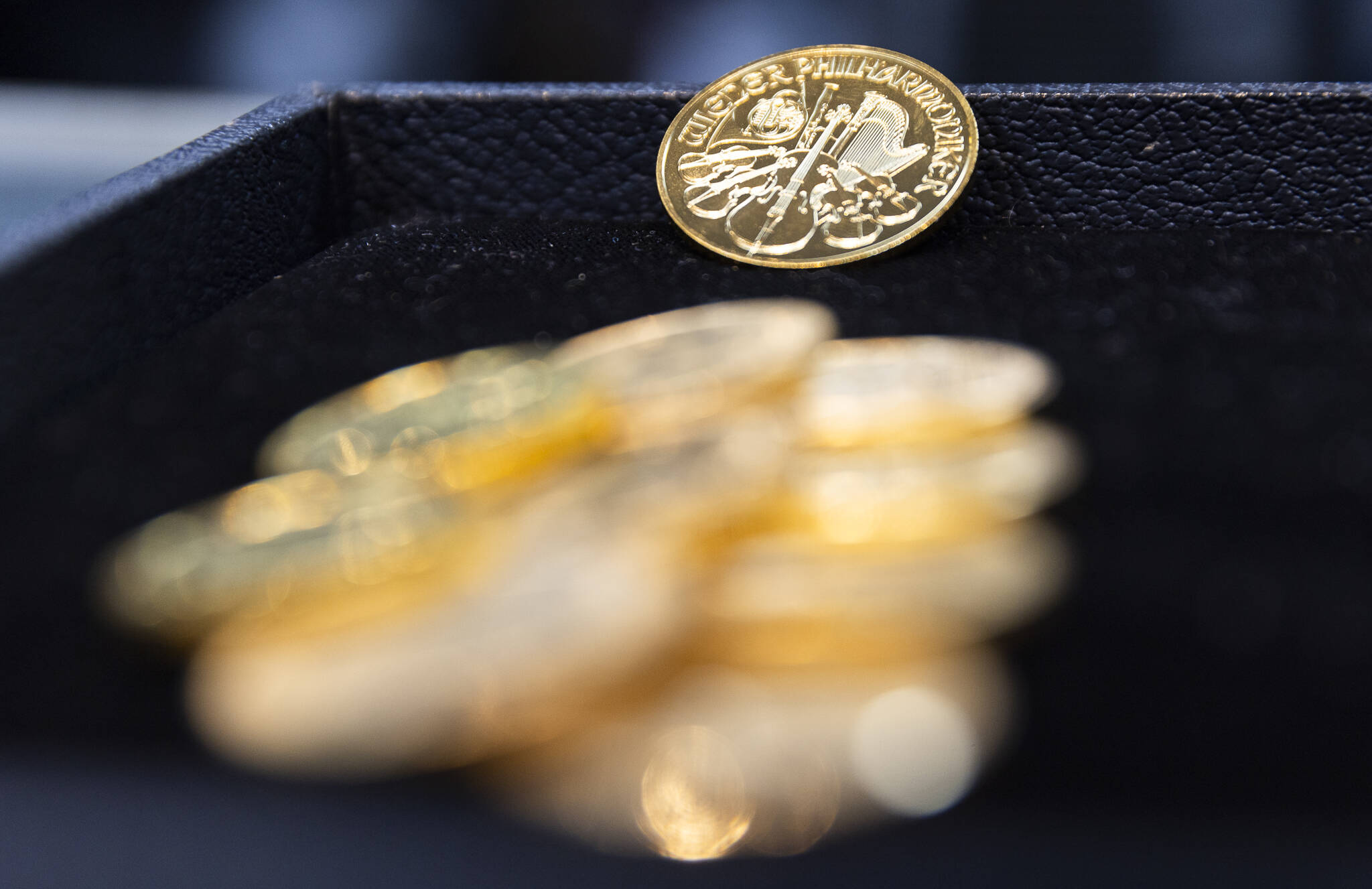
EVERETT — New state and local sales taxes on the purchase and redemption of gold, starting Jan. 1, have the owners of The Coin Market in Lynnwood worried about the store’s future.
Since 1985, gold buyers and sellers in Washington state have been exempt from state and local sales taxes, a common practice in all but four states.
The tax change comes after Washington Gov. Bob Ferguson signed a bill in May ending gold sales tax exemptions, part of a package of new levies aimed at helping the state plug its multi-billion-dollar budget gap.
The Coin Market co-owner Bryan Geraghty said he is concerned that the 10.6% sales tax, a combination of a 6.5% state tax and a 4.1% Lynnwood local tax, will scare customers away from buying gold coins and bullion.
“We’re worried about staying in business and just hoping for the best,” Geraghty said.
While the new law takes effect, one state lawmaker is sponsoring legislation to repeal it in the new legislative session starting on Jan. 12.
“We really need to listen to businesses on what the impact will be of new taxes,” said Rep. Amy Walen, D-Kirkland.
She said she is concerned Washington gold dealers will lose business to out-of-state dealers.
A spokesperson for the Washington Department of Revenue said in an email that ending the sales tax exemption would bring in an estimated $7.4 million in the first six months of 2026 and $17.6 million in the following 12-month period, starting July 1. The estimate also includes a new business and occupancy tax that will also be imposed on gold store owners.
But Geraghty said gold purchasers and sellers can easily purchase gold in Oregon or Idaho, where there is no tax, or in California, where transactions of at least $2,000 are not subject to the state’s income tax.
Only four other states impose a state sales tax on gold: Hawaii, New Mexico, Maryland, Vermont, and the District of Columbia, according to data from Swiss America, a large national online gold dealer.
State Sen. Jesse Salomon, D-Shoreline, who introduced the gold tax bill, said in an email to The Daily Herald that he sponsored the legislation “to make our tax code fairer and more efficient, removing outdated tax code provisions and directing resources towards our schools, health care, and social services.”
He did not address the concerns of The Coin Market owners about being put in financial jeopardy.
A spokesperson for the governor did not respond to requests for comment.
The controversy over the gold tax comes as the price of the commodity has been on a historic upswing, bringing hundreds of customers a month to the Lynnwood shop to buy or sell gold, Geraghty said.
As of Monday, the spot price of gold had reached $4,350.20 20 per ounce, up more than 70% from the beginning of 2025, according to data from the Commodity Exchange Inc.
“The demand for gold has increased because of concerns about the declining value of the U.S. dollar and inflation, Geraghty said. He said buyers view gold as a rising asset in an uncertain economic environment, and sellers want to cash out and reap profits.
Geraghty said a tax on gold is fundamentally unfair; people don’t pay a tax on other investments, such as buying or selling a share of Apple stock.
He said, of course, that gold buyers, like other investors, pay a capital gains tax when they make money on the commodity.
But this is totally different, he said.
“So on gold, they are taxing it twice,” he said.
A 10.6% tax would mean the purchaser of a 1-ounce American Gold Eagle or a rectangular 1-ounce gold bullion would pay more than $456 in Washington state sales tax.
Brendan Geraghty, Bryan’s brother and co-owner of the Lynnwood coin shop, said selling precious metals is the shop’s main business.
He said that while the shop has thousands of historical coins, coin collecting isn’t very popular today.
“It’s somewhat of a dying hobby,” said Brendan Gearghty. “The average age of a coin collector is like a 60-year-old guy.”
Brendan Geraghty said young people today are interested in Pokémon cards and electronics.
Removing the exemption on gold came after a review by the Joint Legislative Audit and Review Committee in December 2024. The committee is chaired by Salomon, who introduced the gold tax bill.
The committee made no recommendation on whether to keep the exemption, but said it wasn’t clear what the policy’s purpose was.
The review said the exemption saved precious metal buyers and sellers around $27 million in state and local taxes in 2023, up from around $4.7 million in 2017, a more than 450% increase.
It said that ending the sales tax exemption could hurt Washington gold dealers, but also noted that 39% of gold transactions by Washington consumers were online with out-of-state dealers.
The JLARC made no recommendation on whether to keep the exemptions.
The bill ending the state and local sales exemption on gold also imposes a state business and occupancy tax of 0.471% on gold dealers on their retail sales of precious metals.
Carolyn Beko, president of the Washington Coin and Bullion Association, said there are about 100 stores in Washington that sell gold, and many of their owners are concerned about their survival.
She said some stores that are attempting to diversify their offerings, such as selling gold jewelry.
Beko said the sales tax is counterproductive; it wouldn’t raise any money for the state.
“No one will be buying gold in Washington,” she said.
The association has begun a campaign to abolish the new law, seeking contributions to lobby legislators for repeal during the 2026 legislative session. Beko said she is heartened by Falen’s legislation to repeal the gold tax, but said a lot more lobbying will need to be done to convince other legislators to join in ending the tax.
Duke University Finance Professor Campbell Harvey agrees with Beko’s assessment.
“All this tax does is put stores out of business or decrease their profitability,” said Harvey, who has conducted extensive research on gold investments.
He said it’s too easy for gold buyers or sellers to go to another state and avoid the tax.
“This law is not very well thought out,” he said. “They will only raise a trivial amount of money from the tax.”
Harvey said the tax is very unfair because other types of investments aren’t subject to the tax.
He compared it to the Stamp Act of 1765, Britain’s first direct tax on American colonists, which imposed a special tax on all legal documents, newspapers, pamphlets, playing cards, and dice to raise revenue for British troops after the French and Indian War.
Harvey said the gold price upswing has a lot to do with increasing doubt about whether yields will remain high on the U.S. 10-year treasury bond, “traditionally the safest asset in the world.”
“Now, people are thinking twice about that, and at the top of the list for diversification alternatives is gold,” he said
Harvey suggested that Washington investors could buy a gold exchange-traded fund, which trades on the stock market and offers access to gold’s price movements, without owning the commodity.
“You’re not going to pay the stamp tax; there is no 10%,” he said.
That wouldn’t help the owners of The Coin Market.
Brendan Geraghty said he and his brother brought The Coin Market back in 2019 from its previous owner, who was retiring. The two already owned a coin store in North Seattle and were looking to expand.
Because of a commission of around 2%, Bryan Geraghty said dealers rely on a high volume of gold transactions.
He said the sales tax is an example of government gone “amok.”
Bryan Geraghty hopes that at least some coin buyers and sellers will continue to come.
“We want to stay in business,” he said.
Randy Diamond: 425-339-3097; randy.diamond@heraldnet.com.
Talk to us
> Give us your news tips.
> Send us a letter to the editor.
> More Herald contact information.
Gallery