
When I was 18, I took my first independent trip to Europe. During that trip, I toured “Mad” King Ludwig’s Neuschwanstein Castle in Germany — a medieval castle dream. Then, just over the border in Austria, I found the Ehrenberg ruins — a medieval castle reality. Decades later, I’m still enthralled by the striking contrast between these two castles — so close in distance (just 30 minutes by car) but offering worlds-apart experiences.
Neuschwanstein, the ultimate fairy tale castle, seems to be on every tourist’s list. In the foothills of the Alps, about a two-hour drive from Munich, it’s the most lavish of three extravagant castles belonging to Ludwig II, who ruled Bavaria for 22 years, until his death in 1886.
Rather than deal with politics in Munich, Ludwig retreated to the countryside. He lived at his family’s hunting palace, Hohenschwangau (another impressive castle that’s well worth visiting) while devoting himself to the Neuschwanstein’s construction nearby. Although Ludwig spent 17 years building Neuschwanstein, he lived in it only 172 days. Soon after he moved in, Ludwig was declared mentally unfit to rule Bavaria. Days later, he was found dead in a lake (it’s still debated whether he was murdered or died by suicide).
Ludwig was a true romantic living in a Romantic age. His best friends were artists, poets and composers, such as Richard Wagner. Longing for the natural beauty and emotion of an earlier time, he built his medieval fantasy on a hilltop not for defensive reasons, but because he liked the view. His palace is wallpapered with misty medieval themes — brave knights, fair maidens and scenes from Wagnerian operas. But even as he strove to evoke medieval grandeur, he embraced Industrial Age technology. Neuschwanstein — only about as old as the Eiffel Tower — had electricity, running water and a telephone.
To visit the castle, travelers must buy tickets for the 30-minute guided tour. Advance reservations are strongly recommended, especially in summer, when long lines plague the castle and tickets can sell out. A highlight of the tour is Ludwig’s extravagant throne room, based on the plan of a Byzantine church. A 1-ton chandelier in the shape of a Byzantine crown hangs above the exquisite mosaic floor consisting of 2 million stones — a visual encyclopedia of animals and plant life. Another memorable stop is the king’s Neo-Gothic bedroom, featuring an elaborately carved canopy bed topped with a forest of Gothic church spires, “Tristan and Isolde” wall paintings and a personal chapel.
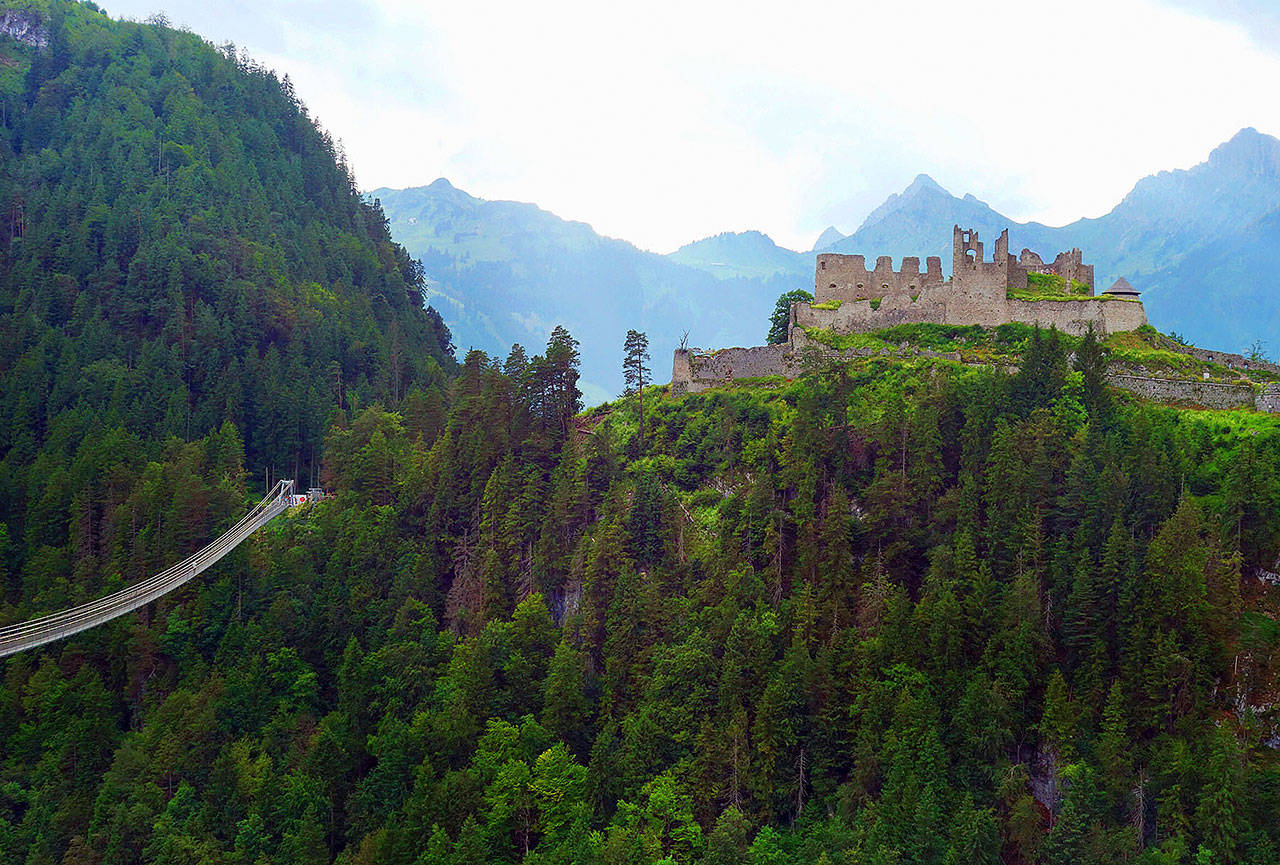
A great complement to the crowds and commercialism of Neuschwanstein is a hike up to the stark and brooding ruins of the Ehrenberg Castle ensemble, above the town of Reutte, Austria. Ehrenberg is an especially fine example of the countless castle ruins rotting away on hilltops all over Europe. It offers lots of medieval wonder to anyone hardy enough to hike up to the top where, amid sword ferns and broken ramparts, you’re practically alone in your own private castle ruins in the Alps. It’s an excellent contrast to Ludwig’s touristy fantasy castle just down the road.
In Roman times, the Via Claudia — the road below Ehrenberg — was the main route between Italy and Germany. About 10,000 tons of precious salt passed through this valley each year, so locals built this complex of fortresses and castles to control traffic and levy tolls on all who passed. The complex consists of four parts from different periods: the old toll buildings on the valley floor; the 13th-century Ehrenberg Castle, built on the hilltop directly above the valley; Schlosskopf, a mightier 18th-century castle on a higher peak; and Fort Claudia, a smaller fortification across the valley.
When I first hiked up to the ruins, it was overgrown with trees and entirely desolate. Ehrenberg Castle crowned its mountain like an ornery barnacle. The others were lost in a thick forest. I hiked up into the misty mountain of meaningless chunks of castle wall pinned down by Pixy Stix trees and mossy with sword ferns. It inspired yet confused me.
Today, thanks to the work of local archaeologist Armin Walch, the hungry forest has been cut away, and the castle ensemble has been revealed and renovated. Hiking paths wind through the ruins, signs help orient visitors, and a recently built 1,300-foot-long pedestrian bridge hangs more than 300 feet above the valley floor, connecting Ehrenberg with Fort Claudia. An interactive, kid-friendly museum gives visitors the chance to try on a set of armor, lift replica weapons, and experience the limited vision knights had to put up with when wearing helmets.
It’s fun to balance the over-the-top opulence of Neuschwanstein Castle with the peaceful, ramshackle ruins of Ehrenberg. This mix of famous must-sees and intimate back-door sights is, to me, what makes travel in Europe so special.
— Tribune Content Agency
Talk to us
> Give us your news tips.
> Send us a letter to the editor.
> More Herald contact information.
























