As glassmaking was streamlined, Clevenger Brothers stuck by old techniques
Published 1:30 am Wednesday, June 5, 2024
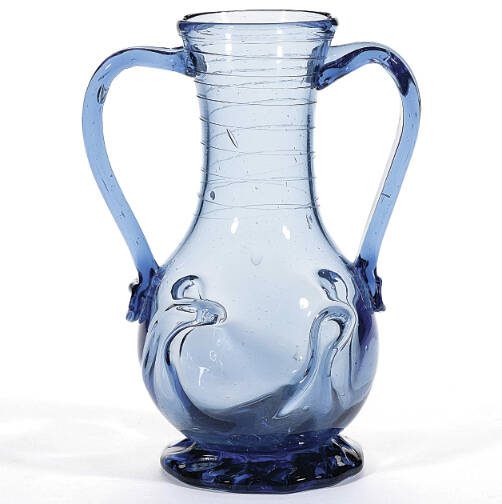


With the invention of the mechanical glass press in the 1800s, the glassmaking industry moved away from free-blown, hand-decorated pieces and embraced new ways to mass-produce inexpensive decorative glass. But not everyone wanted to leave the old ways behind.
Brothers Henry Thomas, Lorenzo and William Elbert Clevenger were apprentices at the Moore Brothers Clayton Glass Works, where their father, William Henry, also worked. The Clayton Glass Works closed in 1912. In 1930, the Clevenger brothers constructed their own glass furnace in their backyard in Clayton, New Jersey. They used their training to make glass in the old-fashioned South Jersey style developed in the colonial years: free-blown vessels decorated with blobs or threads of glass applied by hand. They soon started making mold-blown glass, including reproductions of famous antique bottles like the Fislerville Jenny Lind calabash flask and the figural E.G. Booz whiskey bottle.
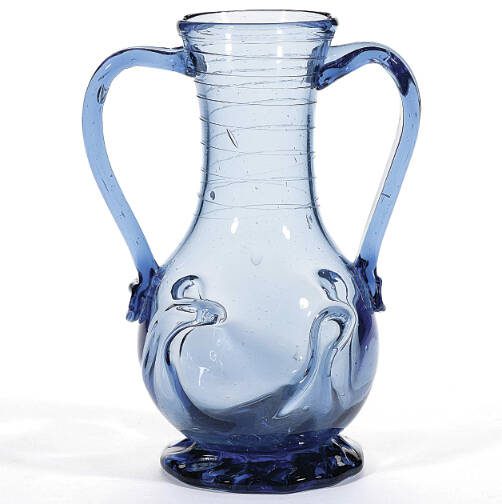
A Clevenger Brothers vase sold for $192 at an auction by Jeffrey S. Evans. It was free-blown, with a rough pontil mark as evidence. Its two handles, decorative glass blobs called lily pads, and the threading around its neck were applied by hand. The vase’s medium blue color is also faithful to the earlier glass traditions. It is still recognizable as a 20th-century piece; for one thing, Clevenger Brothers glass is usually heavier than pieces made in the 1700s and 1800s. The brothers’ intent was not to create forgeries of valuable antique glassware but to continue the traditions of their glassmaking forebears.
Q: I am writing you in the hopes that you can steer me to someone who might be interested in some china I own. I have eight place settings of the rose-colored Royal Staffordshire Charlotte Clarice Cliff dishes. I have the dinner plates, salad plates, bread plates and all the cups and saucers. The best information I could find to date is that they were manufactured sometime between 1920 and 1929. I could find pieces available on the Internet but not a complete set.
A: Clarice Cliff started working for A.J. Wilkinson’s Royal Staffordshire Pottery in Burslem, England, in 1916. She is best known for her later art deco designs that she created when she had her own studio at Newport Pottery, like the Bizarre and Fantasque lines. Complete sets of china can be difficult to sell, but Clarice Cliff sells well. You could check antiques and consignment shops in your area to see if they sell similar items. You could contact an auction house. Selling your dishes to a matching service is another option.
Q: I have a set with a perfume bottle, compact and lipstick tube made of pearl. They are in a case that reads “Le Kid Paris” inside. What is its value?
A: “Le Kid” was created by the Marcel Franck perfume company in Paris in 1926. It was the first purse-sized perfume atomizer. Individual Le Kid perfume bottles are worth about $50 to $120. Many dealers who sell jewelry also deal in items like perfume bottles and compacts. There are also collectors who specialize in perfume bottles, like the International Perfume Bottle Association (IPBA).
Q: I have a sugar and creamer that is stainless steel. It was my husband’s parents’ parents’. We’re in our 80s now, so it is old. It also has a small server tray with it. They measure 9½ inches long. It is not marked “stainless steel,” but I don’t think they had to do that then. I am wondering what it is worth. It does not have a scratch on it. It’s lovely.
A: Stainless steel was available to artists and manufacturers around 1920. Its light weight and resistance to tarnishing and rusting made it appealing to decorative arts. Its ease of cleaning and sterilization and its lack of reaction to most substances make it especially useful for kitchenware and tableware. Many 20th-century designers have made stainless-steel pieces in the art deco, midcentury and postmodern periods. Stainless-steel sugar and creamer sets by known designers can be worth about $100 to $200. Without a known maker, they are usually worth $50 or less. If you cannot identify a maker, any identifying information, like a date or country of origin, can help increase the value.
TIP: Never put silverware and stainless-steel flatware in the dishwasher basket together. The stainless can damage the silver.
On the block
Current prices are recorded from antiques shows, flea markets, sales and auctions throughout the United States. Prices vary in different locations because of local economic conditions. Shaving mug, souvenir, scenic cartouche, Atlantic City Light House, pink-shaded ground, scuttle, gilt trim, 4 by 3 inches, $25.
Val St. Lambert, plate, Orchidee, blue flash flowers and leafy vine around the rim, acid etched, wheel engraved, marked, circa 1880, 6 inches, $120.
Spongeware, pitcher, Bennington Rockingham style, brown sponge and drip, mask carved under spout, ribbed, eight-sided base, 9 by 7 inches, $130.
Toy, wagon, art deco style, red, blue stripe, white handle, metal, 34 by 16 inches, $175.
Capo-di-monte, lamp base, multicolor classical scenes, acanthus leaf lower border, footed, brass base, four serpent head feet, Italy, 20th century, 25 inches, pair, $210.
Textile, flag, American, 45 stars, loose weave, wool and cotton, machine sewn, Spanish-American War, circa 1896, 58 by 93 inches, $290.
Furniture, secretary, Charles II style, oak, carved, frieze flanked by lion’s masks, flowers and leaves on two top doors, scrolls and mask on drop front, urns on two lower doors, England, circa 1900, 64½ by 34 inches, $405.
Advertising, salesman’s sample, livestock feeder, painted red, stenciled lettering, Marting Mfg., Smidley Feedlot Equipment, 10½ by 7 inches, $630.
World War II, calendar, Keep ‘Em Flying, airplane graphic, Do Your Part Daily, rotating month, date cards, metal, 14 by 9 inches, $1,070.
Toy, figurine set, astronaut, four astronauts, clear helmets, three robots, arms raised, box, Cherilea, 3 inches, $1,800.