When reporters Ken Armstrong and T. Christian Miller published “An Unbelievable Story of Rape” in 2015, #MeToo was nearly two years away from becoming a full-blown social movement.
Their report for ProPublica and the Marshall Project, also made into an episode of “This American Life,” told the harrowing story of Marie, a teenager in Lynnwood, who was raped in her apartment by a masked intruder.
She reported the assault to police, who soon began to doubt her account and eventually charged her with filing a false report. Years later, an extraordinary second investigation in Colorado would uncover the truth: Marie had been the victim of a serial rapist operating in both states.
The investigation went awry because, put simply, a vulnerable young woman responded to her violent assault in the “wrong” way. Armstrong and Miller’s Pulitzer Prize-winning article raised a question at the heart of to the cultural reckoning to follow: Whose stories do we believe?
Now, a TV adaptation, “Unbelievable,” shows how victims are sometimes treated with as much suspicion as their attackers.
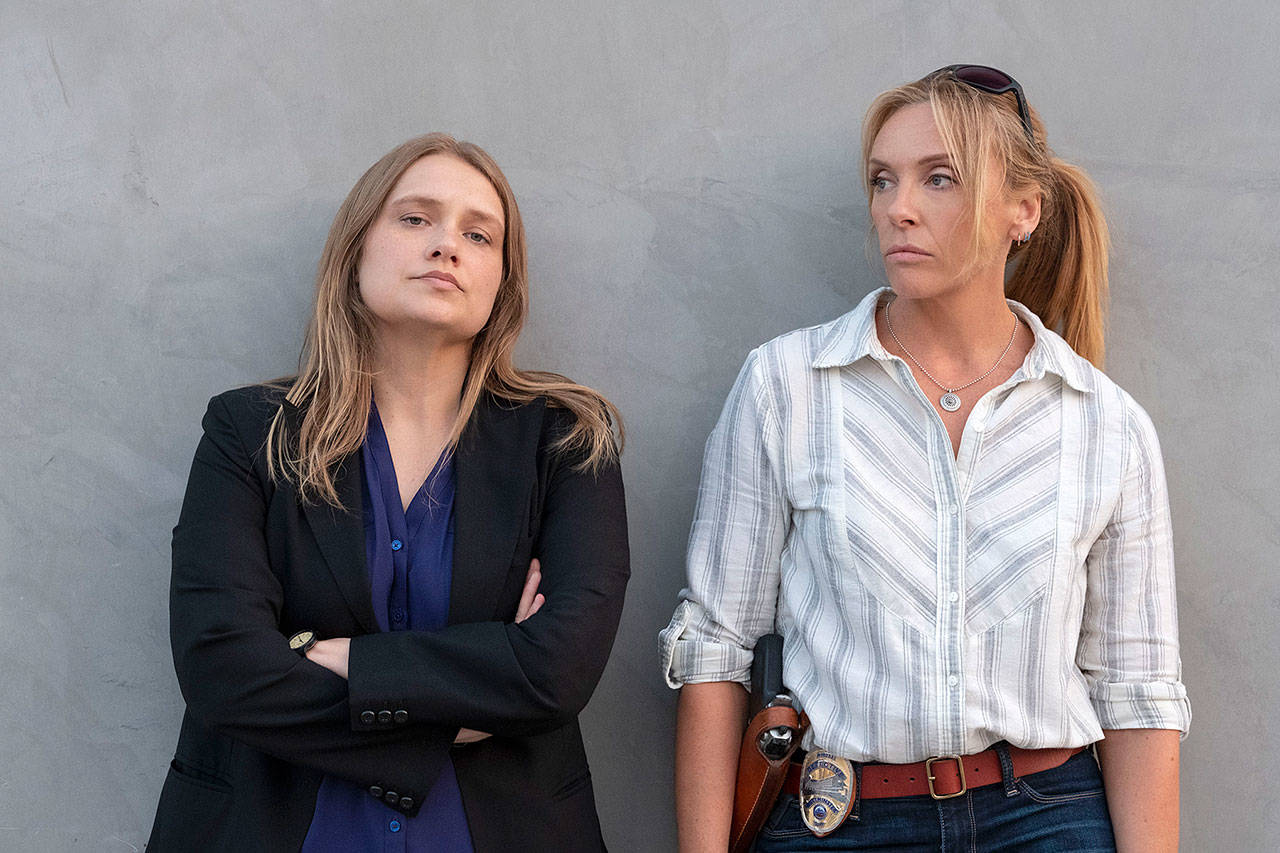
The eight-part Netflix series stars Kaitlyn Dever as Marie and Merritt Wever and Toni Collette, respectively, as Karen Duvall and Grace Rasmussen, the determined, empathic Colorado detectives who help uncover the truth about her attack. Created by Susannah Grant and directed in part by Lisa Cholodenko, “Unbelievable” has won critical acclaim for its riveting performances and timely message.
It also offers one of the most revolutionary depictions of rape and its aftermath in the history of the small screen, showing little interest in the rapist or his motivations and instead focusing on Marie and the detectives determined to bring him to justice.
“I was conscious of how accustomed to the world of ‘rape porn’ we all have become — the voyeuristic view of quasi-violent sexuality,” Grant said. “I really didn’t want to watch a rape. I wanted the viewer to understand the experience of that sort of violation and assault.”
The story of “Unbelievable” begins with what would typically be a reporter’s worst nightmare: the discovery that another journalist is pursuing the same story.
Miller, a former Times staff writer, learned of the Colorado investigation from contacts in law enforcement, who cited it as an exceptional example of a rape prosecution. He was impressed by the ferocity of the detectives in that case, Edna Hendershot and Stacy Galbraith (their names have been changed in the series), and began reporting.
At the same time, Armstrong was circling the story from a different angle. His goal was to understand what Marie had gone through and why the original investigation had gone so wrong.
“Marie did everything the police could want,” Armstrong said. “She tells them what happened again and again and again. She goes to a hospital and gets a rape exam. There is physical evidence consistent with her account. If someone like Marie isn’t believed, how can it be surprising that so many other women are not believed?”
Eventually, Miller and Armstrong joined forces. Among other things, their article hints at the ways media portrayals of rape can inform the expectations of the public: One of Marie’s foster moms becomes suspicious of her account, because, she says, it feels like something out of “Law & Order.”
“I think a lot of us have an idea that there is one right way to act when you’re been hurt,” Armstrong says. “There is no right way.”
Grant, the Oscar-nominated screenwriter of “Erin Brockovich,” has experience telling stories about women whose charges of sexual misconduct are met with skepticism. She wrote the 2016 HBO film “Confirmation,” which dramatized the showdown between Supreme Court nominee Clarence Thomas and Anita Hill, the former employee who accused him of sexual harassment.
HBO’s mantra on that politically sensitive project was “if you don’t have credibility, it’s worthless,” Grant said, a lesson she applied to “Unbelievable.”
She and her writers took some necessary liberties — changing names, compressing timelines and creating composite characters. But they also paid assiduous attention to the details of the case. “Being truthful to the experience of the people involved was absolutely essential,” Grant said. “You don’t want anyone to look at it and say, ‘Well they exploited my traumatic experience.’”
They relied heavily on Miller and Armstrong’s reporting but also made contact with Marie “to let her know what our intentions with the series were and how we were approaching the storytelling,” Grant said, as well as to ask about smaller details that came up in the writing process. “She was always available to answer them and more than generous with her time, her memories and her experience,” Grant added.
Cholodenko, the director of such films as “Laurel Canyon” and “High Art” and the HBO miniseries “Olive Kitteridge,” helped establish the show’s visual approach to the assault. The audience witnesses the rape from Marie’s point of view, through brief, fragmented flashbacks. At times, the camera is partially obscured, to mimic the blindfold she has been forced to wear.
“I really wanted to stay with the subjectivity of her experience,” Cholodenko said.
The director also came up with the idea of cutting to a scene of Marie joyfully running through the waves, inspired by one of the real Marie’s favorite photos. “When she’s in the middle of this assault, that’s what she’s latching onto — it’s just escaping the moment,” she says. But this survival mechanism also interrupts some of her memories of the attack later, when she’s trying to recount the details to the police.
“One of the things about the article that really struck me was that no two women experience a rape the same way,” Cholodenko said. “Trauma expresses itself in all kinds of ways, with people mixing up facts or having big gaps in their memories.”
The interrogation that follows Marie’s rape is nearly as traumatizing. Over and over again, she’s asked to recount the details of the assault. At the hospital, her body is intimately probed and examined. A perkily robotic nurse gives her a phone number to call in case she experiences further symptoms — “trouble swallowing, hives, thoughts of killing yourself.”
When Wever appears in the beginning of the second episode, gently asking a rape victim in Colorado to share the details of her attack, her compassion feels like an epiphany.
The rapist (played by Blake Ellis) gets very little screen time and few lines of dialogue. He is utterly forgettable, a mediocre blank slate, and his motivations are less important than his methodology. Karen and Grace try to understand what drives him, but only to stop him. They do not try to “get inside his head” or speculate about how a traumatic childhood or broken relationships might have inspired his crimes, and neither does the show.
“Something that distinguishes this show from other treatments of the subject is our focus on the victims and the investigators and our very specific desire to steer away from an exploration of the disturbed psyche of the rapist,” executive producer Sarah Timberman said. “I think sometimes those explorations are what lead you into things that feel exploitative, and that’s the last thing we wanted to do here.”
Marie has seen the series and largely approves, according to Armstrong, binge-watching it in two sittings.
“She says that she cried a lot, that it was difficult to watch, but she was glad that she did,” Armstrong said — and that, even though the series is a dramatic reconstruction, “watching (the rapist) get arrested in the show was closure for her.”
The series was in post-pro-duction last year when Christine Blasey Ford testified before the Senate about the alleged attempt by then-Supreme Court nominee Brett Kavanaugh to rape her at a party decades earlier, prompting another round of debate about memory, trauma and credibility.
“We were looking at the cut (of ‘Unbelievable’) on one screen and watching the Kavanaugh hearings playing out on another. To hear over and over again the same kind of misconceptions about how people experience trauma” was “upsetting and frustrating,” Grant said.
But she also gently pushes back against the idea that “Unbelievable” is uniquely relevant in 2019.
“Anytime you land a story about gender-based power imbalances, there will be a current event that’s relevant. It’s timely now, and I bet it’s timely in a year, and I bet it would have been timely eight years ago,” she said. “Let’s hope it’s a little less timely in 20 years.”
Talk to us
> Give us your news tips.
> Send us a letter to the editor.
> More Herald contact information.
Gallery