
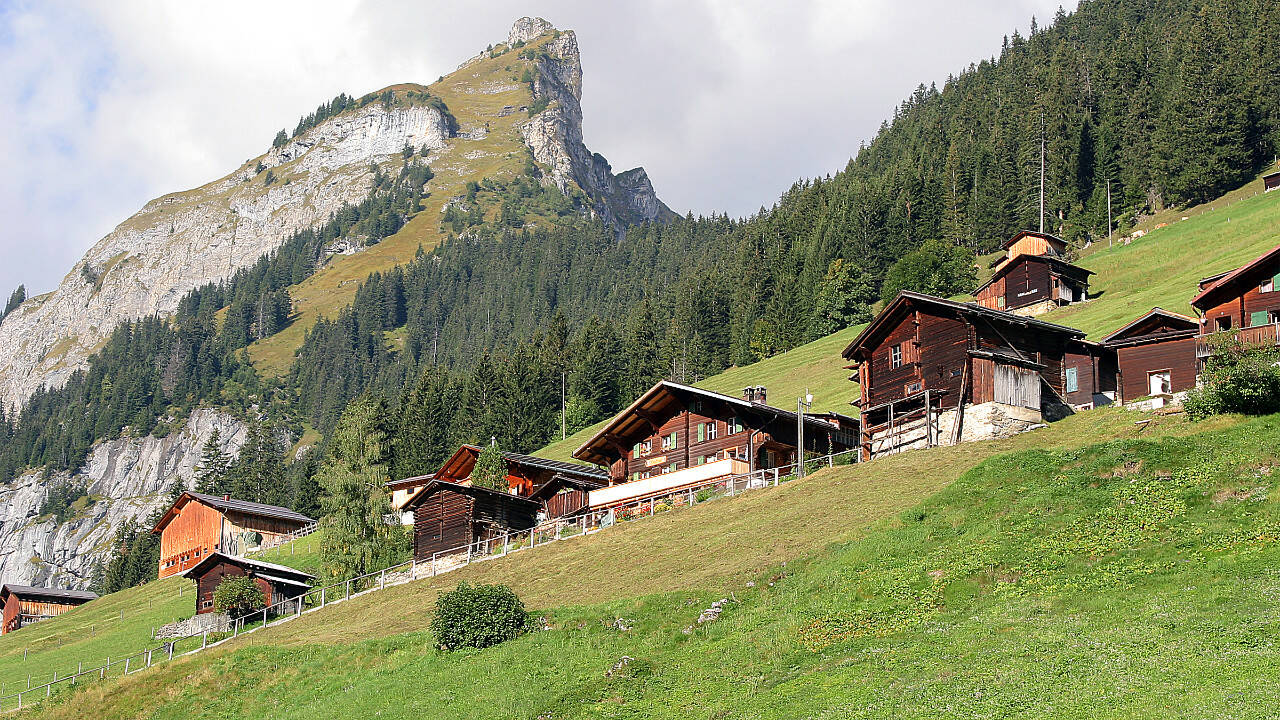
The villagers of the Swiss Alps have an endearingly intimate relationship with the nature that surrounds them, the history of their valley and the folk legends that make that history even more interesting. And, taking a hike there with a local comes with as many cultural insights as it does alpine views. I’m spending my day walking with my schoolteacher friend, Olle, exploring the alpine landscape surrounding his home in Gimmelwald. Before we’re too far along, I realize I’m getting a blister.
Opening his rucksack on a rock, Olle asks me to take off my shoe and sock. Muttering that he can’t believe how tourists tackle these mountains without good hiking boots, he fits some moleskin around my tender toe. As Olle works, I lie back on the rugged tufts of grass growing through the pebbly shale.
We continue on, following a faint path along the ridge. I stop every few steps to enjoy vast views of the Schilthorn on our left and the Jungfrau on our right. Olle takes on his teacher’s voice: “We respect nature more than the tourists do. When there’s an avalanche warning, we take the gondola down. Tourists continue sledding. There are many accidents. In Lauterbrunnen, maps show red flags for places of mountain injuries and black ones for deaths.” Pointing to the towering rock cliff of the mountain over the valley directly ahead of us, he says, “The Eiger is solid black.”
As I squint up at a wasp-like helicopter, Olle answers my question before I ask it. “Those are mostly sightseeing trips. But even sightseeing trips are related to mountain rescue. As they show a tourist around, they are practicing for emergency rescues.”
“Are there really dead climbers hanging from ropes on the Eiger?” I ask.
“Yes,” says Olle. “It’s sad when bodies are finally recovered. They look like they did when we saw them last, except with a very light beard. You can tell from the beard how long they lived. The family has to identify them.”
The weather can turn at any time. Just last month, a storm hit fast. Within a few minutes, five people died: three mountaineers on the Eiger, one on the Monch, and one in the air — a paraglider.
I tell Olle of a harrowing experience I had back in my youth-hostel days. We’d hike up the Schilthorn from the hostel with a plastic bag, sit on the bag, and slide down the glacier — breathtaking fun. As a reckless young tour guide, I’d lead my groups down the mountain in the same way.
One day, late in the season, sliding on an icy but smaller-than-usual sliding field, I started going out of control. Hurtling directly toward the rocky edge, I didn’t know what to do, but I did know I had to do something. After almost too much time to consider my options, I dug my hands like brakes into the rocky ice. Going through several degrees of burn in a matter of seconds, I ground to a halt with blackened, blistered, and bleeding hands — and a bloody butt.
My group heralded me as a hero. But in the doctor’s office in Murren, I was scolded as a fool, the whipping boy for all the stupid tourists who disrespect the power of the mountain. The doctor didn’t even bother to clean my hands. He lectured me, sprayed something on my wounds, and bandaged me. I left knowing that the little bits of Schilthorn embedded in my palms would come out only in the pus of a later infection.
Olle nods, as if in support of the doctor, and says, “This happens many times.”
He tells me that even cows become victims of the mountains, occasionally wandering off cliffs. Alpine farmers expect to lose some of their cows in “hiking accidents.” These days, cows are double the weight of cows a hundred years ago and no less stupid. If one wanders off a cliff in search of greener grass, the others follow. Farmers tell their sons about the time at the high Alp above Gimmelwald when a dozen cows performed this stunt — and died like lemmings. Helicopters recover the dead cows, flying them out, but because the meat must be drained of blood immediately for human consumption, it’s wasted. It’s meat fit only for dogs.
Switzerland originally attracted me by its icy peaks and its thrilling mountain lifts that made conquering summits just a matter of buying a ticket. But what keeps me coming back is the way it embraces its traditions and celebrates its culture. This is a land where nature is both wild and accessible and where the traditional culture survives most heartily in its most remote corners.
Edmonds resident Rick Steves (www.ricksteves.com) writes European guidebooks, hosts travel shows on public TV and radio, and organizes European tours. This article was adapted from his book, “For the Love of Europe.” You can email Rick at rick@ricksteves.com and follow his blog on Facebook.
Talk to us
> Give us your news tips.
> Send us a letter to the editor.
> More Herald contact information.
























