
Of the great cities of Europe, four are worth a week of sightseeing: London, Paris, Rome and Istanbul. And of those, Istanbul offers the most thrills for the best price. With every visit, I simply get out and stroll.
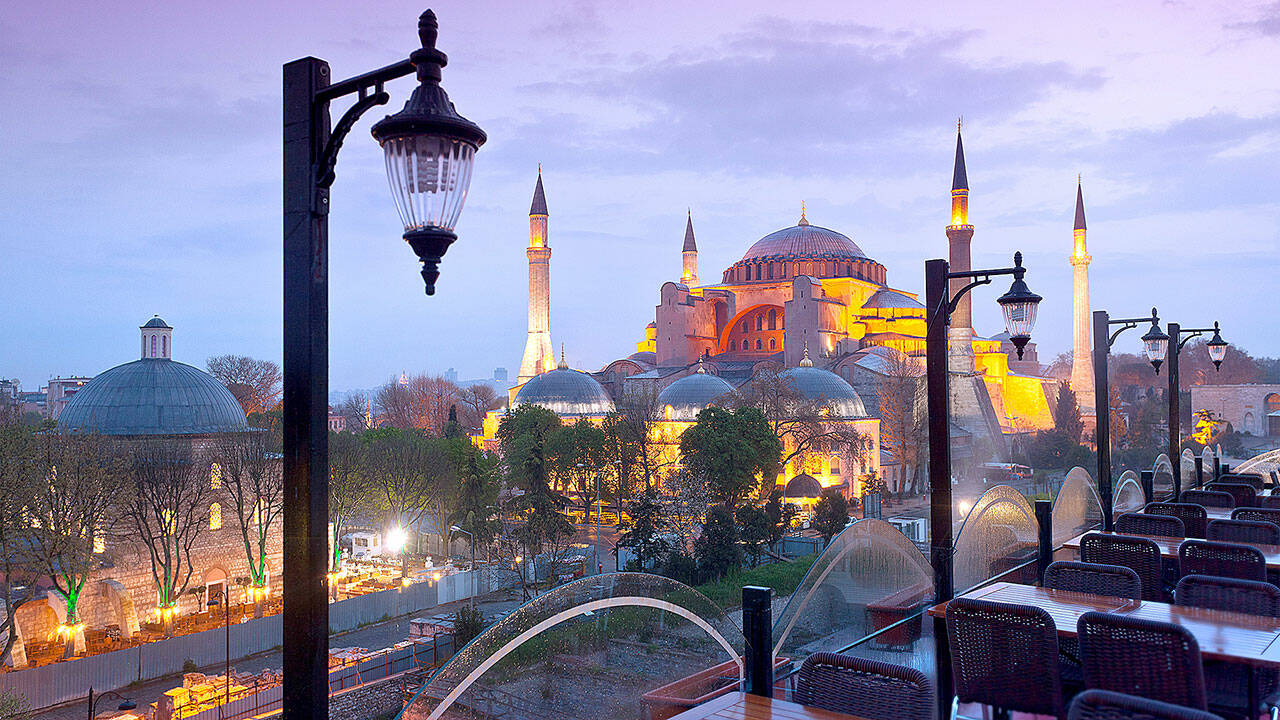
The historic and touristic center of Istanbul between the Hagia Sophia Mosque and the Blue Mosque is virtually traffic-free, with blossoming trees, refreshing fountains and a mix of strolling visitors from all over Europe and the Middle East as well as locals. I take a minute to sit on a bench and marvel at the almost Parisian elegance of the scene.
As the sun sets and evening prayer time approaches, I hike through teeming streets to the iconic Blue Mosque. The outer courtyard is crowded with families — worshipful parents and kids looking for entertainment.
Wandering under stiletto minarets, I listen as a hardworking loudspeaker — lashed to the minaret as if to a religious crow’s nest — belts out a call to prayer. Noticing the twinkling lights strung up in honor of the holy month of Ramadan, I think, “Charming — they’ve draped Christmas lights between the minarets.” (A Turk might come to my house and say, “Charming — he’s draped Ramadan lights on his Christmas tree.”)
The Blue Mosque offers a warm welcome. Stepping out of my shoes, I enter the vast space — more turquoise than blue — hoping for deja vu that never comes. Something’s missing. Gone is the smell of countless sweaty socks, knees, palms and foreheads that had soaked into the ancient carpet from worshippers’ energetic, physical prayer workouts. Sure enough, the Blue Mosque has a fresh new carpet — with a subtle design that keeps worshippers organized in the same way that lined notepaper tames written letters.
As the prayer service lets out, I’m caught up in a sea of Turks that surges toward the door. This is the kind of connecting with humanity moment that I seek out. It’s the closest I’ll ever come to experiencing the exhilaration of body-surfing above a mosh pit. As I surf the flow of worshippers through the gate and out into the street, the only way to get any personal space is to look up into the sky. Doing that, I enjoy another prized memory — another Istanbul deja vu: Hard pumping seagulls flap their wings through the humid air in the dark sky before surging into the light, crossing and then circling the floodlit minarets.
The Hippodrome — a long, oblong plaza shaped like a chariot racecourse, as was its purpose 18 centuries ago — is invigorated by the multigenerational conviviality of the Ramadan crowds emptying out of the mosque. While the crowd seems to be gaining energy, I’m running out of steam. But before heading back to my hotel, I look for a tea house to follow my end of day ritual.
I established this ritual in visits to Turkey as a backpacking student and I return to it now. I cap my day with a bowl of sutlac: rice pudding with a sprinkle of cinnamon. It’s still served in a square steel bowl with a small matching spoon. Another part of the ritual: I don’t let a Turkish day go by without enjoying a tea house game of backgammon with a stranger. Looking at the board tonight, I notice that it’s cheap and mass produced, almost disposable. Today’s dice — plastic and factory perfect — make me miss the tiny handmade “bones” of the 20th century, with their disobedient dots. But some things never change. To test a fun cultural quirk, I toss my dice and pause. As I knew would happen, a bystander moves for me. When it comes to backgammon, there’s one right way … and everybody knows it. And in Turkey, perhaps as a result of its ruthless history, when starting a new game, the winner of the last game goes first.
With each backgammon game, I think of one of my most precious possessions back home: an old time, hand- hewn, inlaid backgammon board, with rusty little hinges held in place by hasty tacks, and soft, white wood worn deeper than the harder, dark wood. Twenty years after taking that backgammon board home, I open it and still smell the tobacco, tea and soul of a traditional Turkish tea house.
There’s almost nothing in my world that is worn or has been enjoyed long enough to absorb the smells of my life and community. It’s a reminder to me of the cost of modernity. At home, the feel and smell of my old backgammon board takes me back to Turkey. And when it does, I’m reminded how, in the face of all that modernity, the endangered though resilient charm of traditional cultures — anywhere in our world — is something to value.
Edmonds resident Rick Steves (www.ricksteves.com) writes European guidebooks, hosts travel shows on public TV and radio, and organizes European tours. This article was adapted from his new book, For the Love of Europe. You can email Rick at rick@ricksteves.com and follow his blog on Facebook.
Talk to us
> Give us your news tips.
> Send us a letter to the editor.
> More Herald contact information.
























