
Collecting is a pastime in almost every country.
Children start collecting with stones, leaves, bottle caps and free toys that came with a Happy Meal. Adults search for things by great artists, things that bring memories of new or old technology, history, family or the future.
Collections have special meanings either bringing joy or money, so it is not a surprise to find there are many porcelain plates and paintings that picture collected things.
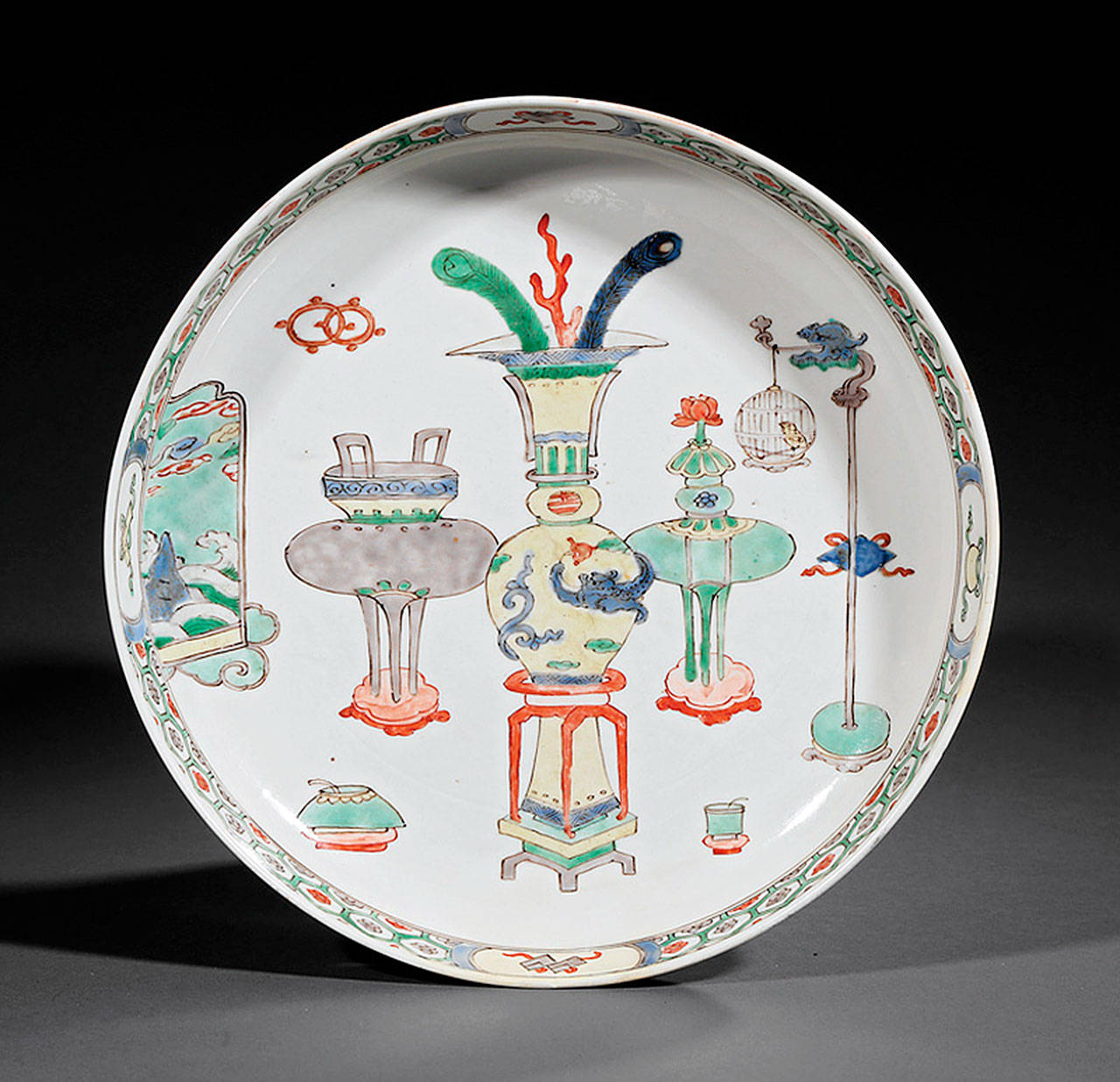
During the 17th century, the Chinese had a popular pattern that pictured vases, tables, birdcages, screens and other household furnishings. The pattern continues into the 19th century.
An English Ridgway Potteries dinnerware pattern called “Homemaker” shows pieces of 1950s furniture, and a set of dishes called “50’s Kitchen” by Fitz and Floyd has individual kitchen equipment — even an aluminum TV-dinner tray. All of these patterns are similar, scattered individual items, not scenes or groupings.
The Chinese 17th-century Famile Verte dish recently sold for $2,440 at a Neal Auction in New Orleans. The American plate sells for $10; the English version sells for $5 to $10.
Q: My mother-in-law worked at a Kodak developing store in the late 1940s and ’50s. She got several 5-by-8 and 8-by-10 photos of famous people. There are 5-by-8 photos of Duke Ellington, Queen Elizabeth in her 20s, Richard Nixon, Mel Tormé, Jack Dempsey and Gary Cooper. The 8-by-10 photos include Jackie Robinson, President Eisenhower and Winston Churchill in lawn chairs, Clark Gable, Eleanor Roosevelt, Liberace in his 20s, Louis Armstrong, Marilyn Maxwell and Bob Hope. Are they worth anything?
A: The value of a photo depends on the importance of the person photographed, the occasion and the condition and clarity of the photo. Photos of politicians, if taken on an important occasion, might sell for more than photos of celebrities. Photos of sports heroes might sell at a sports-card meet. Unless the photos are of “significant events,” they probably would sell online for $10 or less. If you plan to sell your pictures, identify the event as well as the people pictured.
Q: I have purchased a vase with the markings of Val Saint Lambert. It’s cranberry-cut crystal, 6½ inches tall, and has a gold label on the bottom that reads “Val St. Lambert/Begioue.” I am hoping you might be able to tell me more about this vase.
A: The Val St. Lambert glassworks company was founded by Messieurs Kemlin and Lelievre, a chemist and an engineer, in 1826 at a Cistercian monastery in Seraing, near Liege, Belgium. The company made all types of table and decorative glassware, and pieces often are decorated with cut designs. The company still is in operation and prides itself as making one of the clearest glasses in the world. The label you mention actually reads “Val St. Lambert/Belgique/depose,” which indicates that it was made in Belgium. Your vase was made in the 1930s and is worth about $250 to $350.
Q: I have a clear glass jar shaped like a duck’s face. It’s 4½ inches long and 2¼ inches wide. The red metal screw lid reads “Nash Kiddy Bank, Try Our Tic Tic Relish” with a slot for coins. The jar originally held prepared mustard. Is it meant to be Donald Duck? And does the jar have any value?
A: Your Nash’s Mustard jar was designed to look like Donald Duck. The shaped jar’s design was patented in 1938. After the mustard was gone, you could remove the inner liner of the lid and press open the coin slot. Nash’s Mustard was also sold in jars shaped like the head of boxer Joe Louis, called “Lucky Joe,” a clock and the Liberty Bell from the late 1930s into the 1950s. The jars were made by Hazel-Atlas Glass Co. Jars like yours are easy to find and sell for about $10 to $25.
Q: I have an old key-cutting machine that has a hand crank. It appears to be cast iron and still works. I have cut older model car keys as well as house keys. The only marking I can find is “Patented Oct. 22 1895.” I am wondering about its value.
A: A machine “for duplicating articles” was designed by Edmund R. Darling of Woonsocket, Rhode Island, and patented as of Oct. 22, 1895. It had two slots with clamps on a bed plate and a slide with bearings that moved up and down and across the machine. A key was placed in one of the clamps and a blank in the other. The cutting operation was saidto be “easy and rapid.” It’s not clear who actually made your machine, but marked cutting machines by other companies can be found from about 1907. They saved and used by lock collectors. Yours would sell for about $60 to $80.
Q: I need information and value on my grandfather’s set of sandstone-like building blocks. They are in a wooden box with two trays of blocks, plus pictures and directions (in German) for building castles and buildings. The set is called “Richter’s Designs for Architectural Models.” It was made in Germany. There is no date, but the set probably is from the late 1890s.
A: An early mention of building blocks was in a 1798 book about educating children. In the early 1840s, Friedrich Fröbel created the idea of kindergarten and designed educational-toy “gifts” to stimulate children’s intellects through play. Among these were wooden blocks in various shapes. In the 1870s, German engineers Otto and Gustav Lilienthal developed stone building blocks of quartz sand, chalk and linseed oil. Businessman Adolf Richter purchased the rights to the stone and the machines used to make them. He called them “Richter’s Anchor Blocks” and sold them in sets with instructions for “Designs of Architectural Models.” They became popular. Richter died in 1910, but the blocks continued to be made in Rudolstadt, Germany (East Germany), until 1963. A club was formed in 1979 for fans of the blocks. The company was restarted in 1994 and it’s now owned by Gollnest & Kiesel, a European specialty toy company. Fifteen types of sets are still made — of quartz sand, chalk and linseed oil — like the antique ones. Old sets from the late 1800s and early 1900s have sold from $50 to $200.
Tip: Use paper plates between your china plates to help prevent chipping.
Current prices
Current prices are recorded from antiques shows, flea markets, sales and auctions throughout the United States. Prices vary in different locations because of local economic conditions.
Postcard, embossed “Memorial Day Souvenir,” Betsy Ross making the first flag, stars and stripes, c. 1905, 3 ½ x 5 ½ inches, $25.
Snuff box, lift lid, hammered brass, oval cartouche with beaded frame, Hungary, c. 1905, 2 x 3 inches, $65.
Cup and saucer, cup with orange peel pattern and petal rim, saucer with painted roses and scalloped rim, Westmoreland, 1906, 4 x 6 inches, $110.
Water sprinkler, figural duck, cast iron, rusty orange color, angled spouts on top of head, c. 1920s, 6 x 13 inches, $200.
Tricycle, wood, paint and metal, spoked wheels, shaped plank seat, handle bar, 1800s, Marked, Haywood Wakefield, 19 x 22 inches, $315.
Souvenir, cuff bracelet, sterling silver and enamel, etched with travel landmarks in Vienna, Austria, c. 1905, 2 x 7 inches, $460.
Train-whistle sign, “W,” Pennsylvania Railroad, iron, angular shape, orange and black, mounting hole, 1910s, 16 x 16 inches, $650.
Desktop telephone, black metal with bakelite receiver, rotary dial, rubber cord, round base, Art Deco style, Western Electric, 1925, $905.
Butler’s tray, Victorian, mahogany, turned hinged stand, front loading two-plank tray, shaped side handles, c. 1850, 48 x 32 inches, $1,255.
Wine cabinet, French Renaissance, walnut with marble interior, barley twist columns, drawer, carved pendant, 1800s, 47 x 20 inches, $2,250.
Talk to us
> Give us your news tips.
> Send us a letter to the editor.
> More Herald contact information.
























