
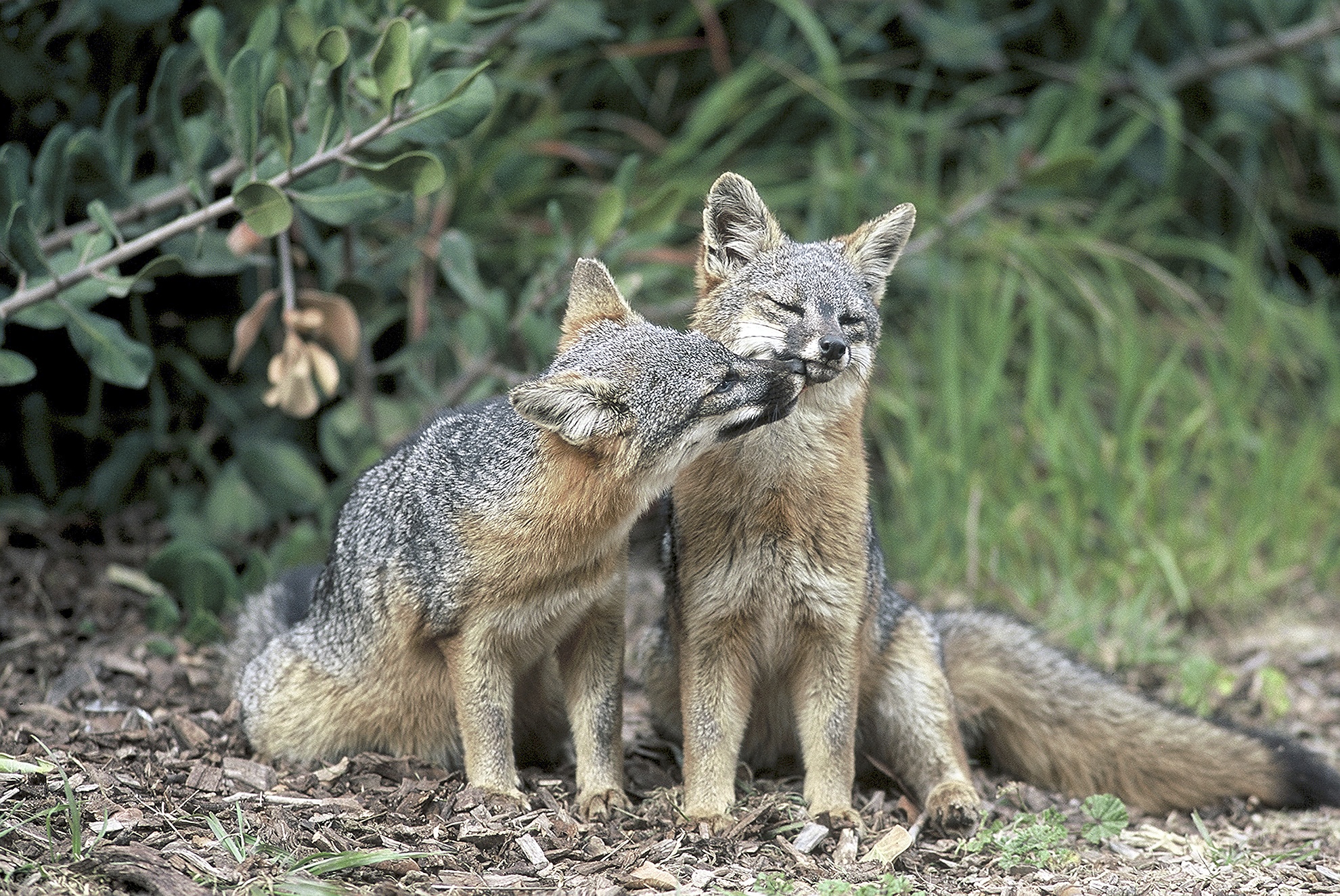
U.S. Fish and Wildlife Service                                Two island foxes in the Channel Islands National Park in California.

U.S. Fish and Wildlife Service Two island foxes in the Channel Islands National Park in California.

California island foxes removed from endangered species list

Associated Press

LOS ANGELES — Not long ago, foxes native to the Channel Islands off the California coast teetered on the edge of extinction.

They have rebounded to the point where U.S. wildlife officials on Thursday removed three subspecies of island fox from the roster of federally endangered species, hailing their comeback as the fastest recovery of any mammal listed under the Endangered Species Act.

The diminutive foxes that roam San Miguel, Santa Rosa and Santa Cruz islands were placed on the endangered list in 2004 after their populations were nearly wiped out by golden eagles.

Scientists credited the swift recovery to an effort to relocate predators and breed foxes in captivity so they can be reintroduced to the wild.

“We’re ecstatic that we’ve reached this point so quickly,” said Steve Henry, field supervisor of the U.S. Fish and Wildlife Service’s office in Ventura.

About the size of a house cat, the island foxes — with their gray coats and reddish-brown ears — are only found on six of the eight Channel Islands where they have lived for thousands of years.

Populations have returned to self-sustaining levels ranging from an estimated 700 foxes on San Miguel Island to 2,100 foxes on Santa Cruz Island.

Centuries ago, ranchers and farmers imported nonnative animals such as pigs, cattle and sheep to the islands. Golden eagles migrated after native, fish-eating bald eagles were wiped out by the discharge of chemical DDT off the coast.

The golden eagles preyed on piglets and hunted foxes. By 2000, there were only 15 foxes each on San Miguel and Santa Rosa islands and 55 foxes on Santa Cruz Island.

The wildlife service partnered with the National Park Service, Nature Conservancy and Catalina Island Conservancy to hatch an aggressive plan that included moving golden eagles to Northern California, reintroducing bald eagles to the islands, vaccinating foxes and breeding them in captivity.

The effort was not without controversy. Thousands of pigs were shot and killed, angering animal rights groups. Wildlife officials said eliminating pigs was necessary to force golden eagles to forage elsewhere and help the foxes bounce back.

The islands’ remoteness also played a key role in the foxes’ resurgence, giving scientists better control over recovery efforts than if they happened on the mainland.

Years ago, “you would not have seen a fox. Now, you go out there and you don’t have to wait very long before a fox crosses your path,” said Scott Morrison of the Nature Conservancy, which co-owns Santa Cruz Island.

Funding for the yearslong recovery came from public and private sources and included volunteer time. Officials did not have an estimate of the overall cost but said the captive rearing and monitoring portions of the program cost about $20 million.

With the fox delisting, 19 animals and plants have been pulled from the endangered species list since President Barack Obama took office, more than previous administrations, wildlife service director Dan Ashe said.

The last U.S. mammal to be removed from the list in record time was the eastern Steller sea lion in 2013 after more than two decades. Since the Endangered Species Act passed in 1973, 37 species have recovered.

Biologists planned to monitor foxes on the northern Channel Islands by conducting periodic health checks and tagging select foxes with radio collars. Technician Stacy Baker used a tool Thursday to examine the teeth of a 3-year-old female fox on Santa Cruz Island. After giving it a clean bill of health, the fox scampered into the underbrush.

Foxes on Santa Catalina Island — a tourist destination — also are recovering but not as fast as their counterparts on the northern Channel Islands. Their numbers plummeted in the 1990s after an outbreak of canine distemper, likely brought over from the mainland.

Federal officials downgraded the status of the Catalina foxes from endangered to threatened because disease outbreak remains a concern.

Talk to us

> Give us your news tips.

> Send us a letter to the editor.

> More Herald contact information.

More in Local News

A sign notifying people of the new buffer zone around 41st Street in Everett on Wednesday, Jan. 7. (Will Geschke / The Herald)
Everett adds fifth ‘no sit, no lie’ buffer zone at 41st Street

The city implemented the zone in mid-December, soon after the city council extended a law allowing it to create the zones.

Logo for news use featuring the Tulalip Indian Reservation in Snohomish County, Washington. 220118
Teens accused of brutal attack on Tulalip man Monday

The man’s family says they are in disbelief after two teenagers allegedly assaulted the 63-year-old while he was starting work.

A view of the Eastview development looking south along 79th Avenue where mud and water runoff flowed due to rain on Oct. 16, 2025 in Snohomish, Washington. (Olivia Vanni / The Herald)
Eastview Village critics seek appeal to overturn county’s decision

Petitioners, including two former county employees, are concerned the 144-acre project will cause unexamined consequences for unincorporated Snohomish County.

Snohomish County commuters: Get ready for more I-5 construction

Lanes will be reduced along northbound I-5 in Seattle throughout most of 2026 as WSDOT continues work on needed repairs to an aging bridge.

Logo for news use featuring the municipality of Snohomish in Snohomish County, Washington. 220118
Snohomish man held on bail for email threat against Gov. Ferguson, AG Brown

A district court pro tem judge, Kim McClay, set bail at $200,000 Monday after finding “substantial danger” that the suspect would act violently if released.

Kathy Johnson walks through vegetation growing along a CERCLA road in the Mt. Baker-Snoqualmie National Forest on Thursday, July 10, 2025 in Granite Falls, Washington. (Olivia Vanni / The Herald)
Activism groups to host forest defense meeting in Bothell

The League of Women Voters of Snohomish County and the Pacific Northwest Forest Climate Alliance will discuss efforts to protect public lands in Washington.

Debris shows the highest level the Snohomish River has reached on a flood level marker located along the base of the Todo Mexico building on First Street on Friday, Dec. 12, 2025 in Snohomish, Washington. (Olivia Vanni / The Herald)
SnoCo offers programs to assist in flood mitigation and recovery

Property owners in Snohomish County living in places affected by… Continue reading

x
Delay on Critical Areas Ordinance update draws criticism from groups

Edmonds is considering delaying updates to a section of the ordinance that would restrict stormwater wells near its drinking water aquifer.

Logo for news use featuring Snohomish County, Washington. 220118
Providence Swedish welcomes first babies of 2026 in Everett, Edmonds

Leinel Enrique Aguirre was the first baby born in the county on Thursday in Everett at 5:17 a.m. He weighed 7.3 pounds and measured 20 inches long.

Marysville house fire on New Year’s Day displaces family of five

Early Thursday morning, fire crews responded to reports of flames engulfing the home. One firefighter sustained minor injuries.

Floodwater from the Snohomish River partially covers a flood water sign along Lincoln Avenue on Thursday, Dec. 11, 2025 in Snohomish, Washington. (Olivia Vanni / The Herald)
Images from the flooding in Snohomish County.

Our photographers have spent this week documenting the flooding in… Continue reading

The Optum Everett Campus on Tuesday, Aug. 27, 2024 in Everett, Washington. (Olivia Vanni / The Herald)
In Snohomish County, new year brings changes to health insurance

A contract termination between Optum and Humana, as well as the expiration of enhanced tax credits for people covered by Affordable Care Act, went into effect Jan. 1.

Support local journalism

If you value local news, make a gift now to support the trusted journalism you get in The Daily Herald. Donations processed in this system are not tax deductible.



















