
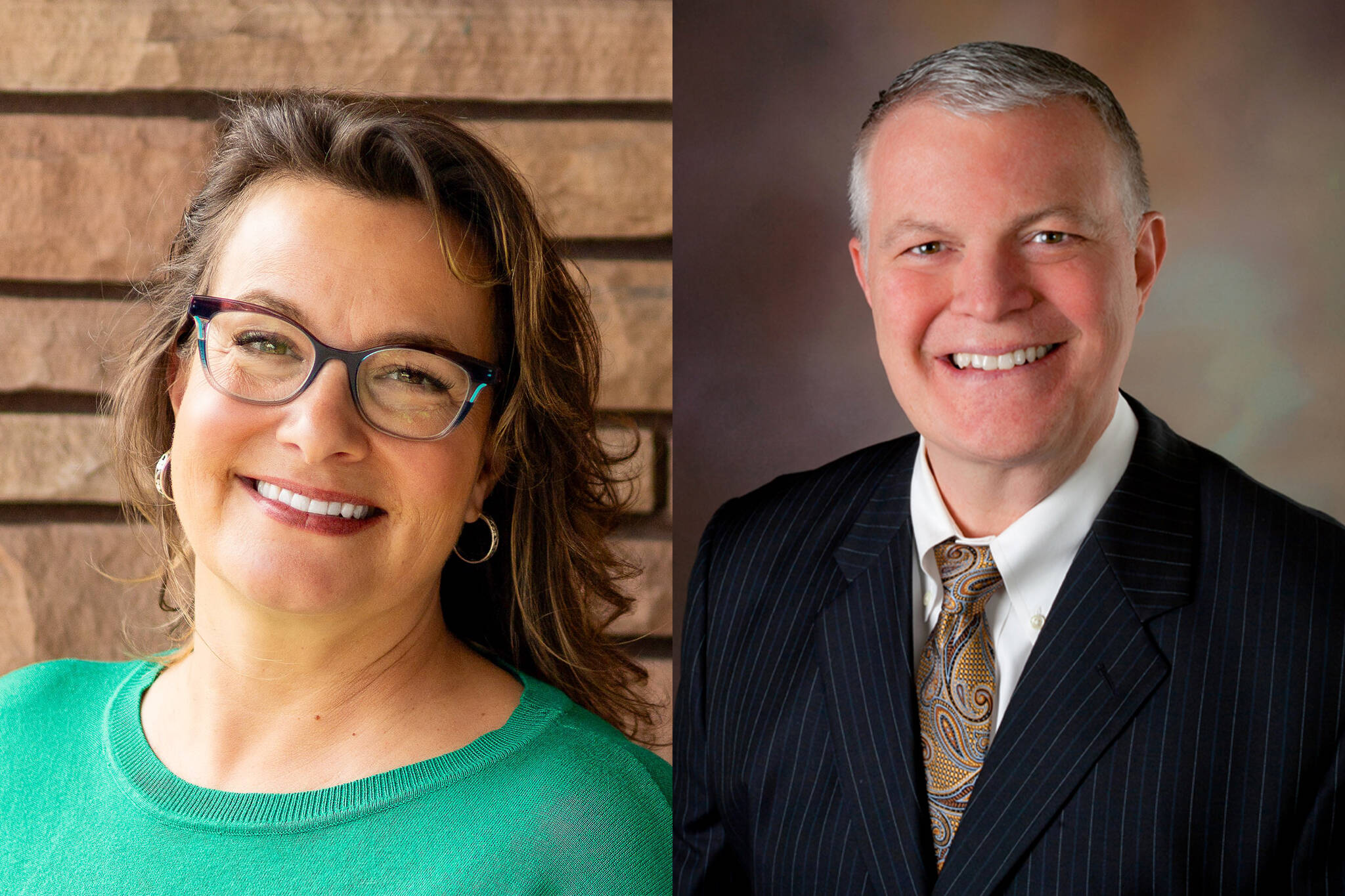
EVERETT — Incumbent mayor Cassie Franklin and former City Council member Scott Murphy are set to face off in the general election as the two seek the mayoral seat in the city of Everett.
The election is poised to be a close one. In the August primary, Murphy won with a narrow margin of just 65 votes, earning 35.2 percent of the vote compared to Franklin’s 34.8 percent. Together, the two candidates have raised nearly $500,000 in campaign contributions.
The winner will be the administrative head of Snohomish County’s largest city, presiding over its over 1,200 employees and $173 million general fund budget. The mayor earns $215,940 per year.
Election day is Nov. 4.
Cassie Franklin
Franklin, 54, is seeking a third term in office after being first elected to the mayoral seat in 2017. She had previously served as an Everett City Council member and the CEO of Cocoon House, a local housing nonprofit.
She has touted increases in housing construction, shelter space, new business licenses and falling crime rates as successes from her first two terms in office.
One of the city’s biggest challenges is its ongoing structural deficit, which has persisted since before Franklin took office. Franklin has cited the state’s 1 percent cap on annual property tax increases — lower than the rate of inflation — as a primary reason for the budget challenges, also faced by other cities across the state.
During her time in office, the city has closed cumulative budget gaps totaling about $100 million through spending cuts. Franklin has argued that Everett needs a revenue solution as cuts have become more and more difficult as services shrink.
In 2024, the city put forth a property tax levy lid lift that would have increased the city’s levy rate from $1.52 per $1,000 of assessed value to $2.19 per $1,000. For the average Everett homeowner, property taxes would have increased by about $336 per year, according to city estimates. Opponents of that levy said the city was overspending and needed to increase efficiency.
After voters shot the levy down, the city cut 31 jobs via a mix of buyouts, eliminating unfilled positions and layoffs. Twenty-four other workers saw their hours reduced or faced mandatory furloughs. After the cuts, the library was forced to reduce its hours and the city’s park ranger program was cut entirely.
While the 2026 budget will not require staffing reductions because of the previous year’s cuts and the use of COVID relief dollars, Franklin said the city needs to find a revenue solution, either through an increase to the statewide property tax cap or a new levy targeted toward specific programs at the city.
“We will need to talk with our community about what they’re interested in investing in,” Franklin said. “No one wants to see us cut, I don’t want to see that. We don’t want to further cut any of our programs and services that really benefit our residents and ensure our quality of life.”
Franklin said conversations with community members will help drive what revenue options the city could explore, including regionalizing services or new targeted levies. The city has held a budget open house and launched a survey to gather community feedback.
Economic development opportunities are a major focus of Franklin’s campaign as another potential source of revenue growth that could address the city’s budget challenges. She cited new downtown construction, work toward a new downtown stadium, the creation of a new Everett chamber of commerce, a local nightlife initiative and a recent push toward earning a Creative District designation as recent positives toward developing the city’s economy.
Franklin also emphasized the work Everett has done toward a south Everett economic development strategy. The city spent $200,000 in American Rescue Plan Act funds to create a south Everett economic plan, which floated ideas to incentivize local property ownership and connect employers with residents looking for job training. Everett staff released that plan in July. Franklin said her goal is to invest in the area of the city while mitigating gentrification.
“Billions of investment will come through light rail, and it’s important that we harness that and use that best for south Everett businesses and residents, and to continue to grow our economy there,” Franklin said.
South Everett has faced a recent challenge as Kroger announced its plans to close the Fred Meyer location at the intersection of Evergreen Way and Casino Road, a long-standing grocery option for locals.
The grocer cited crime and regulations as reasons for the closure. After Kroger reached out to the city for help to address crime in 2022, Everett police implemented a buffer zone around the grocery store and begun emphasis patrols. Those measures resulted in decreased shoplifting rates at the Fred Meyer, Everett police statistics showed.
“There’s not anything else in the public safety arena that we could have done other than stationing a police officer 24/7 at the store,” Franklin said.
Franklin said as more and more shopping moves online, the city needs to continue doing its best to protect businesses and be responsive to their needs.
“What I can do to make this a business-friendly environment is to be tough on crime, have strong public safety initiatives, be sensitive to business taxes, make sure we are working in close partnership on development and redevelopment so that businesses see us as an easy government to work with,” Franklin said. “Those are things I can do, and we are doing it.”
After Fred Meyer announced the closure, the city distributed maps showing nearby grocery options for locals in the south Everett area. Franklin also made a nearby transit route fare-free for six months to remove barriers from accessing nearby services.
On housing, Franklin has said she would continue the work the city has already done through its comprehensive plan and upcoming subarea plans to encourage more dense development and increase housing options across income levels.
Over Franklin’s eight years in office, county point-in-time counts have shown that the city’s homeless population has nearly doubled. But she said those counts may have risen as people gain more access to shelters and the point-in-time count is able to reach more people. When Franklin took office, there was 91 shelter beds across the city, a number that will grow to 700 by the end of 2026, she said. She also celebrated an alternative response team the city implemented in 2024 to better respond to people facing behavioral health challenges.
“I do believe that the investments that we’re making are very successful, and I think proof of that is walking around our community,” Franklin said. “Walk around the city of Everett, then walk around any other urban city on the West Coast. We have very much addressed visible homelessness.”
To further address homelessness, Franklin said she would attempt to work with Snohomish County and cities across the region to make sure resources are more available countywide. She said the county and the state need to better address behavioral health issues.
“We have a lot more work to do in treatment, and that is beyond the city’s ability to tackle alone,” Franklin said. “We have to do that in partnership with the state, the county, but I believe the investments that we’ve made are fantastic. They are working.”
To address public safety concerns, Franklin has increased police spending and implemented new social worker programs. One challenge the city has faced since before Franklin took office is fully staffing its police department. She has previously said she will focus on the department’s implementation of new technology, maintaining competitive salaries and promoting the varied units officers can serve in to drive recruitment.
In July, Everett Police Chief John DeRousse said the city is “leading the way” in its staffing levels. At the time, the city had 19 vacancies, but that was partially due to an increased number of positions from a federal grant, he said. The number of officers currently on patrol is the highest the department has seen in over a decade, DeRousse said.
Crime rates have also dropped during Franklin’s time in office. In 2024, crime rates in Everett were at their lowest rate since 2015, FBI data shows. Under Franklin’s administration, crime rates rose following the COVID-19 pandemic and peaked in 2022 — following a statewide trend — but have been on the decline since.
“We are innovating every single day in our police department, and public safety will always remain a top priority,” she said.
Franklin also said her experience in the mayor’s seat was invaluable during a tumultuous federal administration.
“Our community needs to know that we have a local government that is in touch with them, that has led through the first Trump administration, that has led through COVID, that has led through tragedies, that can focus on what matters to Everett residents and do my best to protect and serve this community,” Franklin said. “While higher levels of government may be chaotic, we can take care of our community successfully, and I have the experience to do that.”
Franklin has been endorsed by Everett’s police, fire and municipal employees unions, the Snohomish County Democrats and the Snohomish and Island County Labor Council. She’s also received endorsements from U.S. Reps. Suzan DelBene and Rick Larsen, Washington Secretary of State Steve Hobbs, Snohomish County Council member Jared Mead, among others.
As of Tuesday, Franklin has received $234,457 in campaign contributions, state filings show.
Scott Murphy
Murphy, 63, is a former Everett City Council member who served on the dais from 2013 to 2021, spending time as chair of the budget committee. He also worked in business, including as the president of a glass and glazing company for more than a decade.
On the budget, Murphy has argued that Franklin’s administration has spent unsustainably given the city’s revenue trends. He said he would take a balanced approach to the budget, recognizing that the city needs more revenue while also looking for more areas to make cuts.
If elected, Murphy promised to reinstate the park rangers program and would find the funding for it from “a complete review of all the city’s budgets,” he said.
Murphy has said the levy lid lift the city put forth in 2024 was too broad, and if more revenue is needed, he would ask for a more targeted levy toward specific departments like parks, public safety or libraries only after making more spending cuts. He said the city’s proposal to use COVID relief dollars toward the 2026 budget was plugging the budget gap without addressing the structural deficit, and argued more work should have been done toward a longer-term solution.
“I would have been working proactively with the council and community to come up a set of options that could achieve support from the community, and that hasn’t happened,” he said.
On housing, Murphy said the city needs to improve its affordability as Everett, like other cities across Washington, has become more expensive to live in. He said the problem is largely a supply and demand issue, and the city needs to utilize tools like more flexible zoning, lot splitting and community land trusts to help incentivize construction of housing units.
“I believe we’ve got to pull every single lever we have available to us,” he said.
One challenge Murphy said he’s heard from developers is that the city’s permitting process is too lengthy, making builders less likely to construct housing in Everett as they seek other areas that are “more predictable and more timely in issuing permits,” he said.
In July, the city’s planning department said permit timelines began to rise after the 2008 recession as the economy began to recover. By 2020, wait times had spiked to as long as 18 weeks due to the COVID-19 pandemic, an increase in regulatory complexity and decreased staffing levels, said Tony Lee, a city public works official. By 2024, staffing had increased and the department was back to meeting its timelines, Lee said.
To improve permitting timelines, Murphy would increase staffing, give employees more training and focus on a “customer service mentality to get builders and developers to come back to Everett,” he said.
“I believe they will come back, but they want to see first that the investments and staffing and training have been put into place so they have confidence in the predictability of the process,” Murphy said.
To reduce homelessness, Murphy said he would conduct a strategic review of the programs the city currently funds, looking at the metrics, results and outcomes, then allocate funding to where the city gets “the biggest bang for the buck,” he said.
A longer-term priority would be to work with nearby cities and Snohomish County to consolidate resources and address homeless challenges regionally, as the city can’t tackle the problem alone, he said.
“We don’t want to waste money on bureaucracy,” Murphy said. “What we want is dollars to go into housing the homeless and the wraparound services.”
On public safety, Murphy said his top priority is getting the police department fully staffed. He’s previously said he would cut red tape for recruitment in the police department and emphasize a city commitment to officer support, training opportunities and community-oriented policing in order to attract police candidates.
Public safety issues, he said, may have been a reason that contributed to Fred Meyer deciding to close its south Everett location, as being short on staffing could have affected the department’s ability to proactively combat theft. If elected, he said he would consider starting a retail theft task force.
“It’s not 100% on this city that this store closed, but I believe the city should have done more earlier,” Murphy said. “It feels a little bit like it may have been too little, too late.”
To build the city’s economy, Murphy said he would create economic development plans focused on specific industries and geographies in the city with milestones for growth. He said he would attempt to attract new technology companies to the city, emphasize the construction industry and work with Washington State University’s Everett campus to try and increase enrollment.
Murphy also said he would prioritize reopening the Forest Park swimming pool that closed in 2020. His longer-term goals include implementing a series of new programs and city-wide reforms. He said they would include:
• A city-led program to connect underrepresented and low-income high school students with opportunities to attend college. Murphy said the program would be modeled after Seattle Promise, which provides up to two years of free tuition to graduates of Seattle Public Schools who attend any one of three Seattle Colleges. That program is funded via a property tax levy and private contributions, but Murphy said he would attempt to create a similar program funded by businesses and philanthropists, without asking for a tax increase.
• Expanding access to child care through new zoning incentives and grants while exploring subsidy or voucher programs for working families.
• Limiting mayors to only serving a maximum of two four-year terms.
• Updating the city’s Climate Action Plan that was originally adopted in 2020.
• Expanding support for immigrant populations by hosting more cultural events, building legal aid partnerships and working closer with local nonprofit Refugee and Immigrant Services Northwest.
• Limiting campaign contributions from contractors that do business with the city.
“I want to solve problems and I want to try to work to make life better for people in Everett, and I’ve got a few ideas on how we can do that,” Murphy said. “We have to be able to navigate and do all these things at the same time, but that’s the job of the city, is to solve problems and make life better for people in the community.”
Murphy has been endorsed by Everett’s local transit union, electrical union and painter’s union, as well as political committees representing accountants and contractors. He’s also received endorsements from State Sen. June Robinson, former Everett mayor Ed Hansen, Everett City Council member Judy Tuohy and Snohomish County Council members Megan Dunn and Sam Low, among others.
As of Tuesday, Murphy has received $251,177 in campaign contributions, state filings show.
Will Geschke: 425-339-3443; william.geschke@heraldnet.com; X: @willgeschke.
Talk to us
> Give us your news tips.
> Send us a letter to the editor.
> More Herald contact information.
























