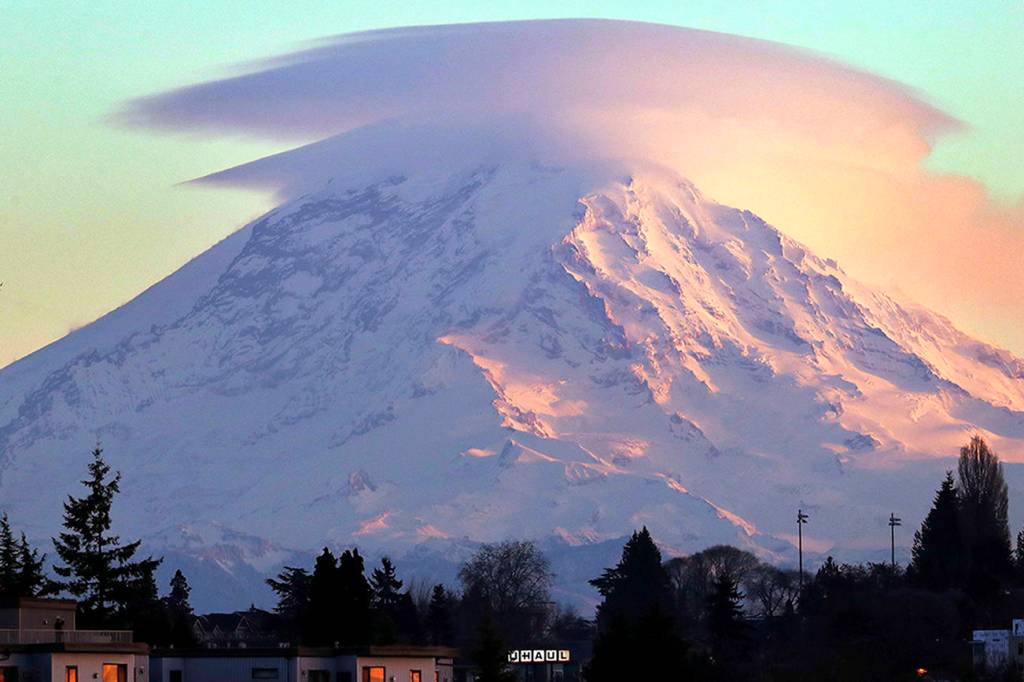
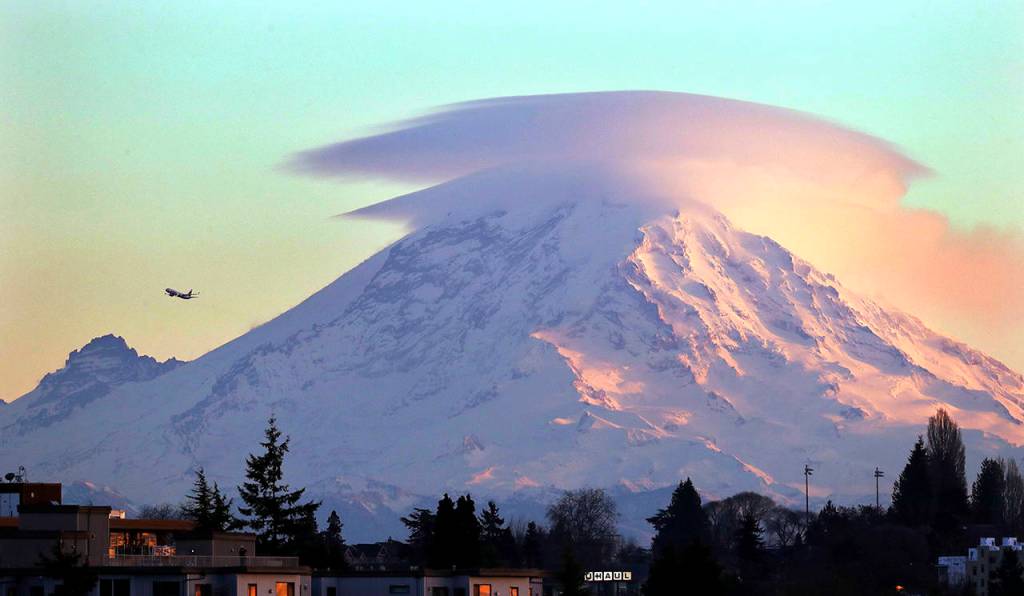
Lenticular clouds cap Mount Rainier at dusk as a jet passes by on Dec. 31, 2018, as seen from Seattle. (AP Photo/Elaine Thompson, file)

Lenticular clouds cap Mount Rainier at dusk as a jet passes by on Dec. 31, 2018, as seen from Seattle. (AP Photo/Elaine Thompson, file)

More than one-third of US volcanoes are under-monitored

Snow-capped Glacier Peak is classified by the U.S. Geological Survey as a “very high threat.”

  • By Julianna Rennie McClatchy Washington Bureau (TNS)
  • Thursday, March 14, 2019 9:18am
  • Northwest

By Julianna Rennie / McClatchy Washington Bureau

WASHINGTON — Of the United States’ 161 active volcanoes, 57 are under-monitored, according to the U.S. Geological Survey, creating blind spots that pose a huge potential threat to public safety.

In 2009, Washington allocated funds to improve the monitoring systems, but the money quickly ran out, and recent spending initiatives never went anywhere.

Dr. Seth Moran is the lead scientist at the Cascades Volcano Observatory, which monitors volcanic activity in Washington, Oregon and Idaho.

A properly monitored volcano has between 12 and 20 scientific instruments on the ground, Moran said. But Glacier Peak, a snow-capped volcano 70 miles northwest of Seattle that’s classified by the U.S. Geological Survey as a “very high threat,” has one.

There are 28 under-monitored volcanoes in Alaska, seven in California and five in Washington state. In the United States, five volcanoes erupted in 2018 and three volcanoes erupted in 2017.

Overhauling the current volcano monitoring infrastructure will require at least $50 million from the federal government and could take a decade to implement, according to Dr. Charles Mandeville, coordinator of the Volcano Hazards Program at the U.S. Geological Survey.

Congress recently took its first step toward addressing the problem. Last month, lawmakers voted to authorize the National Volcano Early Warning and Monitoring System, which was included in a massive public lands bill.

There are currently five volcano observatories across the country that are responsible for monitoring and warning the public about volcanic activity: the Alaska Volcano Observatory, California Volcano Observatory, Cascades Volcano Observatory, Hawaiian Volcano Observatory and Yellowstone Volcano Observatory.

The observatories lack the funding necessary to properly monitor each volcano and watch incoming data around the clock, according to Moran.

The National Volcano Early Warning and Monitoring System would modernize and standardize the tools at all of the observatories. It also would enhance coordination between the observatories by creating a national volcano data center and a national volcano watch office that operates around the clock.

The National Volcano Warning and Monitoring System also creates a federal advisory board and a research grant program for volcano science.

The U.S. Geological Survey first proposed the system in 2005. Since then, lawmakers have been slow to put it into effect. Sen. Maria Cantwell, D-Wash., said: “It has been on the priority list, but just couldn’t move through the process without a larger (legislative) vehicle. We don’t want to do it that way, but basically what happens is other people who have priorities hold up your bills.”

Last year, similar legislation supported by Cantwell and Sens. Lisa Murkowski, R-Alaska, and Mazie Hirono, D-Hawaii, passed in the Senate. But the House, which was controlled by Republicans at the time, never scheduled it for a vote.

On Tuesday, President Donald Trump signed the public lands bill, which passed in both chambers in February.

In the past decade, scientists have developed the technology to not only detect eruptions, but also forecast them. “Volcanoes do things before they erupt, typically, but you’ve got to have ground-based instruments on the volcano to actually record these precursors to an eruption,” Mandeville said.

Extremely sensitive seismometers can record minor earthquakes that increase in frequency before an eruption, and drones carrying sensors can measure changes in gas emissions from the volcano.

If volcanoes are equipped with this technology, then scientists can identify the warning signs of an eruption sooner, which gives emergency responders more time.

Mandeville explained that the Mt. Kilauea eruption in 2018 in Hawaii demonstrated how the National Volcano Early Warning and Monitoring System could help save lives. Scientists at the Hawaiian Volcano Observatory were able to identify the warning signs of an eruption in time to evacuate the surrounding areas. The eruption destroyed more than 700 homes, but there were no deaths.

“A lot of the instrumentation that we would like to put on more of our volcanoes already existed at Mt. Kilauea,” Mandeville said. “It illustrates what can be done to safeguard people when you’ve got the proper instrumentation in place.”

With he public lands measure signed into law, the U.S. Geological Survey will create a plan to implement the newly authorized National Volcano Warning and Monitoring System. The next step will be for Congress to approve the funds it requests.

Murkowski, who chairs the Senate Energy and Natural Resources Committee, said that she’ll work to get full and lasting funding for the National Volcano Warning and Monitoring System, which she has championed for years.

“We’re going to make sure that it is not only a part of this next year’s appropriation, but that we’ve got support going forward,” she said.

Talk to us

> Give us your news tips.

> Send us a letter to the editor.

> More Herald contact information.

More in Northwest

Washington Gov. Bob Ferguson, left, shakes hands with Cowlitz Indian Tribe Chairman Bill Iyall after signing an executive order to improve the state’s relations with tribal governments on Oct. 22, 2025. (Photo courtesy of Washington governor’s office)
Washington tribes could get more say in management of state logging lands

A bill to add two tribal representatives to the Board of Natural Resources is awaiting a Senate vote. Supporters say the change could add valuable perspective to the panel.

A view of the Washington state Capitol building in Olympia, obscured by a slight mist, Jan. 27, 2025. (Photo by Bill Lucia/Washington State Standard)
The bills that didn’t survive the WA Legislature’s first major deadline

A 60-day legislative session can be a cruel thing if you’re hoping… Continue reading

Washington State Capitol building in Olympia. (Courtesy photo)
Ferguson rejects WA lawmakers’ initial crack at income tax legislation

The Democratic proposal targets household earnings over $1 million.

Senate Majority Leader Jamie Pedersen, D-Seattle, during Senate floor debate on Jan. 28, 2026. (Photo by Bill Lucia/Washington State Standard)
WA Senate leader explains dim outlook for a new tax on big businesses

Senate Majority Leader Jamie Pedersen previously backed the payroll tax, but suggests there’s no political path for it. He and others are forging ahead with an income tax proposal.

State Sen. John Lovick, D-Mill Creek, looks on toward the end of the roll call vote for his Senate Bill 5067, which would lower the blood alcohol limit for drunk driving to 0.05% from 0.08% in Washington. The bill passed the Senate on a 26-23 vote on Jan. 28, 2026. (Photo by Bill Lucia/Washington State Standard)
Lower drunk driving limit approved by WA Senate

The bill drops it to 0.05%, and the state would join Utah with the toughest standard in the nation. It still needs House approval.

Washington state Supreme Court Justice Colleen Melody is sworn in Wednesday, Jan. 21, 2026, in Olympia, Washington. (Photo by Jake Goldstein-Street/Washington State Standard)
Washington’s newest Supreme Court justice is sworn in

Colleen Melody is officially the Washington state Supreme Court’s newest justice. Melody… Continue reading

Washington Gov. Bob Ferguson at his State of the State address on Jan. 13, 2026. Ferguson did not discuss the budget cuts he’s proposing in his speech but they’ve stoked plenty of testimony in the first days of the 2026 legislative session. (Photo by Bill Lucia/Washington State Standard)
An icy reception for Gov. Bob Ferguson’s proposed budget cuts

Advocates for schools, public universities, and climate programs are among those unhappy with the raft of cuts the governor relies on to close a $2.3 billion shortfall.

The log-in page of Instagram’s website. (Photo by Alexander Castro/Rhode Island Current)
Push for youth social media safeguards revived in WA Legislature

A proposal would prohibit addictive feeds and push notifications at certain times for minors. Opponents believe it’s unconstitutional.

State lawmakers are considering bills requiring AI detection tools and disclosures to address deepfakes and to establish new safeguards for children using the technology. (Stock photo)
How Washington state lawmakers want to regulate AI

Reining in chatbots, protecting kids from harmful content, and requiring disclosure of AI-generated material are among the ideas under discussion in Olympia.

Bill Lucia / Washington State Standard
State Sen. Yasmin Trudeau, D-Tacoma, makes floor remarks on Feb. 4, 2026 about Senate Bill 6002, which would set state regulations for license plate readers. The bill passed 40-9, with only Republicans opposed.
WA Senate OKs guardrails for license plate readers

The legislation passed Wednesday mandates that reader data be deleted after 21 days and says it can’t be shared except in court proceedings.

House Bill 1608 seeks to build on a 2024 law banning octopus farming in Washington. (File photo)
Washington may ban sales of farmed octopus

Octopus is back on the policy menu for Washington state lawmakers. A… Continue reading

Gov. Bob Ferguson delivers his State of the State address on Tuesday in the House chamber at the Washington state Capitol. (Photo by Bill Lucia/Washington State Standard)
What Gov. Bob Ferguson said in State of the State address

The speech drew a more positive reaction from fellow Democrats than last year’s inaugural address. He touched on flood recovery, taxes and immigration enforcement.

Support local journalism

If you value local news, make a gift now to support the trusted journalism you get in The Daily Herald. Donations processed in this system are not tax deductible.