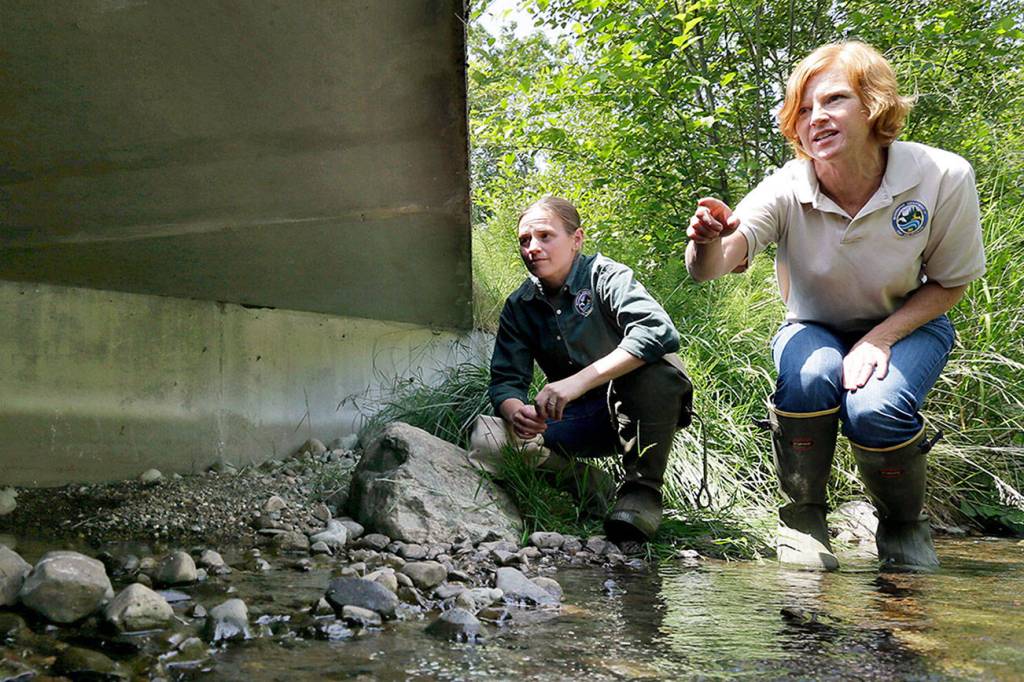
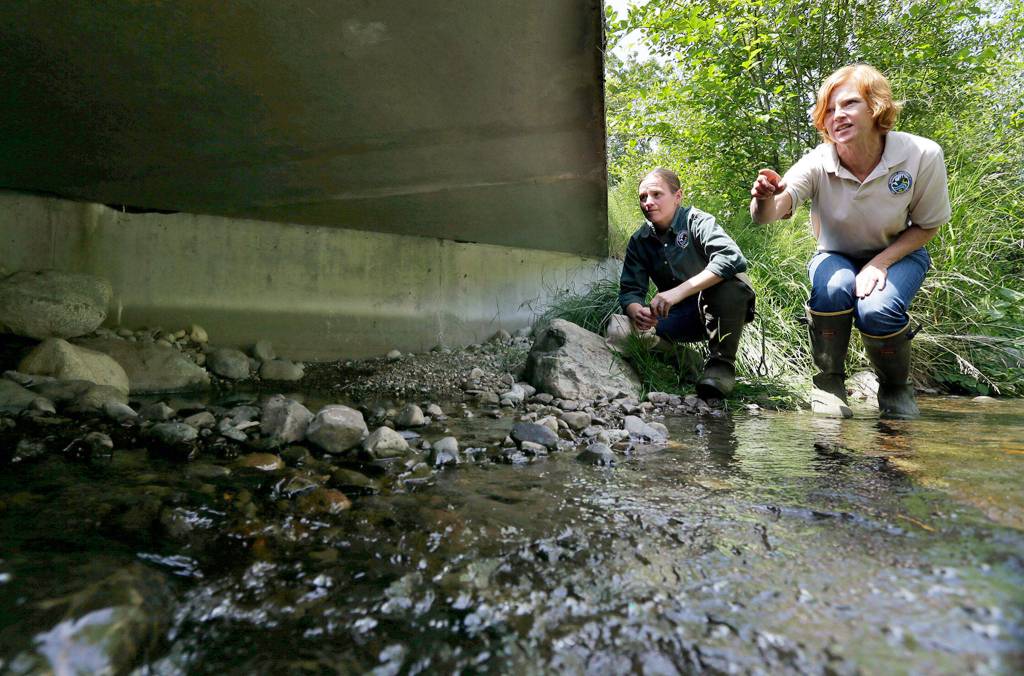
Julie Henning (right), division manager of the Washington Dept. of Fish and Wildlife ecosystem services division habitat program, and Melissa Erkel, a fish passage biologist, look at a wide passageway for the north fork of Newaukum Creek near Enumclaw, Washington, in 2015. The U.S. Supreme Court is leaving in place a lower court’s order that Washington state restore salmon habitat by removing barriers that block fish migration. (AP Photo/Ted S. Warren, File)

Julie Henning (right), division manager of the Washington Dept. of Fish and Wildlife ecosystem services division habitat program, and Melissa Erkel, a fish passage biologist, look at a wide passageway for the north fork of Newaukum Creek near Enumclaw, Washington, in 2015. The U.S. Supreme Court is leaving in place a lower court’s order that Washington state restore salmon habitat by removing barriers that block fish migration. (AP Photo/Ted S. Warren, File)

Supreme Court affirms tribes in case of salmon and culverts

Justices were divided 4-4, letting stand a lower court decision against the state of Washington.

By Phuong Le / Associated Press

SEATTLE — Washington state must continue restoring salmon habitat by removing barriers that block fish migration after the U.S. Supreme Court on Monday left in place a lower court order.

The justices divided 4-4 in the long-running dispute that pits the state against Northwest Indian tribes and the federal government. The tie serves to affirm a lower court ruling in favor of the tribes.

Justice Anthony Kennedy stepped aside from the case because he participated in an earlier stage of it when he served on the 9th U.S. Circuit Court of Appeals.

At issue is whether Washington state must pay billions of dollars to fix or replace hundreds of culverts — large pipes that allow streams to pass beneath roads but can block migrating salmon if they become clogged or if they’re too steep to navigate.

Leaders of several western Washington tribes cheered the decision Monday, calling it a victory that affirms their treaty rights while protecting salmon central to their way of life.

Jay Julius, chair of the Lummi Indian Business Council, called the decision a win for treaty rights, river rights and salmon.

“This is not just about tribes’ treaty right to fish, but also the inherent right to harvest from a plentiful, healthy supply of salmon,” he said in a statement.

Lorraine Loomis, chair of the Northwest Indian Fisheries Commission, said the decision would “open hundreds of miles of high quality salmon habitat that will produce hundreds of thousands more salmon annually for harvest by Indians and non-Indians.”

The Supreme Court in April heard the state’s appeal of a ruling by the 9th U.S. Circuit Court of Appeals. That court affirmed a lower court order in 2013 requiring the state to fix or replace hundreds of the highest-priority culverts within 17 years.

Washington has argued that its treaties with the tribes created no obligation to restore salmon habitat. It said the ruling would force it to perform work that wouldn’t benefit salmon because other barriers may completely block fish, and it would also make the state’s taxpayers responsible for fixing problems created by the federal government when it specified the design for the state’s old highway culverts.

“It is unfortunate that Washington state taxpayers will be shouldering all the responsibility for the federal government’s faulty culvert design,” state Attorney General Bob Ferguson said in a statement.

He said salmon can’t reach many state culverts because they are blocked by culverts owned by others, such as counties and the federal government.

“The Legislature has a big responsibility in front of it to ensure the state meets its obligation under the court’s ruling,” Ferguson said.

In seeking a Supreme Court review, Ferguson was at odds with other state officials, including Public Lands Commissioner Hilary Franz.

“It is time to stop fighting over who should do what,” Franz said Monday.

The U.S. government sued Washington in 2001 on behalf of the 21 tribes to force it to replace the culverts with structures that allow fish to pass through. Because the pipes block salmon from reaching their spawning grounds, they deprive the tribes of fishing rights guaranteed by treaty, the lawsuit said.

In 2013, U.S. District Judge Ricardo Martinez ordered Washington to fix or replace more than 1,000 culverts blocking access to 1,600 miles (2,575 kilometers) of salmon habitat.

The state transportation department has so far fixed 319 barriers, according to a 2017 report.

“It will be a big victory for fisheries,” said Bob Anderson, a law professor and director the Native American Law Center at the University of Washington.

He said that since 1905, the court has consistently upheld the tribal position that they have a right to a fair share of the salmon, and implied rights that go along with that. “This case is a logical extension of those prior decisions.”

Fawn Sharp, president of the Quinault Nation, said the “decision marks seven generations of conflict in our struggle to fully exercise and protect the Pacific Northwest salmon resource the way our ancestors envisioned.”

State Sen. Reuven Carlyle, chairman of the Senate Energy, Environment and Technology Committee, said Monday’s ruling was “a forcing function to double down on every level to re-prioritize our approach to salmon.”

Carlyle said that while he doesn’t think the Legislature needs an immediate special session to address the ruling, work will be done ahead of the next legislative session that begins in January.

AP writers Mark Sherman in Washington, D.C., and Rachel La Corte in Olympia contributed.

Talk to us

> Give us your news tips.

> Send us a letter to the editor.

> More Herald contact information.

More in Northwest

Washington Gov. Bob Ferguson, left, shakes hands with Cowlitz Indian Tribe Chairman Bill Iyall after signing an executive order to improve the state’s relations with tribal governments on Oct. 22, 2025. (Photo courtesy of Washington governor’s office)
Washington tribes could get more say in management of state logging lands

A bill to add two tribal representatives to the Board of Natural Resources is awaiting a Senate vote. Supporters say the change could add valuable perspective to the panel.

A view of the Washington state Capitol building in Olympia, obscured by a slight mist, Jan. 27, 2025. (Photo by Bill Lucia/Washington State Standard)
The bills that didn’t survive the WA Legislature’s first major deadline

A 60-day legislative session can be a cruel thing if you’re hoping… Continue reading

Washington State Capitol building in Olympia. (Courtesy photo)
Ferguson rejects WA lawmakers’ initial crack at income tax legislation

The Democratic proposal targets household earnings over $1 million.

Senate Majority Leader Jamie Pedersen, D-Seattle, during Senate floor debate on Jan. 28, 2026. (Photo by Bill Lucia/Washington State Standard)
WA Senate leader explains dim outlook for a new tax on big businesses

Senate Majority Leader Jamie Pedersen previously backed the payroll tax, but suggests there’s no political path for it. He and others are forging ahead with an income tax proposal.

State Sen. John Lovick, D-Mill Creek, looks on toward the end of the roll call vote for his Senate Bill 5067, which would lower the blood alcohol limit for drunk driving to 0.05% from 0.08% in Washington. The bill passed the Senate on a 26-23 vote on Jan. 28, 2026. (Photo by Bill Lucia/Washington State Standard)
Lower drunk driving limit approved by WA Senate

The bill drops it to 0.05%, and the state would join Utah with the toughest standard in the nation. It still needs House approval.

Washington state Supreme Court Justice Colleen Melody is sworn in Wednesday, Jan. 21, 2026, in Olympia, Washington. (Photo by Jake Goldstein-Street/Washington State Standard)
Washington’s newest Supreme Court justice is sworn in

Colleen Melody is officially the Washington state Supreme Court’s newest justice. Melody… Continue reading

Washington Gov. Bob Ferguson at his State of the State address on Jan. 13, 2026. Ferguson did not discuss the budget cuts he’s proposing in his speech but they’ve stoked plenty of testimony in the first days of the 2026 legislative session. (Photo by Bill Lucia/Washington State Standard)
An icy reception for Gov. Bob Ferguson’s proposed budget cuts

Advocates for schools, public universities, and climate programs are among those unhappy with the raft of cuts the governor relies on to close a $2.3 billion shortfall.

The log-in page of Instagram’s website. (Photo by Alexander Castro/Rhode Island Current)
Push for youth social media safeguards revived in WA Legislature

A proposal would prohibit addictive feeds and push notifications at certain times for minors. Opponents believe it’s unconstitutional.

State lawmakers are considering bills requiring AI detection tools and disclosures to address deepfakes and to establish new safeguards for children using the technology. (Stock photo)
How Washington state lawmakers want to regulate AI

Reining in chatbots, protecting kids from harmful content, and requiring disclosure of AI-generated material are among the ideas under discussion in Olympia.

Bill Lucia / Washington State Standard
State Sen. Yasmin Trudeau, D-Tacoma, makes floor remarks on Feb. 4, 2026 about Senate Bill 6002, which would set state regulations for license plate readers. The bill passed 40-9, with only Republicans opposed.
WA Senate OKs guardrails for license plate readers

The legislation passed Wednesday mandates that reader data be deleted after 21 days and says it can’t be shared except in court proceedings.

House Bill 1608 seeks to build on a 2024 law banning octopus farming in Washington. (File photo)
Washington may ban sales of farmed octopus

Octopus is back on the policy menu for Washington state lawmakers. A… Continue reading

Gov. Bob Ferguson delivers his State of the State address on Tuesday in the House chamber at the Washington state Capitol. (Photo by Bill Lucia/Washington State Standard)
What Gov. Bob Ferguson said in State of the State address

The speech drew a more positive reaction from fellow Democrats than last year’s inaugural address. He touched on flood recovery, taxes and immigration enforcement.

Support local journalism

If you value local news, make a gift now to support the trusted journalism you get in The Daily Herald. Donations processed in this system are not tax deductible.