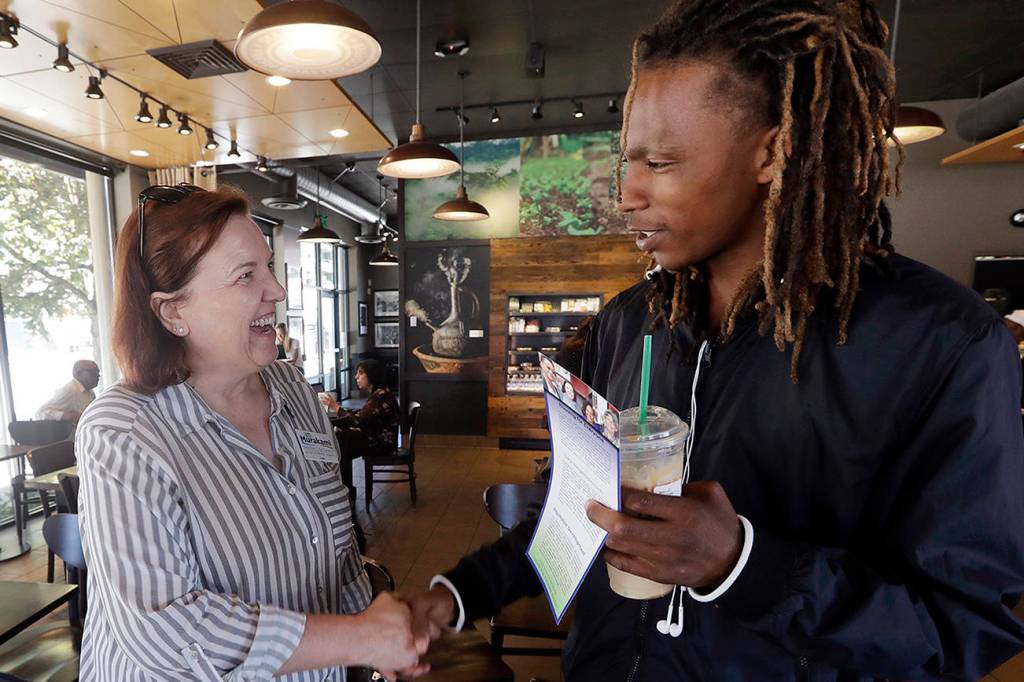
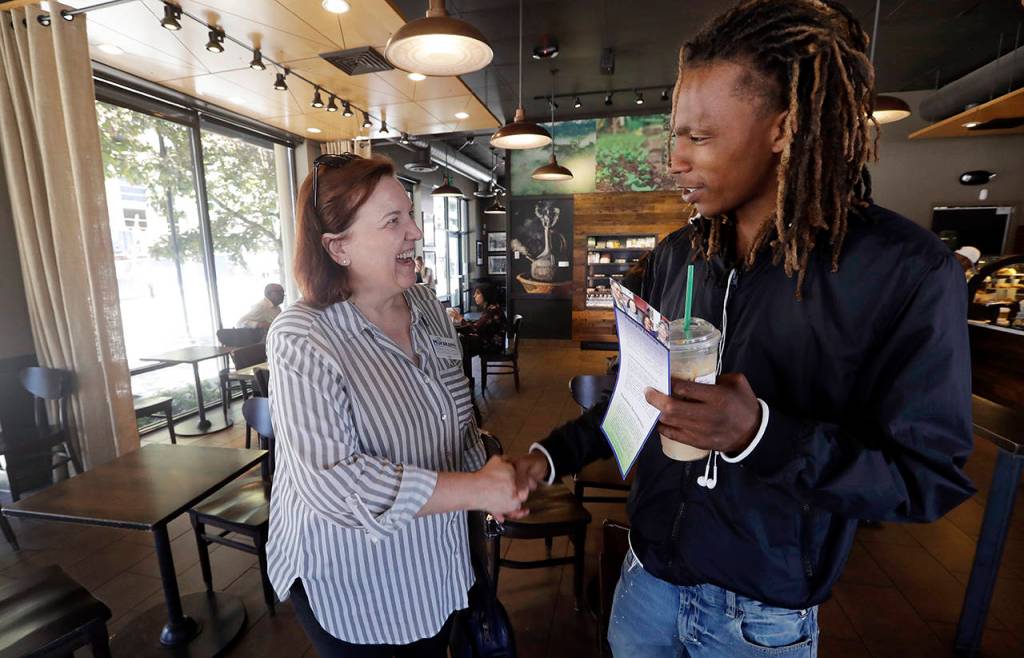
Seattle City Council candidate Pat Murakami (left) greets voter James Williams on June 10 at a coffee shop in Seattle. (AP Photo/Elaine Thompson)

Seattle City Council candidate Pat Murakami (left) greets voter James Williams on June 10 at a coffee shop in Seattle. (AP Photo/Elaine Thompson)

Tax money funds campaigns of unlikely Seattle candidates

A first-of-its-kind program allows Seattle voters to give candidates taxpayer money for their campaigns.

  • By TOM JAMES The Associated Press
  • Thursday, June 20, 2019 5:33am
  • Northwest

By Tom James / The Associated Press

SEATTLE — On a muggy spring morning, Seattle City Council candidate Pat Murakami weaves through front yards and porches, knocking on doors in a gritty but gentrifying neighborhood.

It’s a tradition for political hopefuls. And for Murakami, a two-time council contender, it’s her main fundraising strategy, thanks to a first-of-its-kind program allowing Seattle voters to give candidates taxpayer money to fuel their campaigns.

“I would have been a complete non-contender without the program,” she said of her first race in 2017, when she beat six other primary candidates before losing the general election.

Now entering its second election, Seattle’s voter voucher-based campaign financing program is drawing national attention with support from Sen. Kirsten Gillibrand, a Democrat from New York and presidential contender who proposes duplicating it at the federal level.

It’s one of at least eight public campaign finance programs enacted by city and county governments across the U.S. since 2015.

Seattle officials mail each voter four $25 “Democracy Vouchers” that they can give to City Council or city attorney candidates, split among different candidates, or choose not to donate. Voucher money not used by voters remains in city coffers.

Candidates took in $1.1 million during the program’s first round in the 2017 election.

Supporters say the program draws in candidates who otherwise would not consider running and forces politicians to pay attention to smaller donors. The city’s 2017 City Council race featured 15 primary candidates, with three-quarters applying for the vouchers and nearly half saying they would not have run without them, according to a report commissioned by the city.

This year, 72 candidates registered to compete for seven seats, making the race by several measures the most competitive in more than 15 years.

“It gives candidates the chance to say, ‘I’m going to raise my money by speaking to my constituents,’ rather than dialing for dollars to big out of state donors,” said Ian Vandewalker, a campaign finance expert with the Brennan Center for Justice at New York University.

Gillibrand has said a federal campaign financing system modeled on the Seattle program could distribute $200 per voter in what she called “Democracy Dollars” so voters could individually finance presidential and congressional races.

Statistics show that the popularity of the program is on the rise, with Seattle candidates receiving about 61,000 vouchers worth $1.5 million through May, ahead of the November general election. That’s up from 13,841 vouchers totaling $346,000 over the same period in 2017.

Voter engagement also appears to have increased because of the program. Seattle residents who voted in less than half of the city’s elections before 2017 were found to be four times more likely to vote that year if they used their vouchers, according to a University of Washington study.

The program has seen some speedbumps. Its first year didn’t yield a dramatic increase in donor diversity, with participation highest among older voters and in majority-white neighborhoods.

The program also stumbled in accessibility. Roughly half the candidates who said they wanted to use the vouchers didn’t make it through the qualification process, and others ran into delays getting the money in time to compete.

The city said it has since taken steps to address diversity and accessibility.

Meanwhile, the Pacific Legal Foundation, a libertarian-leaning group, has sued to halt the program on behalf of two Seattle residents. The program is funded by a special property tax, and the lawsuit says it’s a violation of taxpayers’ rights to use the money to fund candidates they may not support.

And even advocates who back campaign finance reform more broadly say translating the Seattle program to the national stage raises unanswered questions.

Scaling a municipal voter campaign finance system to the federal level would be a challenge, Vandewalker said, and a voucher program would likely require more administrative work and be generally more complicated than other more popular public finance models, like funds-matching programs.

In Seattle, the 2017 program cost about $1 million in administrative costs alone, before a single voucher was even turned in.

But it makes all the difference between running and not running for candidates like Murakami, who during her unsuccessful 2017 campaign collected almost 90% of her $172,000 in funding from the vouchers and without it said she “never would have attempted to run.”

Shaun Scott, 34 , who’s running for City Council, said in an interview the program gives him room to talk about policies that might be unpopular with wealthy political donors, like costly environmental reforms known as a “Green New Deal,” partially funded by a tax on high earners. He’s collected more than $50,000 through the voucher program so far.

“I’m a Black working-class Millennial candidate with a net worth of approximately $10,000,” Scott wrote separately on Twitter. “If it weren’t for the democracy voucher program, running for office would be a pipe dream.”


Talk to us

> Give us your news tips.

> Send us a letter to the editor.

> More Herald contact information.

More in Northwest

Masked federal agents arrive to help immigration agents detain immigrants and control protesters June 4 in Chicago. California in September became the first state to ban law enforcement officers from wearing face coverings, in response to immigration raids where federal agents wore masks. (Jamie Kelter Davis/The New York Times)
Ban on police face coverings pitched ahead of WA’s 2026 legislative session

The Trump administration is challenging a similar law passed in California, amid worries over masked immigration agents.

Police are failing to solve most violent crimes in WA

Over 49,000 incidents remain unsolved since 2022, including murders, rapes and robberies.

A Flock Safety camera on Oct. 28, 2025 in Lynnwood, Washington. (Olivia Vanni / The Herald)
Washington lawmakers want to regulate license plate readers

Washington state lawmakers next year hope to rein in law enforcement’s use… Continue reading

Democratic state Rep. Shaun Scott of Seattle (left) is proposing a new payroll tax on large employers in Washington. He took part in a discussion on the state’s tax system during the Budget Matters Summit on Nov. 12, 2025 in Seattle. (Photo courtesy of Washington State Budget and Policy Center)
WA Dems’ latest run at taxing the state’s largest companies

Rep. Shaun Scott’s proposal mirrors an approach Senate Democrats drew up then discarded last session.

Washington Gov. Bob Ferguson appointed Colleen Melody to the state Supreme Court on Nov. 24, 2025. Melody, who leads civil rights division of the state Attorney General’s Office, will assume her seat following the retirement of Justice Mary Yu at the end of the year. (Photo by Jerry Cornfield/Washington State Standard)
Gov. Bob Ferguson makes his pick for WA Supreme Court seat

Colleen Melody, who leads the civil rights division at the state attorney general’s office, will succeed Justice Mary Yu, who is retiring.

Jsason Phipps of the City of Mount Vernon tightens straps on the flood wall along the Skagit River in downtown Mount Vernon on Thursday. The river is forecast to crest on Friday morning after several days of heavy rain pushed waterways in the region to record levels. (Grant Hindsley/The New York Times)
Record flooding forces rescues across Western Washington

Waterways crested at record levels in several flooded small towns across western… Continue reading

Florida Lt. Gov. Jay Collins, left, participates in the extradition from California of Harjinder Singh, accused of causing a crash that killed three people in Florida. (Photo via Collins’ X account)
WA erred in granting hundreds of commercial driver’s licenses to noncitizens

The issue has flared up after a fatal truck crash in Florida earlier this year.

The state ferries Klahowya (center right) and Hyak (left center) are taking up valuable space at the Eagle Harbor maintenance yard of Washington State Ferries. Both retired ferries have been for sale for more than four years. (Photo by Tom Banse for Washington State Standard)
For sale: Two retired state ferries. Dreamers need not apply

The vessels are lingering on the market as Washington State Ferries scrutinizes potential buyers. Past purchases haven’t always ended well.

Washington began selling a specialty plate honoring Pickleball on Nov. 19, 2025. This is a sample of a personalized plate. (Seattle Metro Pickleball Association)
It’s an ace. Pickleball gets its own Washington license plate

The design celebrates the state’s official sport. Other new plate designs are on the way.

Gov. Bob Ferguson signing Senate Bill 5480, a bill exempting medical debt from credit reports, on April 22. (Photo by Jacquelyn Jimenez Romero/Washington State Standard)
WA’s new ban on medical debt in credit reports at risk of federal override

The Trump administration wants to reverse Biden-era guidance on the issue.

The U.S. Capitol building in Washington, D.C., on May 7, 2025. (Photo by Jennifer Shutt/States Newsroom)
End of shutdown ignites sparring among congressional lawmakers

Meanwhile, U.S. Rep. Marie Gluesenkamp Perez was among six Democrats who sided with Republicans in voting the legislation out of the House.

Attorney General Nick Brown has proposed new advice for locales on how to interpret state public records law, with a focus on providing records faster. (Stock photo)
Need for speed: Plan to unclog WA public records system gets mixed reviews

Washington’s attorney general is seeking to reduce public record backlogs as concerns… Continue reading

Support local journalism

If you value local news, make a gift now to support the trusted journalism you get in The Daily Herald. Donations processed in this system are not tax deductible.