
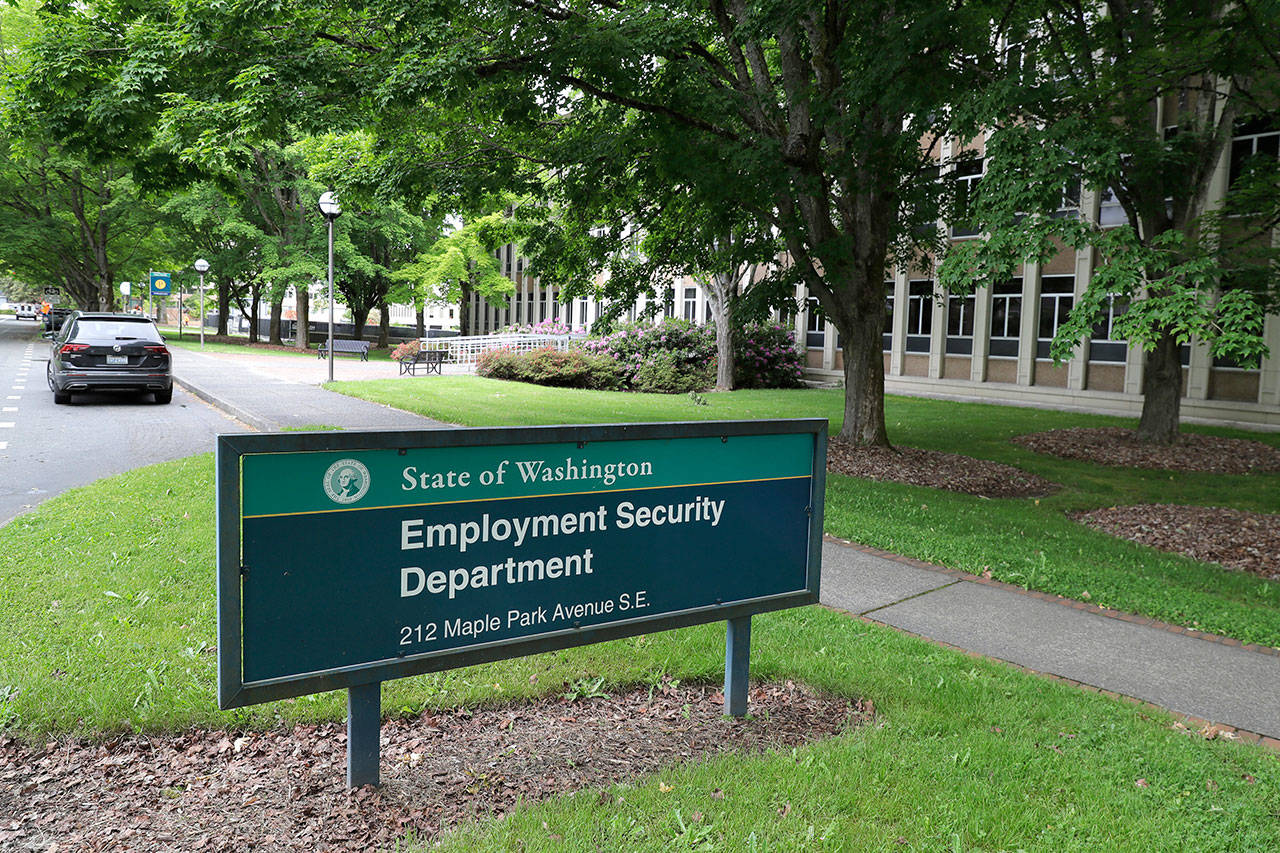
The headquarters for Washington’s Employment Security Department in Olympia. (AP Photo/Ted S. Warren)

The headquarters for Washington’s Employment Security Department in Olympia. (AP Photo/Ted S. Warren)

Washington to apply for federal $300 unemployment aid boost

The program sets the weekly federal benefit here to $300 a week, down from $600 in an earlier program.

Associated Press

OLYMPIA — Washington will apply to join a federal coronavirus program that will provide an additional $300 a week in unemployment benefits, state officials announced Thursday.

The Employment Security Department said in a news release that it will apply for the assistance through the Federal Emergency Management Administration no later than Friday. The program came about through an executive order by President Donald Trump after a federally funded $600 boost to weekly state unemployment benefits ended at the end of July.

To date, more than two dozen states have decided to take the funding. The program cuts the weekly benefit to $300 or $400 a week, depending on which plan governors choose. States are required to chip in $100 per claimant to be able to send out the higher amount, something few — including Washington — have agreed to do.

So far, most states that have said they are taking Trump up on his offer have chosen the $300 version. Some have not decided which plan to take.

Employment Security Commissioner Suzi LeVine said the state will implement the program as quickly as possible once the state’s application is approved, and payments will be retroactive to Aug. 1. LeVine cautioned that not everyone who has filed a claim will be eligible for the extra funding.

To qualify for the weekly bonus, people must certify that they are unemployed or partially unemployed due to COVID-19.

For those starting claims after July 1, the state’s maximum weekly benefit amount increased to $844 from $790, and the minimum increased to $201 from $188.

“We will continue to work with FEMA and the U.S. Department of Labor to pursue any additional funds for Washingtonians that may remain after the initial three-week period of benefits are distributed,” LeVine said in a written statement.

More than 1.3 million people have filed claims for unemployment in Washington since early March when pandemic job losses began, and more than 1 million who filed initial claims have been paid. The state has paid more than $9.7 billion in benefits, including the federal money that expired last month.

Congress has not been able to reach agreement on an extension of the weekly boost, with the Democratic U.S. House wanting to continue the $600 amount and the Republican Senate proposing to scale back the extra aid. The executive order that was issued Aug. 8 keeps the program in place until late December, though it will be scrapped if Congress comes up with a different program. It also will end early if the money for the program is depleted, which is likely to happen within a few months.

The extra money is to come as many businesses remain closed or with limited operations and as counties looking to advance from their current stage of COVID-19 economic reopening are paused indefinitely due to the ongoing pandemic.

Seventeen counties are in Phase 3 of a four-part reopening process, 17 counties, including Snohomish, are in Phase 2 and five counties are in a modified Phase 1 of reopening.

There have been more than 68,000 confirmed coronavirus cases in Washington since the pandemic began, and more than 1,800 people have died.

At a news conference earlier Thursday, Gov. Jay Inslee said that the state has seen some positive trends, with a decline in daily cases and reproductive transmission rate. But he noted that the state’s target for a two-week period is 25 cases per 100,000, and the state is currently at 110.

“We just have so far to go in this effort,” he said.

Talk to us

> Give us your news tips.

> Send us a letter to the editor.

> More Herald contact information.

More in Northwest

Sen. John Lovick, D-Mill Creek, on the Senate floor on Feb. 12, 2026, remarks about his bill to set stricter standards for sheriffs. The legislation was approved, sending it to the House. (Photo by Bill Lucia/Washington State Standard)
Stricter standards for Washington sheriffs approved in state Senate

A lead law enforcement group and Republicans are opposed. The bill would provide a way for the state to remove elected sheriffs and restrict volunteer posses.

A voter puts a ballot in the drop box at the Ballard branch of the Seattle Public Library in King County in August 2024. This voting location is one of the most popular in the county. (Laurel Demkovich/Washington State Standard)
Tighter rules for challenges to voter registrations clear WA House

A spike in challenges by conservatives is fueling Democrats’ desire to make changes that will curtail frivolous claims. The bill next goes to the Senate.

The Washington state Capitol on Friday. (Photo by Bill Lucia/Washington State Standard)
WA income tax on higher earners clears first legislative hurdle

Democrats rejected GOP amendments before pushing their tax on millionaires through a Senate committee. The bill was revised to expand an exemption for small businesses and make other changes.

Washington Gov. Bob Ferguson, left, shakes hands with Cowlitz Indian Tribe Chairman Bill Iyall after signing an executive order to improve the state’s relations with tribal governments on Oct. 22, 2025. (Photo courtesy of Washington governor’s office)
Washington tribes could get more say in management of state logging lands

A bill to add two tribal representatives to the Board of Natural Resources is awaiting a Senate vote. Supporters say the change could add valuable perspective to the panel.

A view of the Washington state Capitol building in Olympia, obscured by a slight mist, Jan. 27, 2025. (Photo by Bill Lucia/Washington State Standard)
The bills that didn’t survive the WA Legislature’s first major deadline

A 60-day legislative session can be a cruel thing if you’re hoping… Continue reading

Washington State Capitol building in Olympia. (Courtesy photo)
Ferguson rejects WA lawmakers’ initial crack at income tax legislation

The Democratic proposal targets household earnings over $1 million.

Senate Majority Leader Jamie Pedersen, D-Seattle, during Senate floor debate on Jan. 28, 2026. (Photo by Bill Lucia/Washington State Standard)
WA Senate leader explains dim outlook for a new tax on big businesses

Senate Majority Leader Jamie Pedersen previously backed the payroll tax, but suggests there’s no political path for it. He and others are forging ahead with an income tax proposal.

State Sen. John Lovick, D-Mill Creek, looks on toward the end of the roll call vote for his Senate Bill 5067, which would lower the blood alcohol limit for drunk driving to 0.05% from 0.08% in Washington. The bill passed the Senate on a 26-23 vote on Jan. 28, 2026. (Photo by Bill Lucia/Washington State Standard)
Lower drunk driving limit approved by WA Senate

The bill drops it to 0.05%, and the state would join Utah with the toughest standard in the nation. It still needs House approval.

Washington state Supreme Court Justice Colleen Melody is sworn in Wednesday, Jan. 21, 2026, in Olympia, Washington. (Photo by Jake Goldstein-Street/Washington State Standard)
Washington’s newest Supreme Court justice is sworn in

Colleen Melody is officially the Washington state Supreme Court’s newest justice. Melody… Continue reading

Washington Gov. Bob Ferguson at his State of the State address on Jan. 13, 2026. Ferguson did not discuss the budget cuts he’s proposing in his speech but they’ve stoked plenty of testimony in the first days of the 2026 legislative session. (Photo by Bill Lucia/Washington State Standard)
An icy reception for Gov. Bob Ferguson’s proposed budget cuts

Advocates for schools, public universities, and climate programs are among those unhappy with the raft of cuts the governor relies on to close a $2.3 billion shortfall.

Bill Lucia / Washington State Standard
State Sen. Yasmin Trudeau, D-Tacoma, makes floor remarks on Feb. 4, 2026 about Senate Bill 6002, which would set state regulations for license plate readers. The bill passed 40-9, with only Republicans opposed.
WA Senate OKs guardrails for license plate readers

The legislation passed Wednesday mandates that reader data be deleted after 21 days and says it can’t be shared except in court proceedings.

The log-in page of Instagram’s website. (Photo by Alexander Castro/Rhode Island Current)
Push for youth social media safeguards revived in WA Legislature

A proposal would prohibit addictive feeds and push notifications at certain times for minors. Opponents believe it’s unconstitutional.

Support local journalism

If you value local news, make a gift now to support the trusted journalism you get in The Daily Herald. Donations processed in this system are not tax deductible.



















