
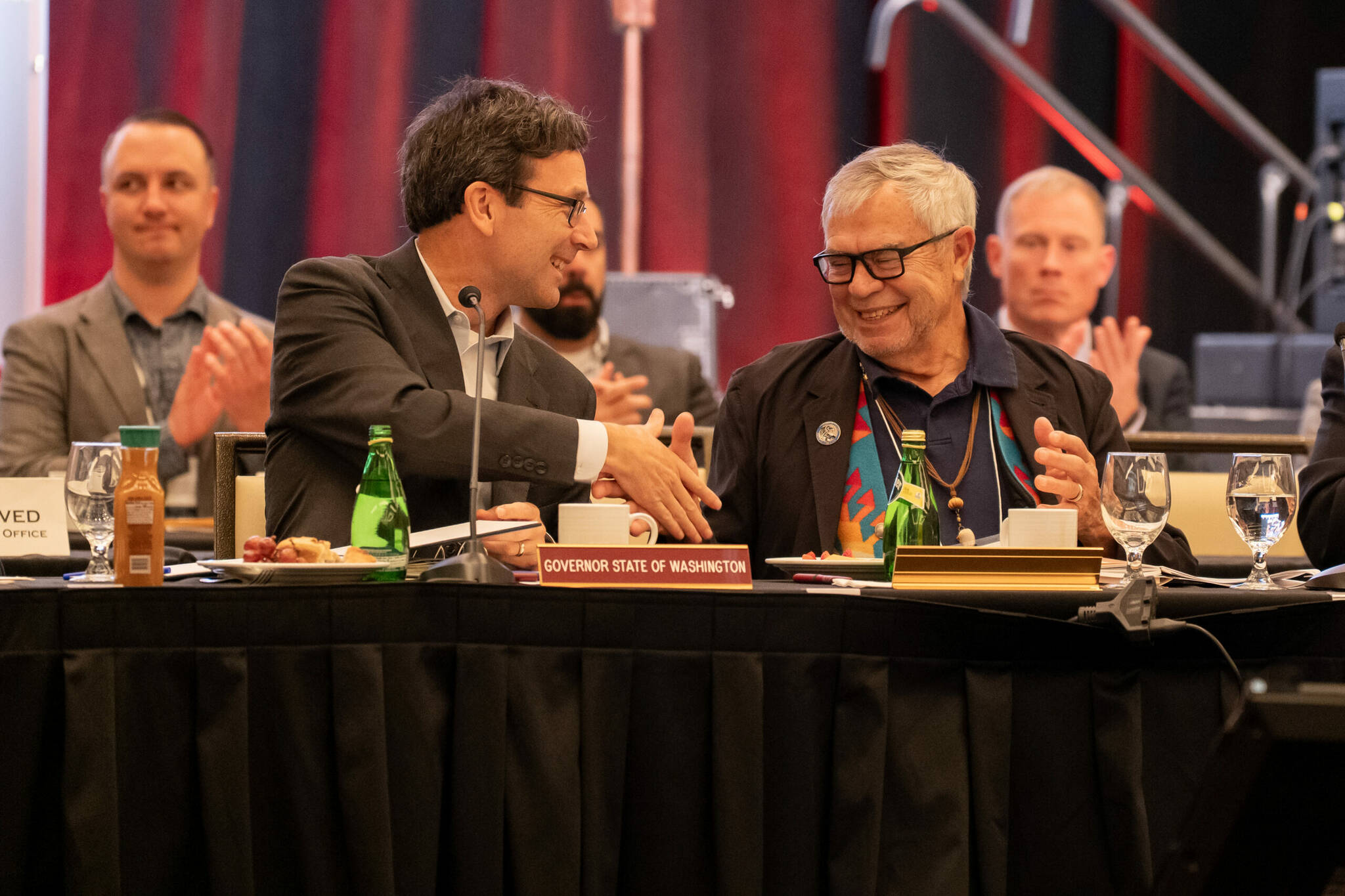
Washington Gov. Bob Ferguson, left, shakes hands with Cowlitz Indian Tribe Chairman Bill Iyall after signing an executive order to improve the state’s relations with tribal governments on Oct. 22, 2025. (Photo courtesy of Washington governor’s office)

Washington Gov. Bob Ferguson, left, shakes hands with Cowlitz Indian Tribe Chairman Bill Iyall after signing an executive order to improve the state’s relations with tribal governments on Oct. 22, 2025. (Photo courtesy of Washington governor’s office)

Washington tribes could get more say in management of state logging lands

A bill to add two tribal representatives to the Board of Natural Resources is awaiting a Senate vote. Supporters say the change could add valuable perspective to the panel.

  • By Aspen Ford Washington State Standard
  • Friday, February 6, 2026 12:31pm
  • Northwest

Two Washington tribal leaders could soon snag seats on the state’s Board of Natural Resources, which guides logging sales and other management decisions for millions of acres of public land.

Sen. Claudia Kauffman, a Democrat from Kent who’s the first Native American woman to serve in the state Senate, proposed Senate Bill 5838. On Monday, it was voted out of the Senate Committee on Agriculture and Natural Resources. The bill originally called for only one tribal representative to be appointed to the board, but it was changed to two members as it moved through the committee process.

The proposal is backed by Public Lands Commissioner Dave Upthegrove, who chairs the board and leads the Department of Natural Resources. The department requested the legislation.

If enacted, the governor would appoint a tribal representative from each side of the Cascades, bringing the board’s membership from six to eight. Eligible tribal members must hold an elected position in a federally recognized tribe whose reservation or treaty-ceded lands are in Washington.

The board approves timber sales, manages conservation land, establishes sustainable forest harvest levels and oversees the sale and exchange of state trust lands. The board’s decisions guide the work of the state Department of Natural Resources, which manages about 6 million acres of public land in Washington.

Having stewarded Washington’s lands for thousands of years before statehood, supporters say the unique tribal perspectives would benefit the board’s decision-making.

“We can’t undo the past, but we could create a more just and inclusive future,” Upthegrove said in committee testimony.

It’s time to stop talking about tapping into Native American knowledge, he added in an interview with the Standard, and to “actually do it.”

A handful of the bill’s supporters testified at House and Senate hearings. Among them was Bill Iyall, chairman of the Cowlitz Indian Tribe and former Tacoma city engineer.

“We’re consulted late in the game oftentime after major decisions are made by the state,” Iyall said in an interview. “The bill supports proactive collaboration instead of reactive problem-solving.”

“We do as much restoration in southwest Washington as any single entity. We do that out of our own resources,” Iyall added.

Critics of the proposal worry that tribal members would sway the board away from timber sales that benefit counties and public schools.

“I’ve got timber mills that rely on jobs and children who rely on the food that comes from their parents having jobs in those mills,” said Sen. Keith Wagoner, R-Sedro Woolley. “You can understand my reticence to put somebody there who might be voting against my district’s interest.”

Wagoner’s concern partially stems from the commissioner’s directive to preserve about 77,000 acres of forests, he noted.

“I would not presume how any individual would vote,” Upthegrove said during a hearing, responding to Wagoner. “We have timber tribes, non-timber tribes. We have a lot of diversity of views in tribal government.”

The Cowlitz Indian Tribe is “in a position where we can economically gain from commercial timber harvests,” said Iyall. “Why can’t we be a part of that game? We can make it work for everyone as well.”

Another concern is that tribal members are not direct beneficiaries of logging sales on state lands, which fund schools and other local government services.

“As the fiduciary of state forest lands, DNR is obligated to act in the county’s best interests and no one else’s,” said Paul Jewell, government relations director of the Washington State Association of Counties.

But Upthegrove insisted the proposal does not change the legal responsibilities of the board.

Seven tribes signed in as pro for the proposal, including the Spokane Tribe of Indians, the Jamestown S’Klallam Tribe and the Confederated Tribes and Bands of the Yakama Nation.

“We’ve just done a poor job as a state, historically, honoring that government-government relationship,” said Rep. Chris Stearns, D-Kent, who sponsored a House companion bill.

Last October’s Centennial Accord meeting, Stearns noted, started new progress in addressing that issue. During the event, Gov. Bob Ferguson signed an executive order requiring state agencies to create meaningful relationships with tribes and to establish tribal consultation policies.

If the bill is passed and signed by Ferguson, the tribal representatives would serve four-year terms and assume the responsibilities of any other board member.

Currently, the board includes a governor’s appointee, the state superintendent of public instruction, the commissioner, the director of the University of Washington’s School of Environmental and Forest Sciences, the dean of Washington State University’s College of Agricultural, Human and Natural Resource Sciences and a representative from a county with state forestlands.

The bill now awaits a Senate floor vote. If enacted, the governor would appoint tribal members to the board by July 1.

“We have vast monoculture forests, quite frankly, because of the past timber and logging practices,” said Iyall. “I think if the tribes had more of a voice in it over the last hundred years, we wouldn’t be in the position we’re in right now.”

This story was originally published by the Washington State Standard.

Talk to us

> Give us your news tips.

> Send us a letter to the editor.

> More Herald contact information.

More in Northwest

Washington Gov. Bob Ferguson, left, shakes hands with Cowlitz Indian Tribe Chairman Bill Iyall after signing an executive order to improve the state’s relations with tribal governments on Oct. 22, 2025. (Photo courtesy of Washington governor’s office)
Washington tribes could get more say in management of state logging lands

A bill to add two tribal representatives to the Board of Natural Resources is awaiting a Senate vote. Supporters say the change could add valuable perspective to the panel.

A view of the Washington state Capitol building in Olympia, obscured by a slight mist, Jan. 27, 2025. (Photo by Bill Lucia/Washington State Standard)
The bills that didn’t survive the WA Legislature’s first major deadline

A 60-day legislative session can be a cruel thing if you’re hoping… Continue reading

Washington State Capitol building in Olympia. (Courtesy photo)
Ferguson rejects WA lawmakers’ initial crack at income tax legislation

The Democratic proposal targets household earnings over $1 million.

Senate Majority Leader Jamie Pedersen, D-Seattle, during Senate floor debate on Jan. 28, 2026. (Photo by Bill Lucia/Washington State Standard)
WA Senate leader explains dim outlook for a new tax on big businesses

Senate Majority Leader Jamie Pedersen previously backed the payroll tax, but suggests there’s no political path for it. He and others are forging ahead with an income tax proposal.

State Sen. John Lovick, D-Mill Creek, looks on toward the end of the roll call vote for his Senate Bill 5067, which would lower the blood alcohol limit for drunk driving to 0.05% from 0.08% in Washington. The bill passed the Senate on a 26-23 vote on Jan. 28, 2026. (Photo by Bill Lucia/Washington State Standard)
Lower drunk driving limit approved by WA Senate

The bill drops it to 0.05%, and the state would join Utah with the toughest standard in the nation. It still needs House approval.

Washington state Supreme Court Justice Colleen Melody is sworn in Wednesday, Jan. 21, 2026, in Olympia, Washington. (Photo by Jake Goldstein-Street/Washington State Standard)
Washington’s newest Supreme Court justice is sworn in

Colleen Melody is officially the Washington state Supreme Court’s newest justice. Melody… Continue reading

Washington Gov. Bob Ferguson at his State of the State address on Jan. 13, 2026. Ferguson did not discuss the budget cuts he’s proposing in his speech but they’ve stoked plenty of testimony in the first days of the 2026 legislative session. (Photo by Bill Lucia/Washington State Standard)
An icy reception for Gov. Bob Ferguson’s proposed budget cuts

Advocates for schools, public universities, and climate programs are among those unhappy with the raft of cuts the governor relies on to close a $2.3 billion shortfall.

The log-in page of Instagram’s website. (Photo by Alexander Castro/Rhode Island Current)
Push for youth social media safeguards revived in WA Legislature

A proposal would prohibit addictive feeds and push notifications at certain times for minors. Opponents believe it’s unconstitutional.

State lawmakers are considering bills requiring AI detection tools and disclosures to address deepfakes and to establish new safeguards for children using the technology. (Stock photo)
How Washington state lawmakers want to regulate AI

Reining in chatbots, protecting kids from harmful content, and requiring disclosure of AI-generated material are among the ideas under discussion in Olympia.

Bill Lucia / Washington State Standard
State Sen. Yasmin Trudeau, D-Tacoma, makes floor remarks on Feb. 4, 2026 about Senate Bill 6002, which would set state regulations for license plate readers. The bill passed 40-9, with only Republicans opposed.
WA Senate OKs guardrails for license plate readers

The legislation passed Wednesday mandates that reader data be deleted after 21 days and says it can’t be shared except in court proceedings.

House Bill 1608 seeks to build on a 2024 law banning octopus farming in Washington. (File photo)
Washington may ban sales of farmed octopus

Octopus is back on the policy menu for Washington state lawmakers. A… Continue reading

Gov. Bob Ferguson delivers his State of the State address on Tuesday in the House chamber at the Washington state Capitol. (Photo by Bill Lucia/Washington State Standard)
What Gov. Bob Ferguson said in State of the State address

The speech drew a more positive reaction from fellow Democrats than last year’s inaugural address. He touched on flood recovery, taxes and immigration enforcement.

Support local journalism

If you value local news, make a gift now to support the trusted journalism you get in The Daily Herald. Donations processed in this system are not tax deductible.



















