
By The Herald Editorial Board
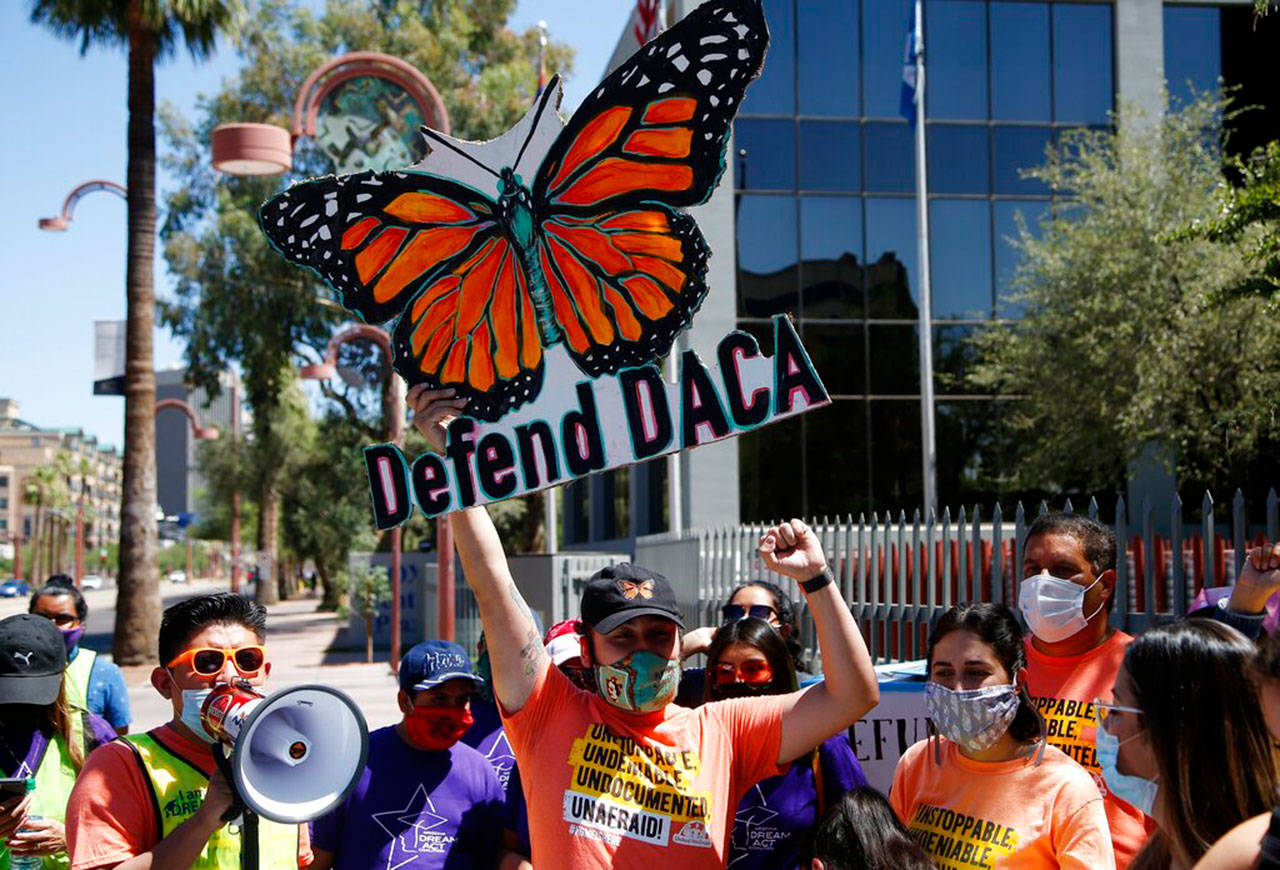
For Lake Stevens’ Sergio Barrera and some 700,000 other “Dreamers” in the United States — and about 16,000 in Washington state — Thursday’s 5-4 U.S. Supreme Court decision regarding the Deferred Action for Childhood Arrivals program was a welcomed — and unexpected — relief.
“It was like a ton of weight was lifted off my shoulders,” Barrera, 25, working as teen director at the Everett YMCA, told The Daily Herald’s Jerry Cornfield. “A lot of us were expecting DACA to end. We were bracing for that.”
The decision means Barrera and others who qualified in the past for DACA again have protection from deportation and can continue their schooling and jobs. But the court’s decision is limited in scope, and a permanent solution will require action by Congress — and perhaps — a change in leadership in the U.S. Senate and the White House.
DACA, established by President Obama in 2012 by executive order, granted relief from deportation and the ability to work legally to those who crossed the border as children under the age of 16 with their undocumented parents. To be eligible, enrollees had to be in high school or have a diploma, or be a veteran who had served honorably, and had not been convicted of a felony or significant misdemeanor. About 700,000 to 800,000 had been enrolled in DACA before its suspension, and an estimated 1.3 million would be eligible currently under its requirements.
But President Trump moved to rescind DACA’s protections in 2017, and challenges to that decision have been working their way through the courts until last week’s Supreme Court ruling.
The court did not judge DACA on its merits; the decision faulted the Trump administration on procedural grounds, ruling it had not used reasoned decision making or followed the federal rule-making process in seeking to end the program. As well, it held the administration had not considered the effects of ending the program on DACA recipients.
The ruling is similar to the court’s 2019 decision regarding the 2020 census — with the same majority — which determined the Department of Commerce had failed to adequately explain its reasoning for including a citizenship question in the census now underway throughout the U.S. More such decisions are possible as other court cases — specifically regarding the Trump administration’s deregulation efforts on environmental and other matters — proceed to the high court.
The court majority, correctly, put the burden of the Dreamers’ fate back on Congress. And that is what the Obama administration intended all along. Obama established DACA as a temporary protection after Congress failed to pass what was then called the Dream Act, which would have granted residency protections under provisions similar to DACA.
The House of Representatives, after Democrats were swept back into control of the House in 2018, last June adopted the American Dream and Promise Act, 237-187, which would provide Dreamers 10 years of legal residence and permanent green cards after completing two years of higher education or working for three years.
But Republican leadership in the Senate has ignored the bill since then and is unlikely to consider it before the November election. And Trump, on Friday, said he would again seek to end DACA, this time, “submitting enhanced papers shortly in order to properly fulfil (sic) the Supreme Court’s ruling.”
Even so, there is some Republican support. Seven Republicans joined Democrats in voting for the House bill; and a few Senate Republicans have voiced support for similar legislation in the recent past. Regardless of the outcome of November’s election, Congress and president are morally bound to resolve this issue in favor of the Dreamers.
And they would have the support of a large majority of Americans. A recent poll by the Pew Research Center found that 74 percent — nearly three-quarters — of Americans favor a law that would provide permanent legal status to immigrants who came to the U.S. illegally as children, including 54 percent of those identifying as Republicans.
A typical defense of Dreamers, one even admitted earlier by Trump, has been that as children they were brought across the border by no fault of their own. But the stronger defense for Dreamers, as we’ve said before, is what they have accomplished in their years on this side of the border.
A 2016 study by the Center for American Progress found that 87 percent of those in the DACA program at that time were employed; 46 percent were enrolled in post-secondary education, including 70 percent pursuing a bachelor’s degree or higher, 20 percent seeking an associate’s degree and 4 percent seeking a vocational certification. Of those attending school, 83 percent were also employed.
Dreamers, having been raised as Americans, have made themselves part of our economic and cultural fabric.
DACA recipients, The Washington Post reported, account for 200,000 “essential workers,” during the nation’s COVID-19 crisis, including more than 27,000 working in health care.
A more recent study by CAP found that deportation of DACA recipients would mean a loss of their contributions to the economy at all levels, including $8.7 billion in tax payments to local, state and federal governments, $24 billion in economic activity and another $2.9 billion in mortgage and rental payments.
As we continue to resume and rebuild our economy, we need the workforce skills and contributions to the nation that Dreamers provide, as well as their contributions as families and individuals in the communities where they grew up.
Talk to us
> Give us your news tips.
> Send us a letter to the editor.
> More Herald contact information.
























