The warm days of spring bring a great migration of many animals, with flocks and herds walking, swimming or flying to their summertime haunts.
The migration of one species, however, takes another form: the back of a semi-truck.
Honeybees get loaded onto trucks and driven to pollinate crops all over the country.
The journey begins with almonds in California. Then the bees are brought north to pollinate the apple orchards of Eastern Washington. Soon thousands of bees will be making their way to Whatcom County’s fields, to pollinate most of the country’s red raspberry crop, as well as the blueberry crop.
In the winter, bee populations can shrink to half their summertime size. So when almonds bloom in late winter, it’s all hands on deck to get bees to pollinate the massive crop. And almond farmers are willing to pay top dollar for any available bees.
“The prices paid for almond pollinating is quite high,” said Eric Thompson, owner and president of Belleville Honey & Beekeeping Supply. Based in Burlington, and with 10,000 hives, Belleville is one of the largest pollinating operations in Western Washington.
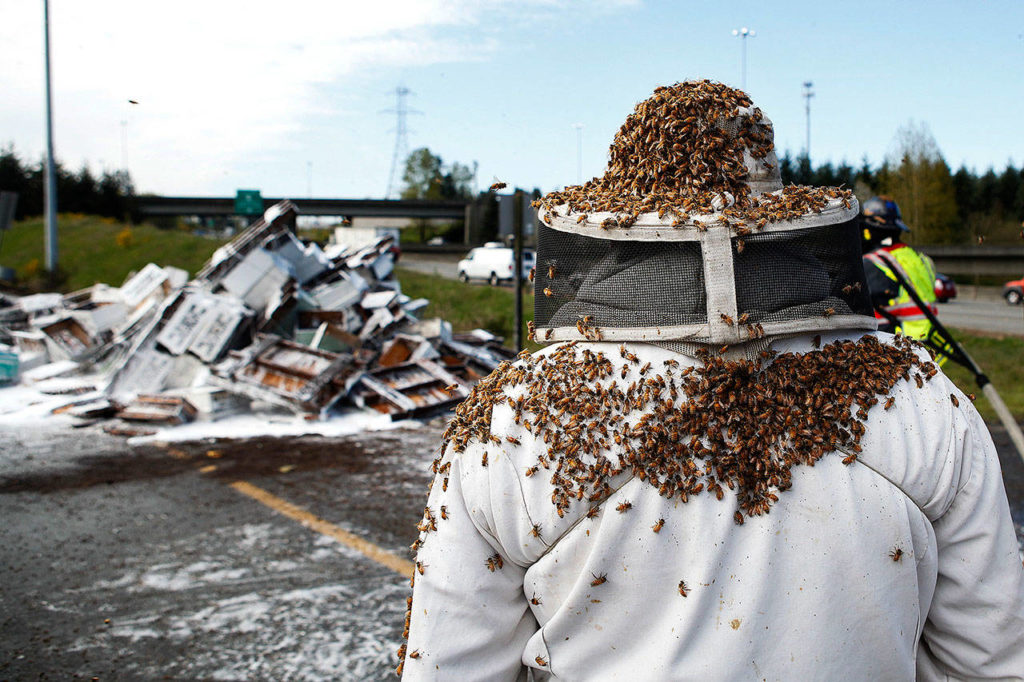
It was on their way back from California in 2015 that some of Thompson’s bees met a tragic end. One of the Belleville semi trucks overturned on I-5 in Lynnwood, and bees from 450 hives swarmed the interstate. The ensuing traffic chaos made national headlines. However, the loss made up less than 1 percent of Belleville’s total hives, and Thompson said his bee population has more than recovered.
For Belleville, the mass exodus of bees to California starts in December when they load 500 hives at a time onto semi-trucks and drive to the Central Valley almond orchards. It takes 20 trips to move all the bees.
When it’s cold outside, the bees stay inside. In wintertime, hives can be loaded all day. As it starts to warm, work is done in the cool of the morning or evening, lest some bees leave their hive to find it missing when they return.
Almond pollination wrapped up in March.
Next, some of Belleville’s hives are trucked to Eastern Washington, where the bees will pollinate apples, cherries and pears. Then it’s blueberries in Whatcom and Skagit counties.
Not all blossoms are created equal, as far as the bees are concerned. Blueberry blossoms don’t tend to have very much nectar, which doesn’t lend itself to making honey. Bees sometimes have a hard time getting enough to eat.
“Blueberries can be kind of tough,” Thompson said. “Sometimes we’ll have to supplement hives.”
That means feeding the bees something extra if the blooms are particularly dry in a given year.
After blueberries, it will be time for hybrid cabbage in Skagit County. Then, around the end of May and June, the red raspberry plants in Whatcom County start to bloom, and around 3,000 hives of Belleville bees will make their way to county raspberry fields.
For beekeepers, raspberries are two-for-one: Not only do beekeepers get paid for pollinating, the bees among the raspberries make lots of good, tasty honey.
Farmers know that, so they tend to pay beekeepers less for pollinating raspberries, Thompson said.
After that, Belleville’s bees go in different directions: Some keep pollinating and are taken to Montana for canola seeds, some go to alfalfa and some go to bee yards, where their main focus is making honey.
“We produce honey in the mid- to late-summer,” Thompson said, “whereas the pollination is mid- to late-spring.”
The bulk of the income of major beekeeping operations comes from pollination — about two-thirds of his company’s income, Thompson said.
That’s not true for BeeWorks Farm, of Bellingham.
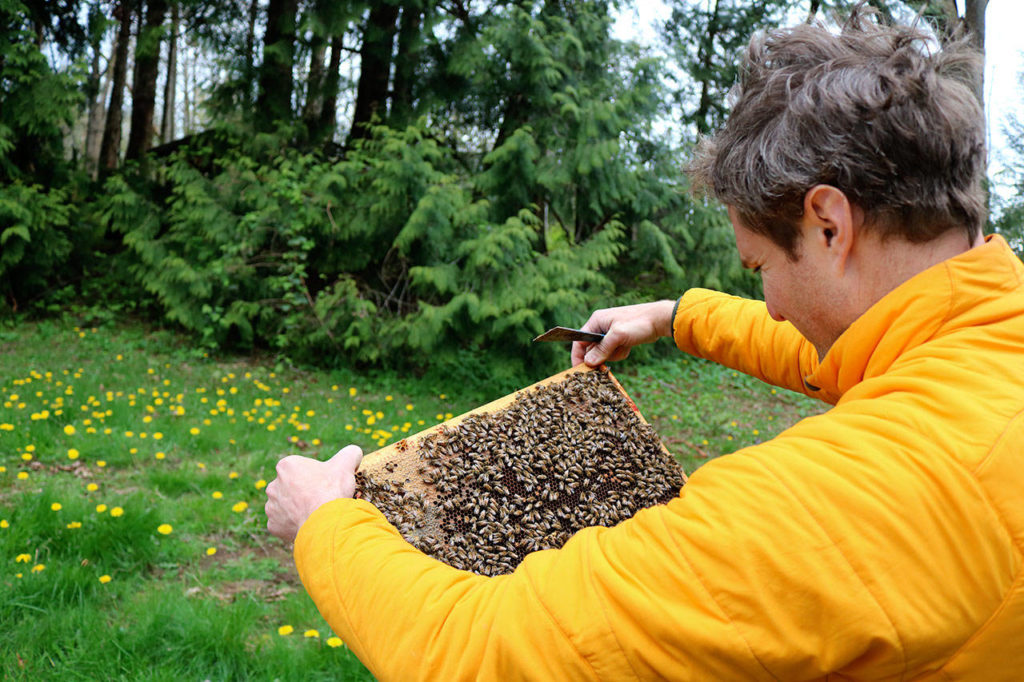
Rob Rienstra runs the company. His focus is on making quality honey. He has a few hundred hives, and he also sends them all to California each winter.
Instead of trucking them himself, he has a bee broker who manages the transport and pollinating contracts down there.
Spending some time in California in February and March allows his bees to multiply and recover from the winter. It allows them to get something to eat, as well, during a time when nothing is blooming in Bellingham.
“They usually come back from being in almonds stronger and more built up,” he said.
In April, his hives were back, scattered on property throughout Bellingham.
This year, he plans to have about 300 hives among the raspberries.
His focus on honey means that he has to pay more attention to the timing of honey harvests. To make raspberry honey, for example, he has to harvest right after the bees have been in raspberries, before they get a chance to add anything else.
That also means he passes on pollinating certain crops. While he’s eager to put his bees in raspberries, he skips the blueberries.
His bees also stay local for most of the year. They spend time in bee yards in Bellingham, and then later in the summer they are moved into the mountains so they can feed on wildflowers.
Most of his bee yards are on private property. For both little BeeWorks and massive Belleville, the arrangement is the same: Property owners allow the hives on their land in exchange for free honey.
Finding suitable bee yards is getting harder and harder, Rienstra said.
As cities spread out, wild land rich with blossoming plants gets developed and turned into pavement, houses and sprawling lawns — basically deserts for bees. It’s getting harder for his bees to find good forage, Rienstra said.
Thompson said the growing challenge — and expense — is in finding good queen bees. The colonies try to hatch queens themselves, but they are rarely successful.
So, many beekeepers purchase queens from professional queen-raisers. Thompson’s come from California and Hawaii.
“There’s such a demand for queens. You have to wait your turn sometimes,” he said. “And their lifetimes seem to be getting shorter and shorter.”
One thing neither man worries about too much anymore is colony collapse disorder, when entire hives die or disperse, for no immediately apparent reason.
That panic first started around 2006.
No single factor causes colony collapse disorder, and it can be caused by a combination of things, including mites, diseases or pollutants, Thompson said.
Beekeepers have learned to keep a closer eye on those problems.
“We’re all constantly experiencing losses,” Thompson said. “We’ve all gotten better at handling them.”
Talk to us
> Give us your news tips.
> Send us a letter to the editor.
> More Herald contact information.
Gallery