
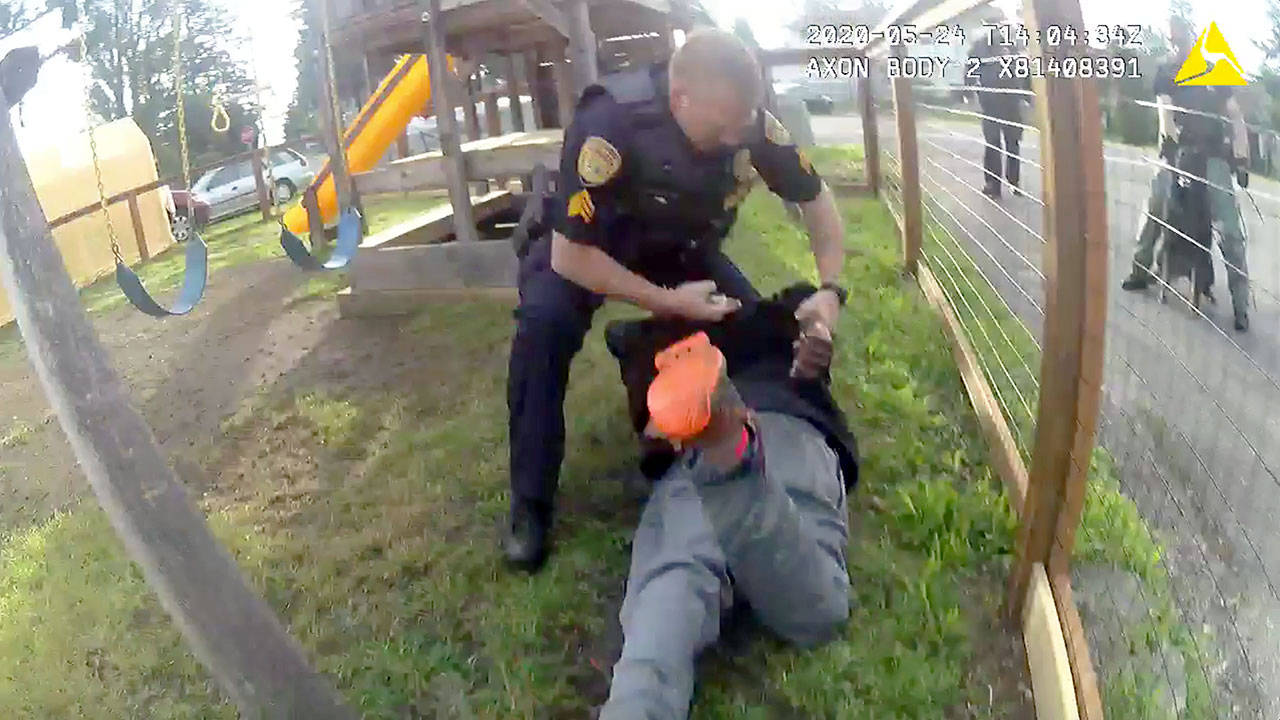
EVERETT — Everett police officers are to get body-worn cameras, technology that city officials say makes people safer and builds trust, but others worry the devices only protect law enforcement and infringe on privacy.
After a pilot program this year, the Everett Police Department is ready to purchase 150 cameras for officers in uniform who often work with the public.
On Wednesday the Everett City Council unanimously approved having Mayor Cassie Franklin sign a grant agreement with the U.S. Department of Justice for $300,000. That money helps cover startup costs in the program’s first year. Over five years, the annual cost for data storage and maintenance, licensing and software is estimated at $270,000, which the city will pay for out of its criminal justice fund.
“I think it will be well worth the cost,” said Janice Greene, president of NAACP of Snohomish County.
City leaders said at a city council meeting Nov. 10 that the program further modernizes the police force and improves accountability and transparency.
“Within the state, we’re seeing more calls for body worn cameras, and it’s becoming best practice,” Everett Police Chief Dan Templeman said.
People urged greater police accountability and sweeping reforms during months of demonstrations after police killed Breonna Taylor and George Floyd, both of whom were Black. That included the “defund the police” movement, which seeks reallocation of government money from law enforcement to social services and programs to help communities of color.
During public comments last week, two people asked the city council to reallocate some its $39.5 million police budget next year to better respond to mental health crises and needs. Police are the largest expense in the general fund that pays for most city services and staff.
The “8 can’t wait” movement to reduce police use of force doesn’t include a call for body cameras, which former President Barack Obama proposed during his presidency as a means of police accountability and improving trust.
Snohomish County is considering body cameras for some sheriff’s office deputies next year.
Everett’s trial run for body-worn cameras began before this year’s movements grew in cities and counties across the country.
“I think we’ve seen in the past the benefits of these body cameras and they can really help to answer questions after the fact,” Councilmember Scott Murphy said at the Nov. 10 meeting.
Body camera video of an Everett police officer kneeling on a Black man’s back for about 14 seconds as he cried “I can’t breathe” three times was raised in court earlier this year. Templeman defended the officer’s actions for being within the city’s use of force manual, which was updated after the incident and instructs officers to move a restrained person into a position where it is easier to breathe “at the earliest safe opportunity.”
But with the city prepared to approve a $1.46 million contract for the equipment and services this week, a technology expert from the American Civil Liberties Union of Washington said the city should have considered other ways to use that annual funding.
“Especially in light of the police accountability discussions that have come out of the conversations after George Floyd’s murder, we’re really concerned about expanding police budgets and expanding police surveillance power,” ACLU of Washington Technology and Liberty Project Manager Jennifer Lee said. “Every time surveillance technology has been deployed in society, regardless of intent, the impact has been to exacerbate existing structural racism.”
In exchange for a sense of security, the loss of privacy and potential for targeting is a concern, Lee said. And the feeling of safety may be an illusion.
Studies about body-worn camera programs reflect a mix of opinions about their efficacy.
Templeman told the city council that early reports suggested a reduction in use of force, citizen complaints and liability.
“Some of the more recent studies are showing that there may not be as significant of an impact,” Templeman said. “But in having conversations with my peers, who I have spoken to as we were piloting these cameras, they had noted at least an anecdotal reduction in complaints against officers.”
Senior policy analysts with the national ACLU wrote in 2017 that “the majority of body-camera video should not be subject to public release” unless a “strong public interest in that video outweighs privacy concerns,” and there are use-of-force incidents or complaints against an officer. They also said videos in which a person is killed, shot or “grievously” injured should be released within five days of a public request.
A 2017 report from The Leadership Conference and Upturn warned that unrestricted access to body camera video “places civil rights at risk and undermines the goals of transparency and accountability.” The solution, the report’s authors wrote, is strong policy that specifies when an officer can review video.
The Everett Police Department manual outlines when and who can access the body camera video. It prohibits officers from secretly recording people, sending the video outside the agency except as required by law for public records requests and from accessing the video server except for “legitimate law enforcement purposes.” City policy also specifies that only body camera administrators, forensic unit members, major crimes unit officers, the office of professional standards and specially trained employees can download videos for law enforcement purposes or public records requests.
Body cameras are a good step toward accountability, said Greene of the NAACP of Snohomish County.
“That’s the type of thing that we’ve been asking for in the community,” she said. “We’ll be following it for what the results are.”
Everett is dedicating a full-time position to redaction, public disclosure and court work related to the videos captured by police officers. It’s a way the city can meet the grant’s requirement for matching funds with in-kind work.
The city’s proposed 2021 budget estimates 16 hours weekly per prosecutor to review and submit body-worn camera evidence, with a goal to create a “timely and transparent” process for making such video public.
Ben Watanabe: bwatanabe@heraldnet.com; 425-339-3037; Twitter @benwatanabe.
Talk to us
> Give us your news tips.
> Send us a letter to the editor.
> More Herald contact information.