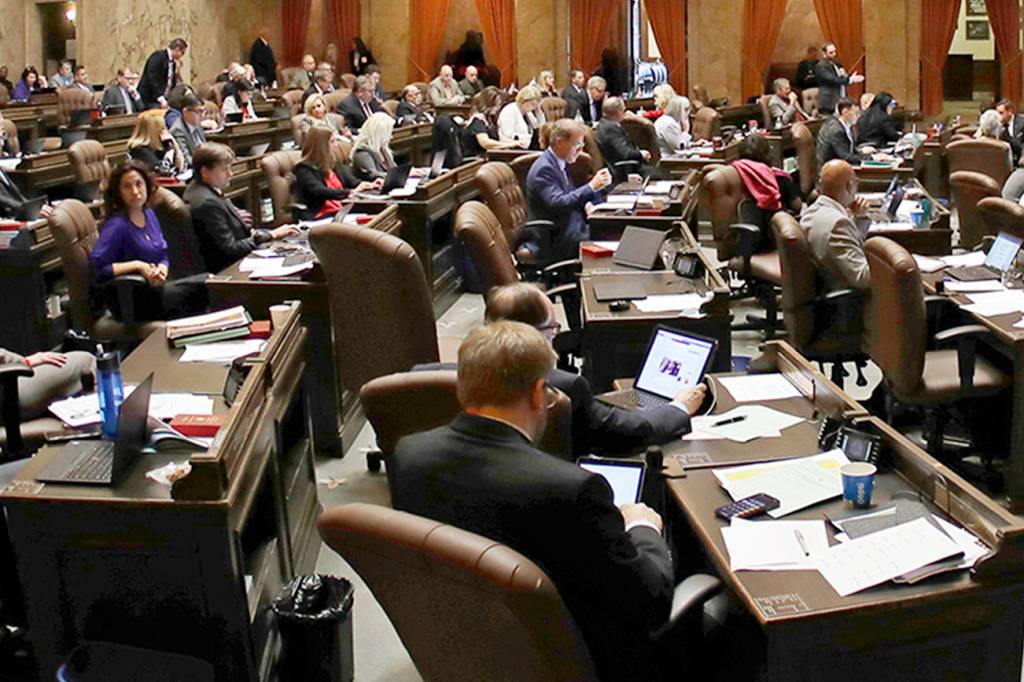
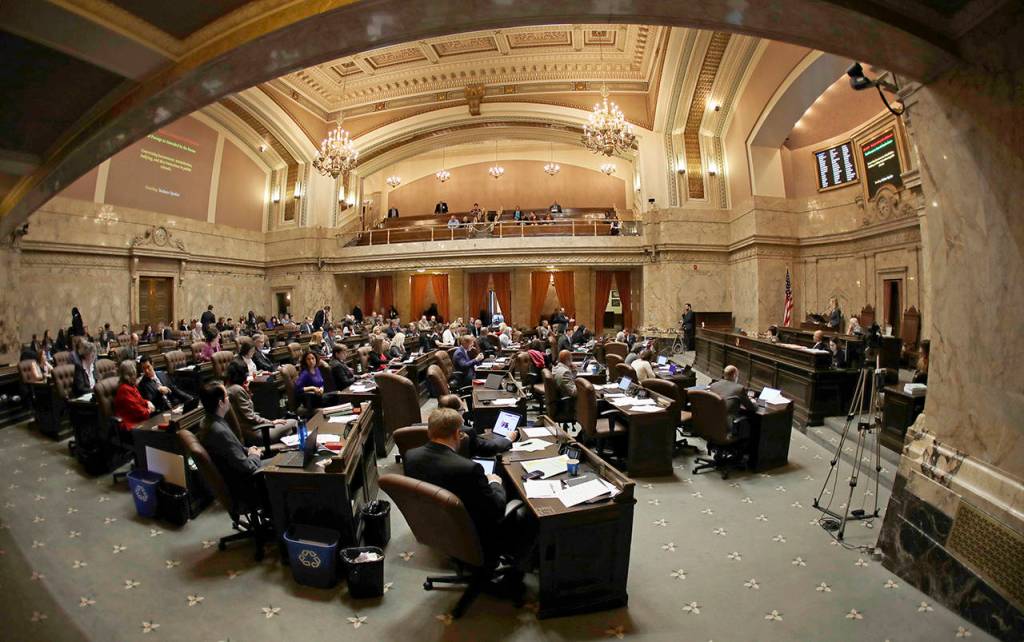
In this April 9, 2019 photo, state representatives listen to speakers on the House floor at the Capitol in Olympia. (AP Photo/Ted S. Warren, File)

In this April 9, 2019 photo, state representatives listen to speakers on the House floor at the Capitol in Olympia. (AP Photo/Ted S. Warren, File)

Legislature sees records requests spike since court ruling

House and Senate administrators in Washington are working through how to deal with the influx.

By Rachel La Corte / Associated Press

OLYMPIA — After several years of not releasing the work records of lawmakers, House and Senate administrators in Washington are working through how to deal with the influx of requests they’re receiving now that the state Supreme Court has ruled legislators are fully subject to the same disclosure laws as other elected officials.

Lawmaker public record requests were fulfilled as recently as 2010, but over the years administrators started citing various changes made to statutes in previous years, which they said exempted lawmakers, even though the measures did not say that. The state Supreme Court disagreed with lawmakers’ assertion in a December ruling.

While seven of the nine justices agreed the offices of individual lawmakers are subject to the Public Records Act, six of them ruled that the Legislature is only subject to a more-limited scope of records available through the House clerk and the secretary of the Senate.

While media and open government advocates hailed the resumption of the release of lawmaker records, there was concern the limited scope allotted to records held by the House clerk and secretary of the Senate could allow for some records to still be withheld. That issue came up in the state Supreme Court ruling, with the lead opinion stating that “the specter of a ‘black hole’ of legislative public records is overblown.”

“The standard governing whether an entity must disclose a public record is whether the record requested is ‘prepared, owned, used, or retained’ by that entity, not simply whether that entity possesses the record at the time of the request,” Justice Susan Owens wrote.

But in a separate opinion in that ruling, Justice Debra Stephens warned of the potential that sexual harassment and misconduct reports could be “consumed by the very ‘black hole’ the PRA meant to avoid.”

“The lead opinion says ‘the specter of a “black hole” of legislative public records is overblown’ … yet it looms large,” she wrote.

While the Senate already had a practice of publicly releasing entire reports on investigations of senators for workplace misconduct or sexual harassment before the ruling, the House does not, choosing in the past to instead just release a summary of a report or nothing at all.

Last month the House did release the entire report into Republican Rep. Matt Shea, who is accused of participating in and planning domestic terrorism against the United States with involvement in three standoffs against the government. But a recent Associated Press request for investigative reports into two former Democratic House members was initially rejected on Friday, with the House citing the fact the reports were held by the clerk. The AP appealed the rejection, and on Saturday the House said the original rejection was sent in error and the request was undergoing a review by the chief clerk.

Chief Clerk of the House Bernard Dean said Monday the House’s policy on releasing full reports is still to be determined, and that any change would need come from the Executive Rules Committee, which is made up of three Democratic leaders — including new Speaker of the House Laurie Jinkins — and two Republican leaders.

“We want to be in compliance with the law,” Dean said. “Part of the struggle we have is understanding how the ruling applies in this environment.”

The 60-day legislative session began Jan. 13, and House and Senate administrators have seen a sharp uptick in the number of public records requests. In the month since the ruling, the Senate has received at least 35 requests, compared to the 20 they fielded in all of 2019. In the House, there were 43 requests in December, compared to nine in the previous December. And they’ve already received 40 requests thus far this month.

Secretary of the Senate Brad Hendrickson said the Senate is currently in the process of hiring a second public records officer and is working with the attorney general’s office and Senate attorneys to implement a records retention policy in conjunction with the House. Dean said the House is potentially looking to hire a third public records officer.

Dean said that several lawmakers have started using legislative cellphones instead of their personal cellphones for work — for public records reasons. Many lawmakers in both chambers have started going paperless, asking lobbyists to send them digital copies of documents they previously printed out in order to make it easier to retain documents under the law.

“It centralizes the record keeping,” Hendrickson said.

Later this week, lawmakers in both the House and Senate will have mandatory training with attorney general staff about the Public Records Act.

Talk to us

> Give us your news tips.

> Send us a letter to the editor.

> More Herald contact information.

More in Northwest

Senate Majority Leader Jamie Pedersen, D-Seattle, makes remarks on Monday during the floor debate over legislation he sponsored to tax personal income over $1 million a year. (Photo by Bill Lucia/Washington State Standard)
Washington state Senate approves tax on personal income over $1M

The bill will next go to the House, as Gov. Bob Ferguson is indicating he’d like to see more changes.

Sen. John Lovick, D-Mill Creek, on the Senate floor on Feb. 12, 2026, remarks about his bill to set stricter standards for sheriffs. The legislation was approved, sending it to the House. (Photo by Bill Lucia/Washington State Standard)
Stricter standards for Washington sheriffs approved in state Senate

A lead law enforcement group and Republicans are opposed. The bill would provide a way for the state to remove elected sheriffs and restrict volunteer posses.

A voter puts a ballot in the drop box at the Ballard branch of the Seattle Public Library in King County in August 2024. This voting location is one of the most popular in the county. (Laurel Demkovich/Washington State Standard)
Tighter rules for challenges to voter registrations clear WA House

A spike in challenges by conservatives is fueling Democrats’ desire to make changes that will curtail frivolous claims. The bill next goes to the Senate.

The Washington state Capitol on Friday. (Photo by Bill Lucia/Washington State Standard)
WA income tax on higher earners clears first legislative hurdle

Democrats rejected GOP amendments before pushing their tax on millionaires through a Senate committee. The bill was revised to expand an exemption for small businesses and make other changes.

Washington Gov. Bob Ferguson, left, shakes hands with Cowlitz Indian Tribe Chairman Bill Iyall after signing an executive order to improve the state’s relations with tribal governments on Oct. 22, 2025. (Photo courtesy of Washington governor’s office)
Washington tribes could get more say in management of state logging lands

A bill to add two tribal representatives to the Board of Natural Resources is awaiting a Senate vote. Supporters say the change could add valuable perspective to the panel.

A view of the Washington state Capitol building in Olympia, obscured by a slight mist, Jan. 27, 2025. (Photo by Bill Lucia/Washington State Standard)
The bills that didn’t survive the WA Legislature’s first major deadline

A 60-day legislative session can be a cruel thing if you’re hoping… Continue reading

Washington State Capitol building in Olympia. (Courtesy photo)
Ferguson rejects WA lawmakers’ initial crack at income tax legislation

The Democratic proposal targets household earnings over $1 million.

Senate Majority Leader Jamie Pedersen, D-Seattle, during Senate floor debate on Jan. 28, 2026. (Photo by Bill Lucia/Washington State Standard)
WA Senate leader explains dim outlook for a new tax on big businesses

Senate Majority Leader Jamie Pedersen previously backed the payroll tax, but suggests there’s no political path for it. He and others are forging ahead with an income tax proposal.

State Sen. John Lovick, D-Mill Creek, looks on toward the end of the roll call vote for his Senate Bill 5067, which would lower the blood alcohol limit for drunk driving to 0.05% from 0.08% in Washington. The bill passed the Senate on a 26-23 vote on Jan. 28, 2026. (Photo by Bill Lucia/Washington State Standard)
Lower drunk driving limit approved by WA Senate

The bill drops it to 0.05%, and the state would join Utah with the toughest standard in the nation. It still needs House approval.

Washington state Supreme Court Justice Colleen Melody is sworn in Wednesday, Jan. 21, 2026, in Olympia, Washington. (Photo by Jake Goldstein-Street/Washington State Standard)
Washington’s newest Supreme Court justice is sworn in

Colleen Melody is officially the Washington state Supreme Court’s newest justice. Melody… Continue reading

Bill Lucia / Washington State Standard
State Sen. Yasmin Trudeau, D-Tacoma, makes floor remarks on Feb. 4, 2026 about Senate Bill 6002, which would set state regulations for license plate readers. The bill passed 40-9, with only Republicans opposed.
WA Senate OKs guardrails for license plate readers

The legislation passed Wednesday mandates that reader data be deleted after 21 days and says it can’t be shared except in court proceedings.

Washington Gov. Bob Ferguson at his State of the State address on Jan. 13, 2026. Ferguson did not discuss the budget cuts he’s proposing in his speech but they’ve stoked plenty of testimony in the first days of the 2026 legislative session. (Photo by Bill Lucia/Washington State Standard)
An icy reception for Gov. Bob Ferguson’s proposed budget cuts

Advocates for schools, public universities, and climate programs are among those unhappy with the raft of cuts the governor relies on to close a $2.3 billion shortfall.

Support local journalism

If you value local news, make a gift now to support the trusted journalism you get in The Daily Herald. Donations processed in this system are not tax deductible.